

The Proper Distinction Between Law and Gospel
Is Not The Gospel
The distinction between Law and Gospel stands among the greatest achievements of Christian dogmatics. Properly understood, it preserves the doctrine of justification, safeguards consciences from despair and presumption alike, and gives a faithful account of the twofold manner in which God addresses fallen humanity. It deserves neither dismissal nor neglect.
Its greatness, however, has frequently invited a subtle confusion. A faithful theological distinction has gradually become, in modern less-literate circles, the governing language by which Scripture itself is read, preached, and even imagined to always speak.
What began as an explanatory principle has become, for some, the principal reality, and the calculus has been mistaken for the landscape.
The proper distinction between Law and Gospel occupies an indispensable but subordinate place within Christian theology. Like all true knowledge, it is a servant of the apostolic proclamation, not the Master.

The New Testament nowhere presents “properly distinguishing Law and Gospel” as the primary grammar of discipleship. Instead, its dominant vocabulary is the Kingdom of God: Jesus Christ, His Father, the Holy Spirit, faith, hope, love, reconciliation, new creation, abiding, walking.
The Way
The insight proceeds in three stages:
The dogmatic status of the distinction.
The linguistic instability created whenever systematic theology mistakes historically conditioned terminology for the permanent vocabulary of revelation.
That Scripture continually judges every theological vocabulary, including its own translations, by returning to its own words, patterns, and internal grammar.
The takeaway is not that systematic theology is a mistake. It is that true theology must remain perpetually-linguistically reformable in an ongoing “Babylonian” age with the living autograph of Holy Scripture alone as our true font and commission.
Doctrine does not change. But tongues sure do.
Hey everyone! This week’s Tuesday publish doesn’t follow Paul and the missionary trail the way we’ve been accustomed recently because I was unable to produce an episode/study for the Upright podcast this week. Instead, I spent the evening with an old friend whom I rarely see.
We’ll be back with our Four-Year Lection programming next week. And, in the meantime, thank you to all you paying subscribers both here and at Patreon and SubscribeStar. You are my baseline.
Honestly, I can’t wait to show you what I’m making next. -🦊 Jonathan
I. The Proper Place of Dogma
Every lasting discipline develops technique as jargon. Medicine does, physics does, and music does. Theology is no exception.
There is therefore nothing inherently suspect about this effect in systematic theology, provided the effect is not ignored. Indeed, dogmatics exists because the Church is called to confess the truth those words reveal, not merely to repeat words without thought or heart. The distinction between Law and Gospel belongs within this noble labor.
It is neither arbitrary nor artificial. The Scriptures plainly contain divine commands, and the Scriptures plainly contain divine promises. The Law always accuses, the Gospel only gives. The Law exposes sin, and the Gospel bestows Christ.
This is not an invention of Lutheran theology.
It is an observation about Scripture.
The Reformers deserve immense gratitude for articulating this observation with unusual precision. It is, beyond measure, a particularly glorious light.
But every created light possesses limits.
Theological language explains Scripture, but it must not become Scripture. That distinction appears obvious in the head, but is harder to spot in the scrum. Time will tell: did the generation slowly forget their God, burying Him anew beneath a plot of clever precepts?
When the explanatory language becomes the primary language, the map is quickly mistaken for the territory. In jeopardy, the reader starts asking Scripture to conform to the vocabulary which was once received in order to point to Scripture.
The servant sits on the horse while the master walks.
This is not unique to modern confessional Lutheranisms.
It is a mark of the Church’s rich history. Long before scholasticism and pietism, the Pharisee and the Sadducee sat privy over the status quo of dogmatism, if not citing Isaiah’s “precept upon precept” in their proof texts against the Essenes, then at the least missing the forest for a bit of mint and cumin.
Fundamentalism. Biblical criticism. Evangelicalism. Rome.
Frozen vocabulary bars the gates to Eden as the Scriptures preach it. So much heresy, schism and false doctrine rests upon the mistaking of temporary grammar for permanent revelation that I have come to believe that the real enemy we face is in communism is Babel.

II. Semantic Idolatry
Languages decay, meanings drift, and words migrate. It can’t be avoided. Empires collapse, and idioms disappear. It’s all vanity. But modern systematic theology behaves as though its technical vocabulary will be around till the trumpet sounds.
It holds no such framework.
Some good English history will demonstrate the point:
The word law descends through Old English lagu, itself derived from Old Norse lǫg, meaning “that which has been laid down.” Its imagery is juridical: something laid, something fixed, something enacted. This is useful and accurate within limits.
But the Hebrew Scriptures ordinarily speak not of lagu but of תּוֹרָה (torah). The root ירה (yarah) means “to teach,” “to instruct,” and even “to direct by pointing.” Torah therefore carries educational and covenantal dimensions before merely legal ones or tree-felling ones. It signifies fatherly teaching in ways the English word “law” is too narrow to admit.
So also, the English gospel derives through Old English gōdspel, meaning “good spiel.” This faithfully translates the Greek εὐαγγέλιον (euangelion), or “good message,” but has a rather clunky entry into the common English fractonym “spell.”
Today, “gospel” is an onomatopoeia. For some it is a music style, for others it is the sweet-honey shorthand for “Jesus died for me.” But in the ancient Roman world, euangelion also announces imperial victory, accession, and public triumph, almost none of which comes through in the show tunes.
III. The Babel Within
The apostles left us not merely a Greek dictionary, but a Greek key to the Hebrew Old Testament. It is the entire prophetic universe as deliverable by intermediaries. Your local English Bible relies on these words.
But no matter how good your translation, it will not abolish Babel. Not if it be the lynchpin tongue of an epoch, as happened for English under James, as much or more so than for German in Luther, hardly to mention the Latin of Jerome.
Yet, for all that, Constantinople needed no translation.
Even so, Babel remains and Babel degrades.
Correct terminology, when achieved, secures the fellowship of the Spirit today. For as long as it is called today, this shall be His gift to us. But it is folly to believe that the same terminology will hold up to the accusations of the enemy in the hearts of our grandchildren. Every council coined vocabulary precisely in order to fix the problems they saw. Then, over time, the very answers to those problems became the new problems.
Why? Because language is dying but refuses to die.
The irony is profound. The Church rightly rejects ongoing revelation, yet the churches often retreat into ongoing linguistic isolation that in the end speaks five thousand words that no one understands.
Scripture is the measure. Scripture is the Judgment. It is by ever returning to it as a source, not just as individuals, but as the whole Body, that the Church is built up against the new confusions of every age.
IV. Illegitimate Totality Transfer
“The letter kills, but the Spirit gives life.”
Paul does not condemn letters. He writes letters, commands churches to read letters, and calls attention to individual letters. His contrast is not between written words and unwritten experience. It is between external administration apart from Christ and the living ministry of the Holy Spirit.
Scripture warns against confidence in external forms, and this includes participles and verbs. But this does not liberate us from our letters. It unleashes them for us to stop confusing the typos with the story.
The value of the Bible is that it continually judges every arrangement of language as it drifts through seasons and aeons. The task is not to escape the letter, but to meet the Spirit who drew it. This means not getting buried beneath too many folios of our own.
Our glosses, our slogans, our technical vocabulary, even our favorite distinctions, only meet the reader in the inspired text when they are actually there.
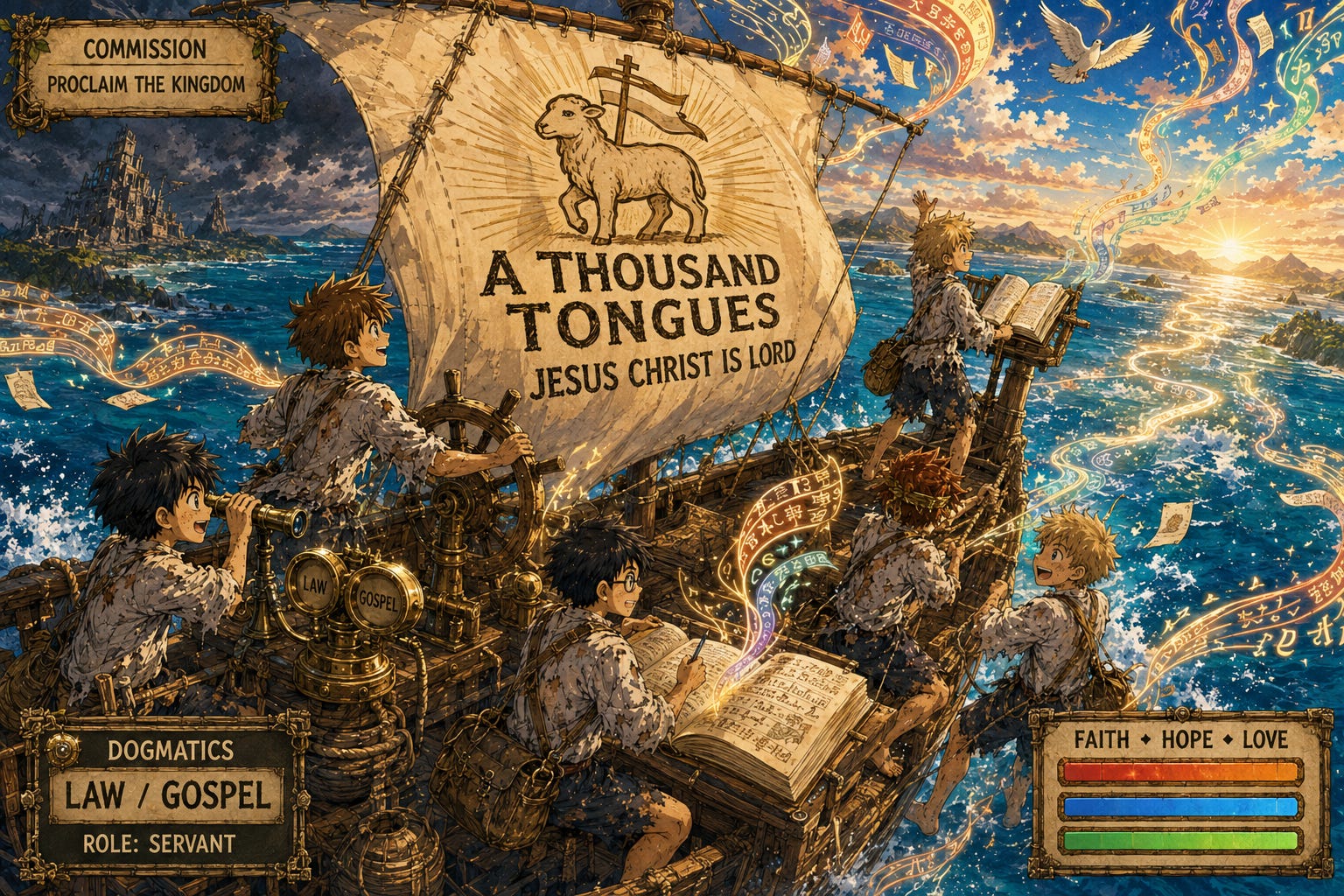
V. A Thousand Tongues
Scripture interprets Scripture.
It’s indispensable. But the phrase is not. In fact, “interpret” is a terribly obtuse word. ‘Scripture translates Scripture’ gets the meaning across just as well, if not better. The Bible translates the Bible carries enough twang to ring true for any southern preacher.
But let’s dig deeper still: Scripture does not merely provide ideas. Scripture reveals words, roots, metaphors, patterns, echoes, prophetic repetitions, and canonical vocabulary. The Bible is its own dictionary, its own grammarian, its own thesaurus, the True Semantic World.
This world is imputed to us for the purpose of transcending every language. Hebrew illuminates Greek, Greek illuminates Hebrew, and both illuminate faithful new translations today. No translation work shall ever be exhausted.
Consequently, the man of God’s work never finishes. We always must together be about the work of reading, hearing, learning, marking, and inwardly digesting the living Spirit of biblical Wisdom.
One copy from the 1800s won’t do! Your home library is meant to be the best kind of museum: beautiful, carefully catalogued, and increasingly glad to see if the next generation even needs it.
VI. Distinctive, Properly Speaking
The distinction between Law and Gospel will remain true, beautiful, and indispensable. Yet it will also remain the narrow use of the word “Gospel,” and that means the less frequently used one.
It is not the center of the apostolic proclamation. There is no “Behold the distinction!” They do not invite the nations into a hermeneutical discourse. They proclaim the Lamb of God and invite them to be washed into the Name of Jesus Christ.
In this rather ironic way, we must always therein remember that the proper distinction between Law and Gospel is a law. Let it not spend too much time as the accuser.

Thanks, Pastor for this encouraging message. I've been wrestling with much of this for the last few years. Coming from evangelicalism, I've been a little disheartened within confessional circles when my I hear my dear brothers and sisters from previous churches are disparaged because they don't have the same vocabulary. I married a Lutheran school teacher (& PK), appreciating Luther's soteriology. I don't feel any more or less saved in either church. I've been less impressed with my own doctrinal adherence and would rather concentrate on day to day fellowship with Jesus and with the Christians I interact with and getting the Gospel out beyond the walls of the church. Systematic studies may help clarify how God works and moves, but it can seem to miss the point. Being an automotive engineer may help build a car, but the engineer may not be the best driver in a race. Raw knowledge is useful, but not always equivalent to wisdom--and a 19 year old mechanic may be more skillful with a wrench! As an elder in my church, I'm mostly concerned with building up young men to take my place and lead. As fathers, we should be want the next generation equipped and in a proper relationship with our Lord
“And every tongue confess that Jesus Christ is Lord, to the glory of God the Father.” - Philippians 2:11