

Paul did not enter Athens as a tourist.
He did not arrive as the invited lecturer in a clean robe, rested and ready to deliver the speech we have named after the hill. He came under pressure. Philippi had answered the Gospel with rods and prison. Thessalonica had answered with a mob. Berea had received the Word more nobly, but the men from Thessalonica followed him there and stirred the crowd again.
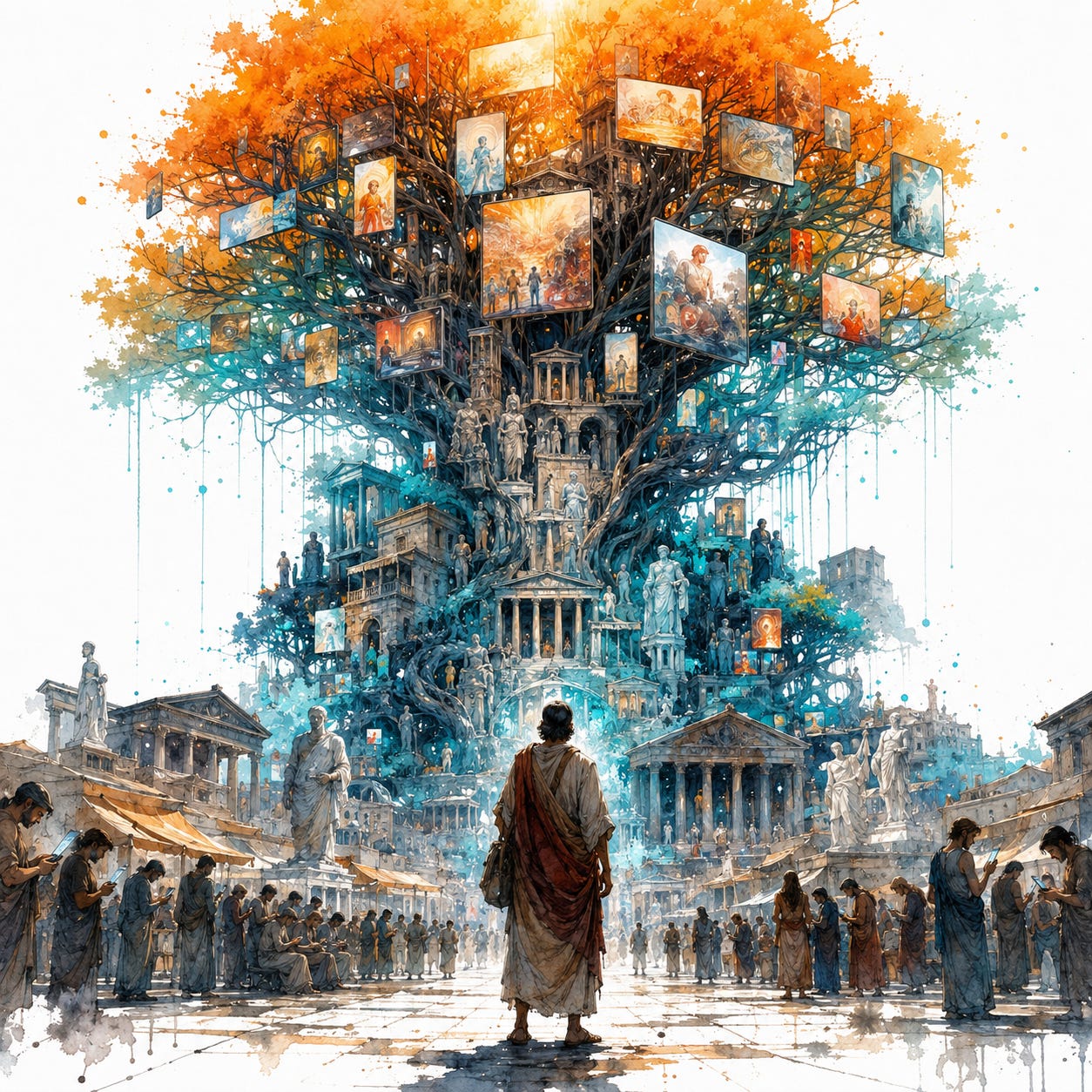
The brothers sent Paul away, and those who conducted him brought him to Athens while Silas and Timothy remained behind. He came, in other words, a refugee: displaced by persecution, separated from his company, waiting in a foreign city.
Luke says his spirit was provoked because the city was given over to idols. He was not an art critic wandering through marble and complaining about pagan taste. He saw the spiritual mechanism beneath the beauty. Athens had filled the visible world with images of invisible powers, then bent itself before the work of its own hands. The city was not merely decorated with idols. It had surrendered its judgment to them.
What has Jerusalem to do with Athens?
The Athenians made novelty a public occupation. We have made it infrastructure. Their marketplace was full of men waiting to tell or hear some new thing. Ours rides in the pocket and refreshes itself before the last new thing has finished dying. The scroll is Athens mechanized: image after image, alarm after alarm, each one asking for the eye and leaving no room for the gaze.
An eye can receive ten thousand pictures and still fail to see.
A gaze abides. It holds an object long enough for judgment, love, repentance, and understanding to become possible. Spiritual health requires this steadiness. You cannot meditate on the horizon while your neck is bent to the feed.
An Iconic Dilemma
We need clean words here.
The Greek words are eikōn, image, and eidōlon, idol.
They are not synonyms.
Paul calls Jesus Christ the icon of the invisible God. He does not call him the idol of God.
The problem is not visibility itself, nor is it holy to war against every scribble. The problem is when the image conceals Jesus Christ rather than reveals Him.
The Christian icon, at its best, receives its meaning from that reality. It is a window only because Jesus Christ first opened the wall. It points beyond pigment, wood, glass, or screen toward the truth it confesses. If it ceases to serve the truth, it ceases to function as an icon no matter what name is written beneath it.
The idol moves in the opposite direction. It takes something made and grants it the authority of the Maker. It may be stone, institution, nation, credential, number, brand, ideology, outrage, or vanity. The material changes. The operation does not.
The idol arrests the gaze, closes the window, and demands that reality answer to the projection. It offers carnal security because it gives the worshiper a god he can manage. That manageable god soon manages him.
Addicted to Pictures
This is the wound.
It is more than a moral weakness. It is a failure of knowledge.
A picture may serve the Word, but a picture that has replaced the Word has undermined the ground of reason in principle. The mind no longer asks if the image is true. The heart bows to the feeling that the image is strong, immediate, pleasing, enraging, or safe.
Appearance replaces judgment. Repetition breeds normalcy.
An empire of lies does not require every statement to be false. It needs only to place falsehood where trust cannot isolate it.
Fifteen percent of adulteration can destroy one hundred percent of unexamined trust. Credentialism thrives in such confusion.
A credential testifies that a man completed a course of study. It cannot prove that he loves truth, resists money, or will tell the truth when it costs him.
Expertise is real and necessary. The expert class is expertise converted into caste, title converted into moral immunity, institutional agreement converted into reality. White-collar satraps do not need to lie very often. They need only to lie unpredictably while demanding you consider any doubt as disobedience.
The Word in the Marketplace
Paul does not answer Athens with panic. He reasons in the synagogue and in the marketplace. He speaks to Jews, God-fearing Gentiles, Epicureans, Stoics, and whoever happens to be there. Luke does not ask us to turn the philosophical schools into cartoons. The Epicureans sought freedom from fear and disturbance. The Stoics sought a life ordered by reason, nature, and virtue. Each school had discipline. Each also had a horizon the resurrection would break.
Some called Paul a babbler. The word carried the smell of a seed-picker, a little bird gathering scraps, a man collecting bits of thought and selling them back without mastery.
Others thought he proclaimed foreign gods because he preached Jesus Christ and the resurrection. So they brought him to the Areopagus. Their curiosity was real, but Luke also names the appetite beneath it: the Athenians and the foreigners among them spent their time telling tales.
Paul enters the open door, his rhetoric chasing neither flattery nor insult. Rather, he does a novel thing. He tells the truth: they are religious in every direction. He has even found an altar to an unknown god! Their altar confesses the limit of their system. It is a hedge against omission, a monument built to ignorance.
What they do not know, Paul announces.
He does not add Jesus Christ to the Athenian collection. He breaks the collection at its root.
The God who made the world does not live in temples made by hands.
The unknown God is not served by human hands as though He lacked anything. He gives life and breath to all. He made the nations, appointed their times and boundaries, and ordered history so that men might seek Him. The Creator is not one local power among competing local powers. Athens stands inside His world.
“In Him we live and move and have our being. We are His offspring.”
Their own poets! This is not a surrender. This is the capture of hostile witnesses.
Because we are God’s offspring, our nature cannot be reduced to gold, silver, or stone shaped by human art and imagination. The offspring do not manufacture the Father. The creature cannot carve the Creator and then demand that the Creator inhabit the carving.
Paul builds the bridge. Then he drives a Kingdom over it.
God now commands all men everywhere to repent. He has fixed a day of righteous judgment by the Man He appointed, and He has given assurance by raising Him from the dead.
The resurrection is the blade. Paul does not offer a principle, an uplifting notion, another school. There’s a man who rose from the dead, and now He will judge the world.
Some mocked. Some stalled. Some believed, including Dionysius and Damaris.
Athens did not fall at Paul’s feet, but neither did the Word return empty.
The Shrug of Empire
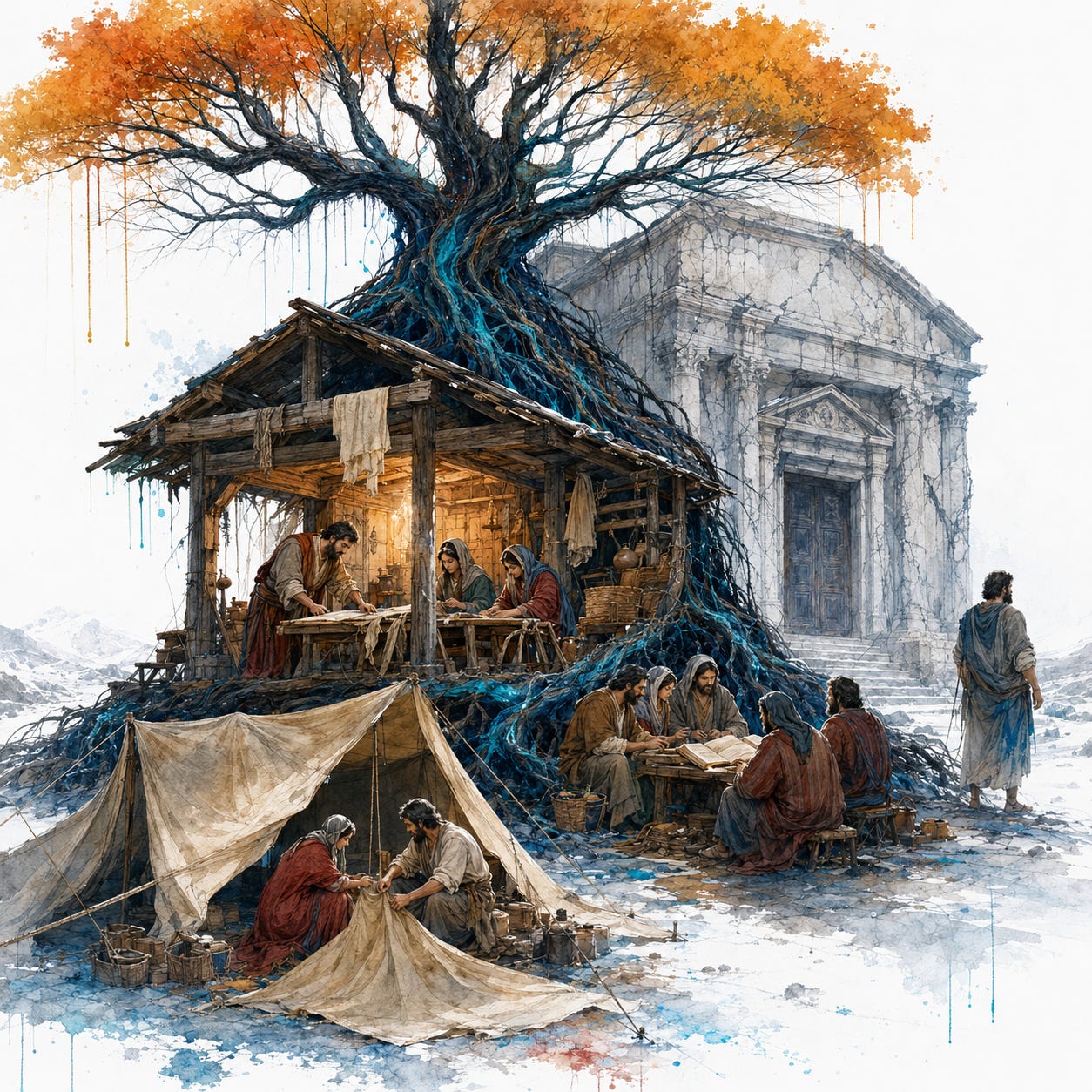
Paul went to Corinth. The scenery changed, from philosophical marble to port-city labor.
There he found Aquila and Priscilla, Jews displaced from Rome by the decree of Claudius. Paul shared their trade, stayed with them, and worked. On the Sabbaths he reasoned in the synagogue.
Paul worked five days in order to preach one. This is a picture of freedom.
The Tent-Maker Framework is not contempt for support by a congregation; Paul elsewhere defends that. But here is strategic economic independence. More so! Aquila and Priscilla were not formed at a distance by Paul. They lived and worked beside him. Canvas, leather, meals, argument, prayer, and ordinary fatigue created the human scale of discipleship. The trade did not interrupt the church. The trade helped give the church a house where at least three gathered every day.
When Silas and Timothy arrived from Macedonia, Paul devoted himself more fully to the Word and testified that Jesus is the Christ. The opposition hardened. He shook out his garments and declared that he would go to the Gentiles. Then he moved into the house of Titius Justus, a worshiper of God whose house stood next door to the synagogue.
That detail carries Paul’s strategic humor. He did not flee Corinth. He moved the work one door over.
How Do You Picture It?
Things we once imagined permanent are failing. Institutional Christianity in the West was formed during a long Protestant summer: buildings, denominations, seminaries, publishing houses, donor networks, political alliances, media platforms, and a shared public vocabulary that remained partly Christian even among unbelievers. That weather has changed.
The answer is not to despise the Church nor baptize isolation. It is to remember what the ekklēsia is. Not an NGO with praise. Not a hedge fund with a chapel. A people called by Jesus Christ’s Words, welcome at His table, chosen for His discipline, and imputed with His life.
A network is useful for moving information, money, and influence.
Those things are dangerous to those given to power.
Impressions, conversions, donors, campuses, subscribers. “Of course, we all know that numbers aren’t faithfulness.”
Do we *all* know that?
Fraternity begins with men who can tell one another the truth and remain in the room. It does not treat a brother as a consumer waiting to be converted into a metric. Neither is it a bunker built against women. It is not grievance organization nor a paramilitary cosplay.
Fraternity is the recovery of male responsibility inside the communion of the saints that confesses the Patriarchy of God, the Father.
All men, owing allegiance to His King, Jesus Christ, are loosed to stand shoulder to shoulder, guarding their households, feeding themselves where possible, teaching their sons, honoring their wives and daughters, bearing one another’s burdens, and refusing the misanthropy and misandry of an age that profits from making every relation hostile.
Christian Fraternity does not stand on shared instinct. It cannot be about your feelings. It is about your convictions. It is a matter of conscience.
The Sons of Solomon prayer for Biblical terminology is not a trick for cornering a market or getting my name out there. The Vocabulary of God is powerful. It places speaker and hearer beneath a meaning neither owns. Without such grammar, the strongest personality inevitably becomes the local dictionary.
Moses gives the grammar of Law: creation has an order, good and evil are not private inventions, worship has an object, blood has weight, words bind, and judgment belongs to God.
David takes that Law into the inner man and sings it through fear, betrayal, kingship, repentance, war, mercy, and praise.
Solomon weighs the created world and gives names to its recurring patterns: the fool, the sluggard, the strange woman, the false balance, the faithful friend, the king, the ant, the tongue, the path.
Then Jesus Christ fulfills the Law, gathers the Psalms into His own suffering and reign, and speaks with the authority of the Logos. He does not merely join the vocabulary. He is the Word by whom the vocabulary holds together.
It is Written
The upright life is therefore dynamic and often grueling. A man testifies to the truth, discovers how much of him still bends toward falsehood, repents, rises, and comes under the Word again. He maintains a steady gaze on the horizon of God’s will while walking through the self-inflicted chaos of a dying age.
Before he judges the world, he is judged by the King.
So hold your perimeter. Refuse idols. The institutions will crack. The pictures will fail. All that we’ve imagined will come to naught. But that which is written in the Book of Life endures forever.
You are the icon of God now, and, thank God, not the only one.
Hey everyone! This is my only post this week since I’m traveling for work. There is also no official podcast this week. But there is a super giant thank you to all of you who support me both with your prayers and your gifts. If you would like to learn more:

Bravo, brother. And amen.
Prayers and blessing in your travels. God be with you.