

How long will you mourn for Saul, seeing I have rejected him?
There are few doctrines of Scripture more assiduously ignored by the modern practical man than the fact of reprobation.
The world is predominantly unconverted, and the promise of Scripture is not that they will all convert. It is that things will go from bad to worse. To neglect the discipline of this righteous judgment is to forget the call of Christianity to live as a remnant Kingdom in a fallen world.

I’m not talking about classroom memory work. I’m talking about that which has already altered how Christians marry, govern, hire, disciple, retire, build, and even read.
We debate down free will with philosophical precision and call it quits, completely and willfully ignorant that most people are not basically trustworthy, not basically reasonable, and not basically inclined toward the good. They only appear that way. Or, they only act that way. Or, that’s what they’re like when the lights are on.
But Scripture is plain and clear. The natural man is an unreasoning animal.
But these speak evil of whatever they do not know; and whatever they know naturally, like brute beasts, in these things they corrupt themselves.
But the natural man does not receive the things of the Spirit of God, for they are foolishness to him; nor can he know them, because they are spiritually discerned.
These are sensual persons, who cause divisions, not having the Spirit.
The Bible is not optimistic about fallen man. It proclaims “the Kingdom of Heaven is at hand; repent!”
Jesus Christ did not come to congratulate mankind on our progress. He came to rescue wicked men from their follies. This is not a marginal. This is the atmosphere in which the Bible breathes.
“Enter by the narrow gate; for wide is the gate and broad is the way that leads to destruction, and there are many who go in by it. Because narrow is the gate and difficult is the way which leads to life, and there are few who find it.”
The apostles repeatedly address Christians as strangers, pilgrims, exiles and sojourners. They do not speak as though Christianity can expect to inhabit a civilization composed primarily of regenerate men, least of all when the majority of the men remain coarse infidels. The early believers expected to endure this world and its prince until the Son is revealed again.
Christians will inevitably live among unbelievers. We are not to shun them, scorn them, or seek to profit to their detriment. But neither should we quite trust them. Not in that way. Not when it comes to what the Spirit says to the churches, (which turns out to be quite a lot.)
From Noah’s family to Abraham, from Gideon’s reduced army to Elijah’s seven thousand, from the faithful remnant of Israel to Christ’s “little flock,” Scripture consistently presents God’s people as preserved by grace rather than multiplied by natural momentum. The remnant is not an exception to the biblical story. It is the central pattern.
Forgetting this is also part of how it always happens.
First, ancient Israel learned to trust strangers. Then they projected their spiritual motives onto their more forbidden ways. Then they imagined themselves educated and erudite, learned unlike those old dead people from before.
Then Nebuchadnezzar showed up.
That is biblical realism.
No sentimental anthropology here.
Jesus teaches that earthly fathers, “being evil, know how to give good gifts” to their children.
Civil order exists because God has written His law upon human hearts. Families endure. Businesses function. Nations govern. Friendships form. Acts of courage, sacrifice, craftsmanship, and affection abound.
People like common sense and honest scales. But liking honest scales is not the same as liking to only get your fair shake.
Scripture teaches that “those who are in the flesh cannot please God.” It teaches that “the natural man does not receive the things of the Spirit of God, for they are foolishness to him.” It teaches that “the mind set on the flesh is hostile toward God.”

These are not descriptions of unusually wicked people. They are descriptions of your normal neighbors daily spirit. And maybe yours too, if you’re not paying attention. That’s where becoming hateful or despairing, bitter or scoffing, becomes the real threat.
It’s not that the maiestatica are unimportant. But Latin vocabulary and platonic categories do not, of themselves, make one wise unto salvation. What such things should do is make one aware of how very illiterate the general society has become, and what little good it does to quibble over the deep meaning of longer barking.
Using four-syllable words is setting the expectation pretty high for some. That’s not an insult. It’s a reason to practice not looking down on people.
But common grace? Civic virtue? Outward cooperation? Political trust?
These things have happened in history apart from Christianity. But not very often. Certainly not enough for us to ignore the writing on the wall all around us. It is not cynical to call a thing what it is.
“The simple believes every word, but the prudent considers well his steps.”
“The prudent foresees evil and hides himself, but the simple pass on and are punished.”
“A fool trusts in his own heart, but whoever walks wisely will be delivered.”
Biblical wisdom is the disciplined habit of distinguishing:
wisdom and folly.
righteousness and wickedness.
faithful men and flattering men.
sheep and wolves.
good trees and bad.
This is why St John commands, “test the spirits.”
Beware of false prophets. Avoid being unequally yoked. Examine elders.
Reject a divisive man.
God alone knows His eternal decree. The hidden things belong to Him. The Church does not preach selectively. The Gospel is without partiality. Every hearer is summoned. Repent! Believe! There is mercy in Jesus Christ.
But a father cannot govern his household indiscriminately. An elder cannot shepherd the flock indiscriminately. A magistrate cannot govern a city indiscriminately. There will be evil men. And good men will commit evil too.
A great many of them he has reserved for retribution on the Day of Judgment.
But not you. Oh, no, not you. You have a better Day coming.
So stop feeling bad about it. Love the damned facts.
They set you free.
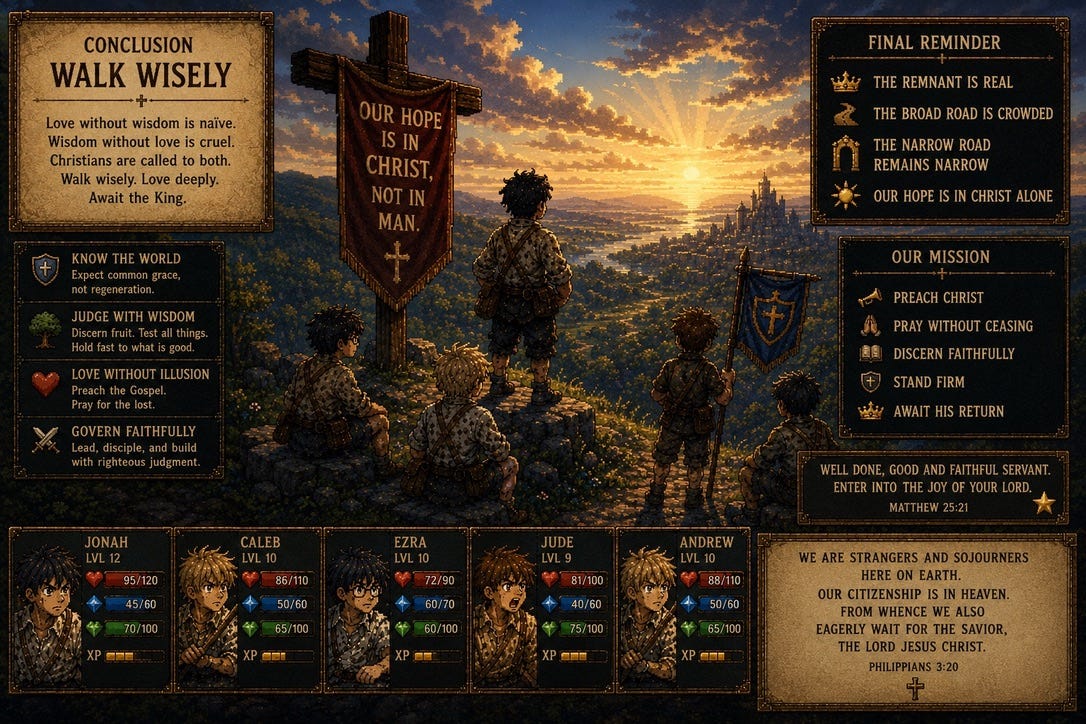

Hey everybody. Thank you for reading! This post was a little late this week, and I’m still not sure it’s up to the level I’ve come to expect from myself. All the same, I’m glad I got it out to you.
If you like what I do, remember you can always throw me a few bucks a month to help my ends me.
This is one of Pastor Fisk's better, more understandable posts. Thanks! (and a sobering reminder of some facts that we don't always at the top of our minds.) I don't quite understand why he left the pastorate (I'm assuming he did or he wouldn't be asking for money to help ends meet).
Very interesting read. Are the images from an AI Zelda game from 1993 Nintendo? and why go with those select five characters?
Jonah, Caleb, Ezra, Jude, Andrew?
Why not Enoch, Stephen, Elisha, Noah and Peter?
or Gideon, Samuel, Elijah, Philip and Nathanael?