Paul’s Theology of Leaving
The theater at Ephesus could hold a city, and the city had lost its mind. For two hours one sentence crashed through the stone bowl:
“Great is Diana of the Ephesians!”
The men who started it knew why. The Gospel had begun to interfere with the silver trade. Demetrius and the craftsmen sold small gods for good money, which meant Paul’s preaching was no longer a private religious opinion. It had reached the cash register.
Now, it was a riot, and Paul wanted to go in.
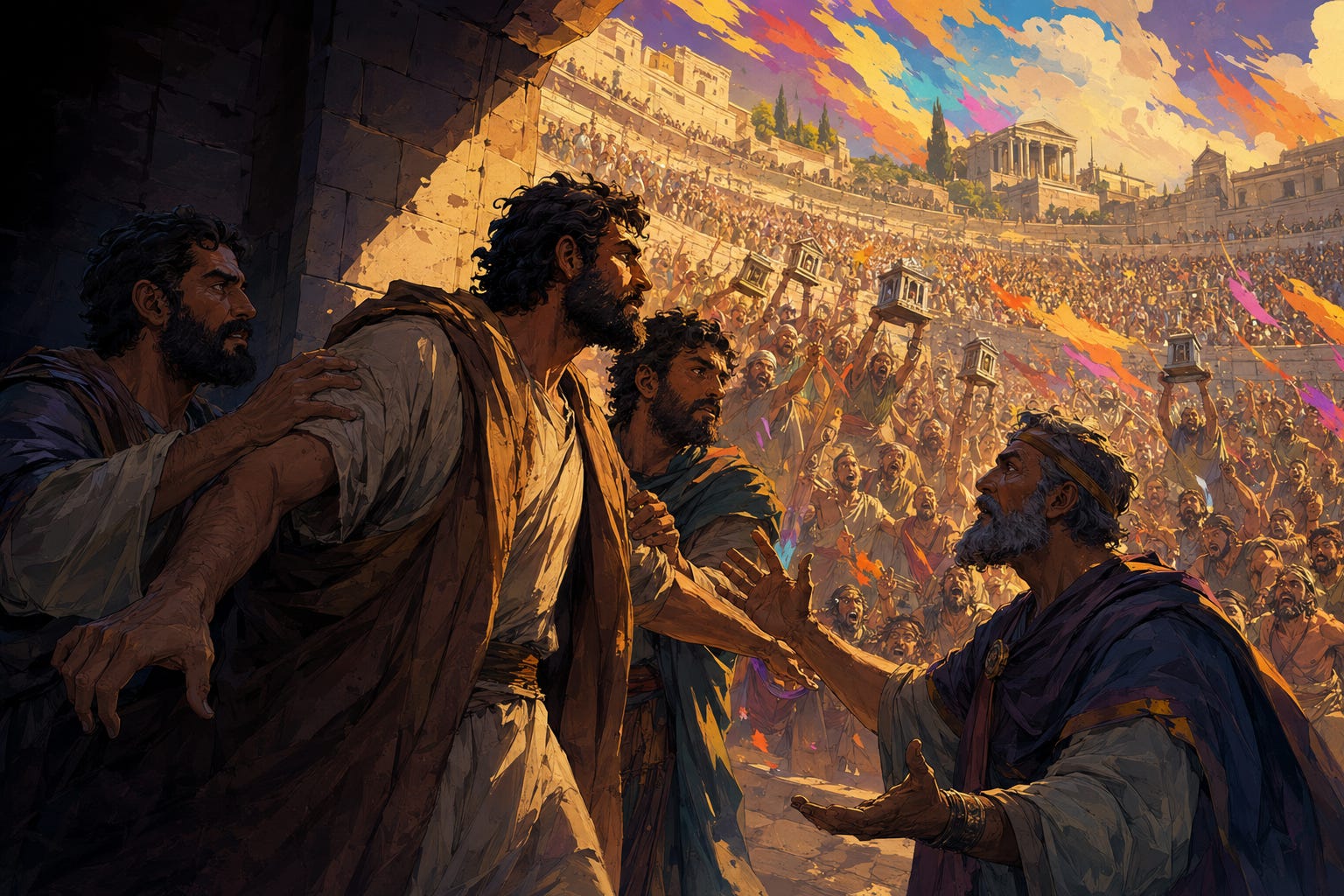
Of course he did.
He had spent years reasoning in public, taking the Word into synagogues, lecture halls, markets and houses. A mob was still made of men, and men could hear.
But the disciples would not let him enter the theater. Even some of the Asiarchs, officials friendly to him, sent word begging him not to venture inside. Paul had courage enough to face the crowd. His brothers had wisdom enough to bar the door.
Luke gives us no shining moment in which the Apostle announces that the Spirit has personally exempted him from consequences. He gives us friends who can still tell Paul no. The Apostle to the Gentiles remains apostolic precisely because he listens to them.
Then the town clerk quiets the mob.
That was months ago.
Now, Paul is sailing past Ephesus without ghosting it. He calls the Christians to his side and gives them his face. Standing on a beach, he speaks of his own humility, tears, trials, public teaching, house-to-house teaching, repentance toward God, and faith in Jesus.
Then he leaves again.
Not Every Theater Is Your Cross
I am inspired by molon labe as much as the next red-blooded meat eater. But we have made an idol out of standing your ground.
“A brave man stays.”
“A faithful pastor never quits.”
“A good father sacrifices everything.”
“A real Christian stands firm.”
You have not so learned Christ.
Before the riot began, Paul had already purposed in the Spirit to pass through Macedonia and Achaia, go to Jerusalem, and afterward see Rome. Ephesus was not the destination. The theater was not an altar. Screaming craftsmen held no authority to rewrite his calling merely by becoming dangerous.
So Paul left Ephesus “for good” without surrendering the Gospel, recanting his preaching, or apologizing to Artemis. He refused to confuse the loudest fight with the appointed one.
Jesus taught His disciples when persecuted to flee from one city to another. Solomon’s prudent man sees evil and hides himself while the simple press on and pay for it. Scripture permits escape to be prudent courage. Sometimes remaining is faithfulness. Sometimes remaining is vanity dressed for church.
Paul was willing to die, but Demetrius held no claim on that hour.
Not every danger is your cross. Some are only theaters full of fools.
A Road Full of Names
A beautiful result of this is how little Paul’s flight resembles escape.
He leaves Ephesus and moves through Macedonia, giving the disciples much encouragement. Then he spends three months in Greece. When a plot forms against him as he prepares to sail for Syria, he changes course and returns through Macedonia. He refuses to force Providence to prove itself. He changes the itinerary and keeps the mission.
Luke fills the road with names: Sopater of Berea; Aristarchus and Secundus from Thessalonica; Gaius of Derbe; Timothy; Tychicus and Trophimus of Asia. These are not an ornamental credit scene. Paul’s movement has gathered men from the cities behind him. The man leaves, but the Word has made a fraternity that travels on.
Flight can turn a man inward. He escapes the dangerous room, discovers the relief of silence, then begins cutting every cord that might pull on him again. Peace becomes privacy. Privacy becomes isolation. Isolation learns to call itself wisdom. Paul’s road runs the other way. He departs one crowd in order to strengthen another. He avoids a plot and finds a journey among brothers.
The riot behind. The people before.
Lucky at the Window
In case you were sleeping, the disciples gather on the first day of the week to break bread. Paul intends to leave the next day. It’s an all-day even. Lamps are lit. The air is close. He speaks long into the night.
Near the open window sits a young man named Eutychus. That means Lucky, and he couldn’t help himself but sneak in forty winks.
A third-story fall leaves no body gently arranged on the ground. Whatever the crowd saw when they reached him, Luke gives the verdict without padding: they took him up dead.
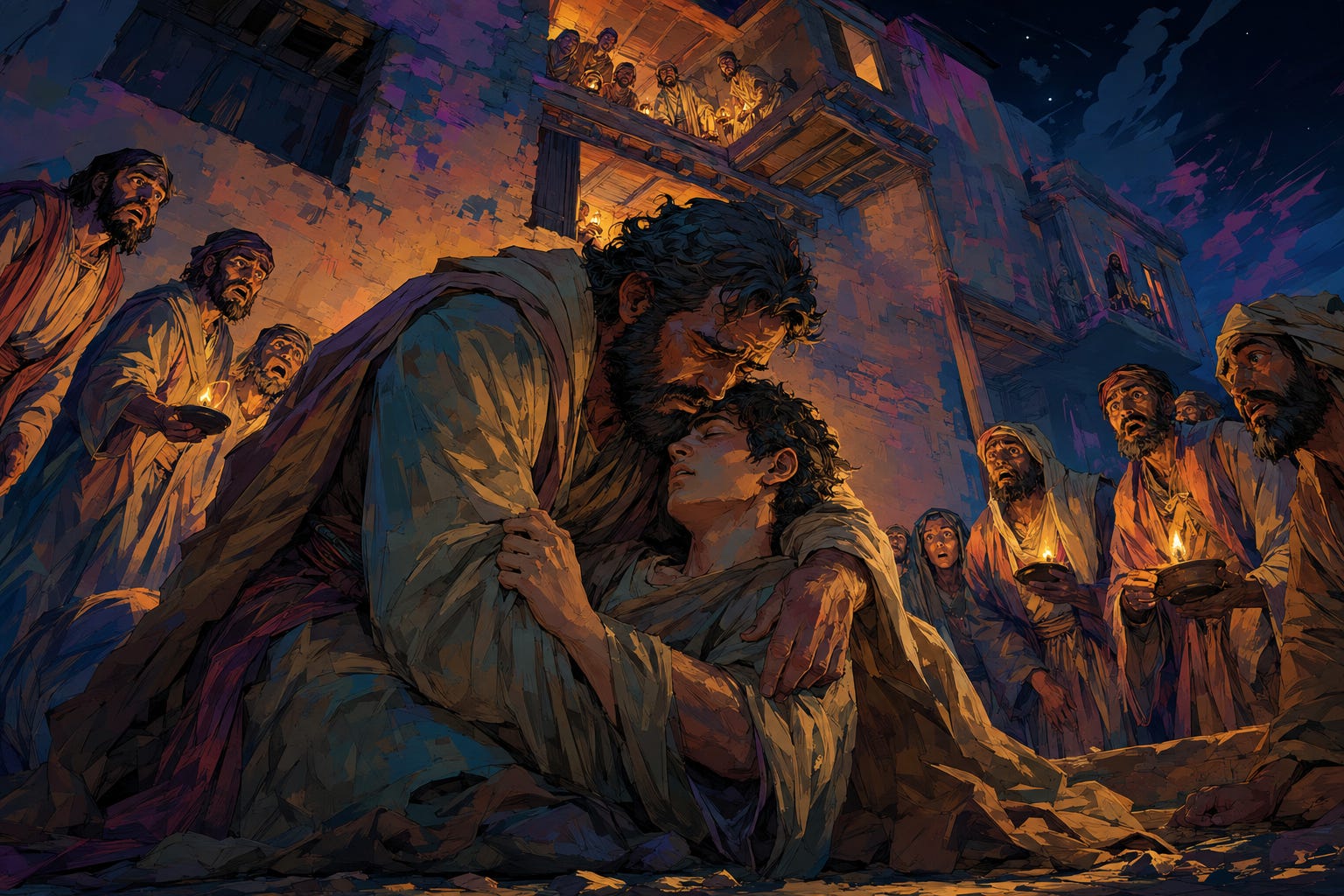
But Paul goes down. He falls upon the young man and embraces him. He speaks peace over the wreck. Life is in him. Then, back upstairs. Break bread. Eat. Keep talking until daybreak.
Paul can leave Ephesus when a riot makes his presence a lightning rod, and he can spend the whole night with a room because the hour calls for his presence. He can change course around an ambush, then pour himself out until sunrise. He is neither addicted to conflict nor governed by comfort. He does not stay to prove that he cannot be moved. He does not leave because people have become expensive. His freedom comes from belonging to a purpose larger than his nerves.
By breakfast, Lucky has become his name again. Paul leaves behind a living young man, a fed congregation and a story strong enough to walk on after him.
The Long Way to a Deadline
The others sail from Troas to Assos. Paul goes on foot. Luke leaves the reason alone and simply follows the path. Assos. Mitylene. Chios. Samos. Miletus. Land and water, walking and sailing, companions together and Paul alone.
The Holy Spirit inhabits all itineraries. Vocation moves through weather, ports, passage money, tired legs and dates on a calendar.
Paul decides to sail past Ephesus and avoid a delay in Asia. He is hurrying to reach Jerusalem for Pentecost.
But Paul loves the Ephesians. He has labored among them publicly and from house to house. He has argued, taught, wept and worked with his hands in their city.
He still sails past.
Their affection carries no claim superior to his calling. Their need cannot be permitted to become endless simply because it is real.
Pentecost waits in Jerusalem. Paul has somewhere to be.
The man who only runs away will eventually make shelter his god. Paul is moving toward something, a feast, the saints, the testimony.
No Cold Goodbyes
He is going to Jerusalem, “bound in the spirit.” Much of what will happen there remains hidden. But he sees it well enough. The Holy Spirit testifies that chains and tribulations await. He fled an uproar, detoured a Jewish plot, and all so he can walk into the lion’s den against the advice of all.
What gives? A man chasing death would have entered the theater. A man worshiping survival would avoid Jerusalem. Paul does both of the things a slogan cannot hold together: he flees and he goes. His route is governed neither by fear nor bravado.
Before he boards the ship, he prepares the elders: savage wolves will come. Some will rise from within and twist the truth. Therefore watch. Remember. Shepherd.
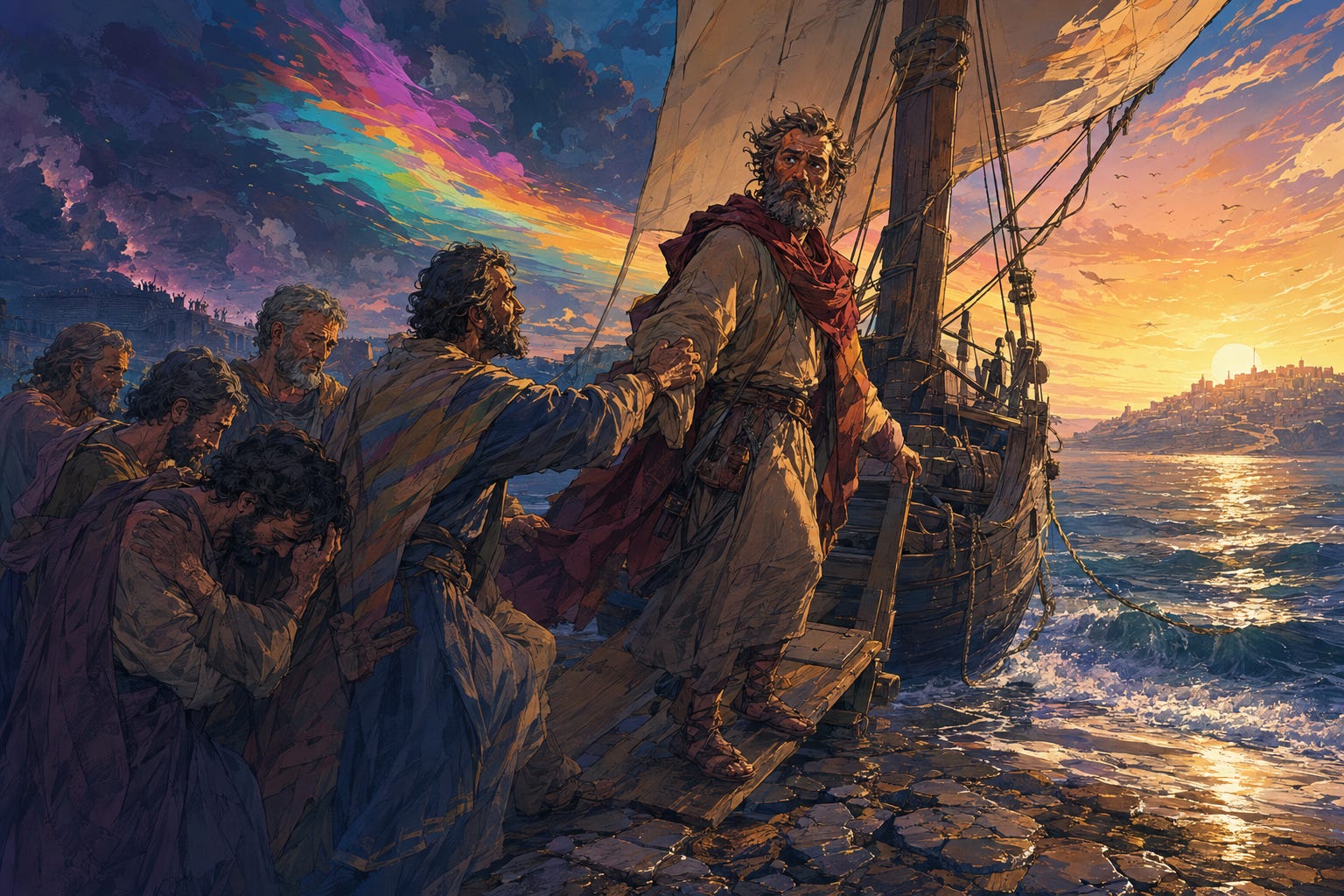
They weep, fall on his neck and kiss him, grieving most because he has said they will not see his face again. Then they accompany him to the ship. Nobody gets to leave dry-eyed and therapeutically complete. Love makes the departure hurt. Faith does not anesthetize it.
Distance Is Not a Sacrament
Our therapeutic century has turned departure into a moral vocabulary all its own. We say boundary, unsafe, toxic and no contact as though naming the distance has already justified it.
Sometimes the words fit. Sometimes they don’t.
Christians are allowed to flee violence, manipulation, persecution and chaos. A shared name or shared blood cannot make evil harmless. Paul himself avoided the theater and changed course around a plot. But distance is a circumstance, not a sacrament. It cannot absolve us by itself.
Paul’s departures bear Christian fruit. He moves toward obedience rather than a frictionless life. He receives the judgment of faithful friends. He strengthens the people he leaves. He remains among named brothers. He makes room for tears. When possible, he gives the truth face to face. He leaves the future open to the Word of grace instead of sealing it beneath his own verdict.
Fear uses flight for a different end. It seeks a world in which nobody can make a claim, offer a correction, require patience or complicate the story. It freezes people at the scene of their worst act and calls the ice a boundary. Eventually the protected self becomes a lonely little Artemis, untouchable, expensive and quite unable to save.
No dangerous person is owed a meeting. Scripture never requires a victim to stand in the theater. Nor do we make it our identity to escape.
Flee, Then Follow
Paul is hard to trap because safety is not his master.
Neither is reputation. He has no need to win every public confrontation, preserve every human attachment, answer every accusation, or prove his nerve to men who are shouting too loudly to know why they came. His life is not dear to him compared with finishing the race and completing the ministry received from the Lord Jesus.
Jesus is the pattern beneath Paul’s road. The Child was carried into Egypt when Herod hunted Him. The Man withdrew when His enemies plotted. He passed through a murderous crowd before His hour had come. Then, when the hour came, He set His face toward Jerusalem and did not run from the cross.
The Christian worships neither danger nor distance. He follows Christ. This is why he can flee the wrong suffering without shame and walk toward the right suffering without fear. He knows the difference between a theater demanding his pride and a Jerusalem appointed by his Lord. He can leave without abandoning, love without remaining, grieve without turning back and disappear from one horizon without vanishing from the communion of saints on the edge of another.
Flee is a Christian verb.
So follow.