

It’s all the rage:
“If he does this, he’s a Narcissist.”
“If you feel that way, you’re an Empath.”
It feels like recognition.
What was tangled becomes named. What was disorienting becomes ordered. The story resolves into two roles you can hold without strain.
One wounds. One feels.
One takes. One gives.
The relief is real. It’s an effective hook.
But psychobabble’s recent Narcissist-Empath fad-theory did not arrive as a finished system. It formed in motion. Old psychological terms drifted forward; new therapy language added texture; moral instincts about harm and innocence supplied weight. Then the whole mix passed through platforms built to reward clarity, confidence, and repetition.
What survives in pop pathology is what can be said quickly, remembered easily, and applied everywhere. Older words from moral and religious discourse fused with newer language from therapy culture inside algorithmic media built for speed, emotional recognition, and identity shorthand now popularized as a single framework that is really just a stack of borrowed parts:
Freud’s Narcissism;
the modern history of empathy;
Jung’s symbolic and typological grammar;
humanistic therapy’s esteem for empathic listening;
attachment and trauma language about sensitivity and hypervigilance;
self-help commercialization;
YouTube sermonizing;
AI voice cloning;
All of it feeding on the recommendation engine that rewards confidence, clarity, and repeatability.
It is a potent framework that is at once true and false.
It is not false because it has no contact with reality. In fact, it often describes real manipulations, real asymmetries, real distortions of speech, memory, and shared reality. But the frame is unstable because each layer changes the meaning of the layer before it. A concept that began in one discipline is repeated in another, simplified in a third, dramatized in a fourth, and then spoken back in the borrowed face and voice of someone who never said it. The result is not pure nonsense. It is something more slippery: partial truth with broken provenance.
Dig Deep
The first root is not Jung but Freud. Sigmund Freud’s 1914 essay On Narcissism is the classic psychoanalytic source that formalized the concept. In Freud, narcissism was not an internet epithet for a manipulative spouse or ex-partner. It was a theory about libido, the ego, and development. Freud treated “primary narcissism” as a normal early condition and “secondary narcissism” as a withdrawal of libidinal investment back into the self. Even the word itself did not originate with Freud alone; later reference works note that Freud borrowed a term already circulating in psychiatric discussion, including use by Paul Näcke, but Freud is the figure who made Narcissism a major psychoanalytic category.
That matters because the internet use of “Narcissist” is several translations removed from its origin. The route runs like this:
mythic Narcissus;
early psychiatric terminology;
Freud’s psychoanalytic development theory;
later object-relations and self-psychology expansions;
modern diagnostic psychiatry;
and then mass-culture shorthand.
By the time the word appears in online relationship content, it usually no longer means what Freud meant. Often it means some blend of grandiose self-protection, exploitative relating, low accountability, emotional inversion, and strategic use of language. Sometimes that blend points to something real. But it is no longer the original term. It is a folk diagnosis built on layered inheritance.

Jump Forward
Modern psychiatry narrowed the term again. The American Psychiatric Association describes narcissistic personality disorder as a pervasive pattern of grandiosity, need for admiration, and lack of empathy, beginning by early adulthood and present across contexts.
That is a clinical threshold, not a synonym for “crooked person” or “person who hurt me.” Many people called Narcissists online would not meet that diagnostic standard, while some who do meet elements of the standard may not resemble the internet caricature. The online world therefore uses the word far more broadly, morally, and narratively than psychiatry does.
The second root is empathy, and here the genealogy is even more easily misunderstood. “Empath” is not a Jungian invention.
The English word “empathy” entered in the early twentieth century as a translation of the German Einfühlung. Edward Titchener is commonly credited with introducing the term into English around 1909.
Early empathy language did not primarily mean what people mean now by “I am an empath.” It first belonged heavily to aesthetics, projection, and the act of “feeling into” an object or form. Only later did the word broaden into interpersonal understanding, emotional attunement, and therapeutic sensitivity.
So the internet phrase “the empath” also sits on a historical distortion. The base word empathy has legitimate intellectual history. But “empath,” as a stable personal type, is much newer and much looser. Even mainstream health and psychology sources now say that “empath” is not a formal diagnosis, though many people identify with the term to describe heightened sensitivity to others’ emotions. That means the word is culturally powerful but clinically soft. It names a felt pattern, not a disciplined category.
Archetypically
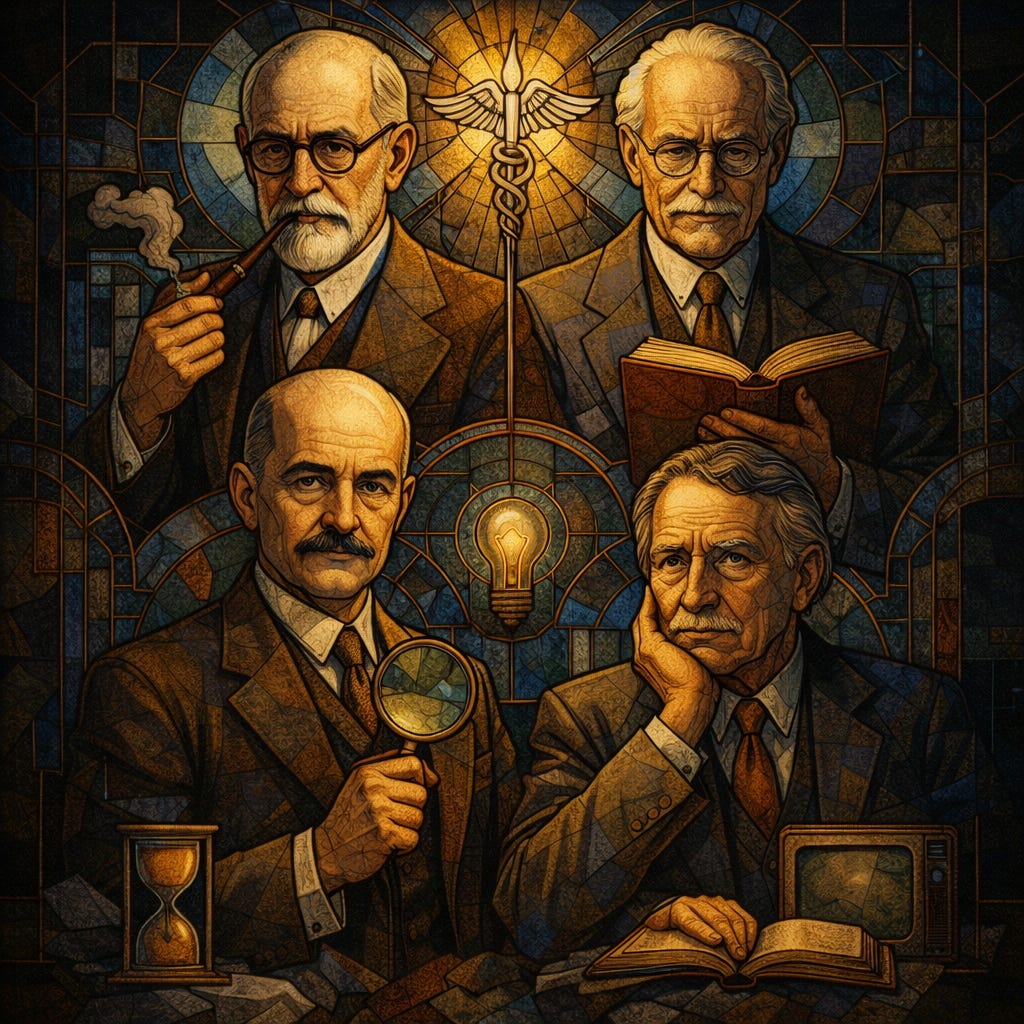
Carl Jung enters the story at a different angle. Jung did not coin the Empath-Narcissist polarity. What he provided was something else: a symbolic grammar for interpreting persons and patterns.
Jung developed the concepts of introversion and extraversion, archetypes, and the collective unconscious. He gave later culture a language for recurring figures, shadows, compensations, projections, and one-sided personalities. This made him immensely attractive to later interpreters who wanted to narrate modern relational struggle in mythic terms. Jung supplied the stage, the masks, and the dramatic lighting. He did not supply the specific internet binary.
That distinction is essential. Jung’s scholarship is typological, symbolic, and developmental. Internet “Jung” content is often moralized, therapeuticized, and then flattened into scripts. It moves from “shadow and projection” to “the Narcissist fears the healed Empath.” It moves from analytic psychology to algorithmic mythology.
The scholarship changes genre. Jung was writing theory and interpretation. The content economy produces recognitional drama. One asks the reader to descend into ambiguity. The other promises that ambiguity has already been decoded.
Then What?
A fourth root comes from humanistic psychology, especially Carl Rogers. Rogers made empathy central to the therapeutic relationship.
Britannica’s summaries of Rogers and of psychotherapeutic approaches note his emphasis on a person-to-person relationship and on empathy, warmth, and a nonjudgmental stance as sufficient conditions for therapeutic change. This did not create “the empath” as an identity type, but it did elevate empathic attunement into a moral and therapeutic ideal. Once empathy became a therapeutic virtue, culture could more easily convert it into a self-description and then into a heroic role.
Add attachment theory and trauma discourse and the internet theory becomes even more combustible.
Attachment theory explains how early relationships shape emotional regulation, security, and responses to threat. In broad popular translation, that becomes an interpretive lens for why one person pursues, soothes, or over-attunes, while another withdraws, controls, or destabilizes. Again, the move is not wholly false. It is one more example of partial truth migrating into a simplified map.
A person with strong sensitivity, fear of rupture, or hyper-attunement may indeed be easier to manipulate. But “easy to manipulate because highly relational” is not the same as “empath” in the mystical or identity-heavy internet sense.
By the time the terms reach late self-help culture, they have become market-ready. This is where “the empath” becomes not merely a capacity but a brandable self. Judith Orloff’s The Empath’s Survival Guide and related materials are a clean sign of that transition.
Whether one cares about her framework or not, the existence of this literature shows that “empath” had become a consumer identity category, complete with self-help strategy, daily practices, and niche audience. The scholar’s term had become the buyer’s term.
The Brand is the Bias
Then the platform era took over. Marshall McLuhan’s old line that “the medium is the message” hits near the mark, and Neil Postman’s critique of television matters even more now than when he wrote it. Amusing Ourselves to Death argued television reduces public discourse because the medium privileges alluring visual imagery. McLuhan argued that the form of a medium shapes the scale and character of human association. Once psychology migrates from books and clinics into short video, thumbnail theology, voiceover confession, and endlessly recommended clips, the medium does not merely distribute the ideas. It edits them in advance.
The ideas must become emotionally legible at speed. They must be titleable. They must be repeatable by strangers. They must survive without context.
Walter Ong’s work on orality and literacy adds another layer. Ong argued that oral and literate cultures form thought differently. In broad terms, literacy stabilizes, externalizes, and slows the word; oral performance is more situational, participatory, and communal. Digital media now creates a strange hybrid: infinitely reproducible speech-like performance without the accountability of embodied presence, joined to searchable text without the discipline of textual study.
In the old print age, ideas had to endure under slow reading. In the platform age, ideas can win by cadence, face, and the feeling of recognition.
Careful What You Wit For
This is where the Narcissist-Empath myth explodes. It is tailor-made for digital media. It offers heroes and villains. It turns painful ambiguity into legible polarity. It helps viewers interpret their own suffering in real time.
It offers a grammar of survival.

The Narcissist-Empath dialectic answers the ache of bewilderment with a plausible mythos - a story. It says, in effect, “The confusion was not confusion. It had a type. You had a type. Now you can see.” And, most importantly, “It wasn’t your fault.”
That is potent juju. As psychobabble, it is potent medicine when the categories outrun evidence or become self-sealing. The user does not merely learn a pattern. You acquire a role.
The scholarship degrades step by step.
First, a term leaves its home discipline. Second, it is moralized or personalized. Third, it is turned into a personality-role pair. Fourth, it is distributed by creators whose incentive is not scholarly precision but retention.
Next, it is dramatized through examples optimized for emotional certainty. Then, it is detached from original texts. Finally, it is voiced by borrowed authorities.
The internet’s current phase becomes a dark web of self-reinforcing pathology loop.
Shallow Fake
Search results today show videos such as:
“When the Narcissist Realizes the Empath Has Learned Their Game | Carl Jung Philosophy,”
“When an Empath Leaves, Toxic People Lose THIS | Carl Jung,”
“The Narcissist’s Last Desperate Move When You Break Free | Jordan Peterson Motivational Speech,”
“When a Narcissist Hurts You, God Strikes with 5 Severe Punishments | C.S. Lewis’s Messages.”
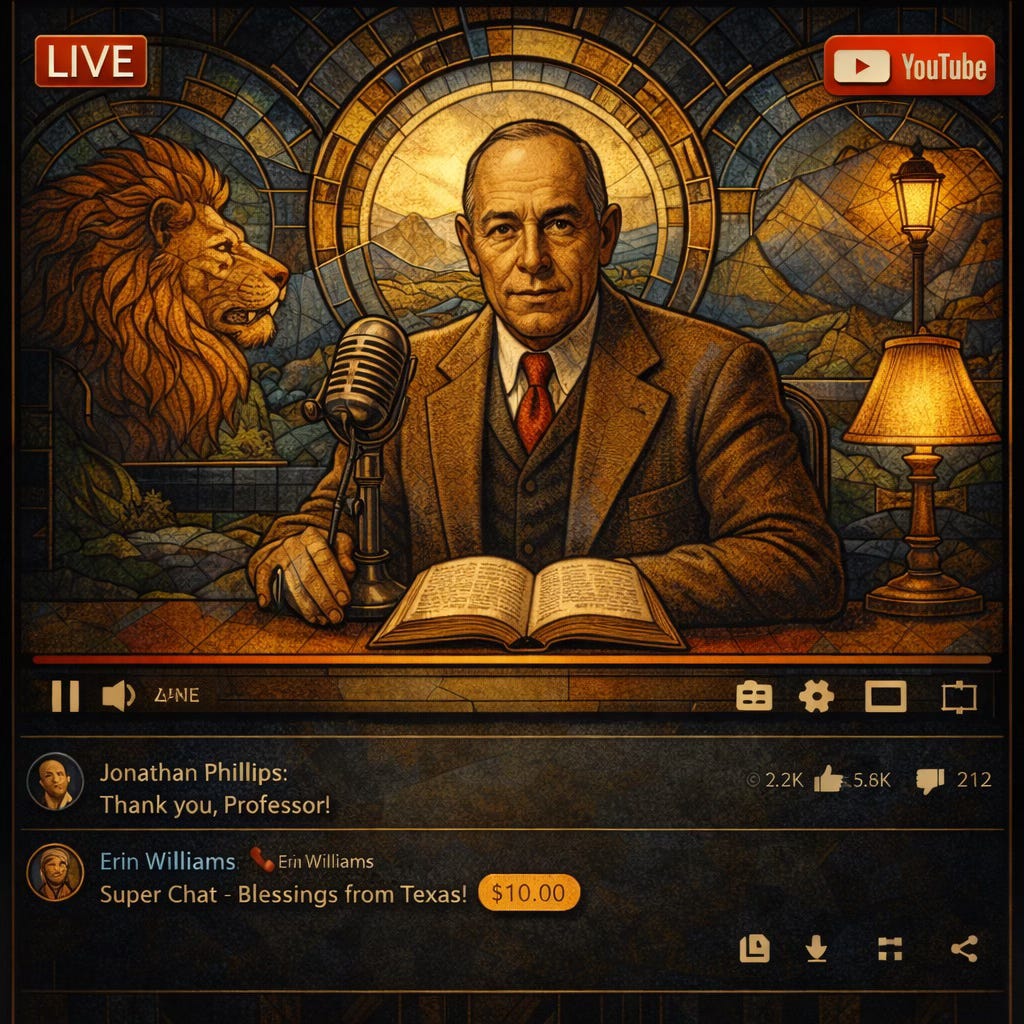
Some of these descriptions explicitly state that they use AI-generated voices or are “inspired by” the supposed thinker rather than authentic recordings. Whatever individual channel ownership may be, the pattern is visible in the open: borrowed names, synthetic voice or style, and algorithmic packaging around relationship polarity.
That is not a minor corruption. It is a doctrinal problem in the order of knowledge itself.
C.S. Lewis did not author internet sermons on Narcissists and Empaths. Jordan Peterson’s real body of work is not identical to the AI-motivational material circulating under his face and name, no matter how effective it may be. The digital user does not meet these authorities through bibliography or context. You meet them through the machine’s fluent resurrection of recognizable masks.
The authority survives while the author disappears. The face remains; authorship collapses.
YouTube itself now requires creators to disclose content that is meaningfully altered or synthetically generated when it appears realistic, and it has also updated privacy standards to allow requests for removal of synthetic or altered content simulating an identifiable person’s face or voice.
Those rules exist because the platform recognizes the problem. But the rule also reveals the scale of the disorder: the medium now assumes that realistic synthetic persons will circulate. The viewer must actively ask whether a person ever actually said what his face now says.
UNESCO has called this a “crisis of knowing,” and the phrase is apt. Reuters Institute reported in 2025 that trust in AI answers among those who encounter them is moderate, not absent, while broader digital news reporting showed continuing struggles of trust and engagement in the news ecosystem. (Disclaimer: AI found that Reuters note and I did not bother to double check it.)
In other words, modern users inhabit a mixed environment of partial trust, partial suspicion, informational overload, and weakened authority structures. Into that environment the Narcissist/Empath polemic provides a perfectly optimized theory of relationship harm: memorable, reusable, morally charged, therapeutically flavored, algorithmically amplified, and often voiced by synthetic elders.
This is why the theory feels both like revelation and like propaganda. It can tell the truth about manipulation. But it can also smuggle in fantasy.
Its strongest claims are often the behavioral ones: selective framing, blame inversion, lack of reciprocity, contempt under correction, emotional exploitation, image management, refusal of shared reality. Its weakest claims are often the identity ones: you are an empath; they are a narcissist; this always happens; your role is the sacred sufferer; their role is the demonic exploiter; the pattern is total.
Once the labels harden into total identity, the framework becomes difficult to falsify. It becomes a story that can interpret everything in advance.
Rewind
That is the point at which biblical categories become more trustworthy than internet categories. The Bible does not lack moral clarity. It has more of it than modern therapy culture. But its categories are straighter.
Proverbs speaks of the upright and the crooked, the wise and the scoffer, the faithful and the treacherous. Those are not sterile labels. They are moral descriptions of persons as known by their path, speech, response to correction, treatment of neighbor, and relation to truth. They are not dependent on platform virality. They do not require borrowed celebrity authority. They do not need a synthetic C.S. Lewis to make them sound wise.
The categories of upright and crooked are especially useful because they stay close to reality.
“Crooked” names deviation from straightness. It names what happens when speech bends, when motives distort, when facts are cut and rearranged, when a line that should run true is forced into a protecting curve. “Upright” names alignment. It is not perfection. It is straight dealing. It is willingness to stand in the light, to hear correction, to let words mean what they mean, to seek reconciliation without twisting reality in order to preserve self.
Those are better categories because they are morally serious without pretending to be clinical diagnoses. They describe what is happening, not merely what tribe of content one has joined.
This does not mean the modern frameworks are worthless. They can still serve as secondary pattern-recognition tools. If a podcast or video uses “narcissist” and what it actually describes is crooked handling of reality, the hearer can extract the useful material. If it uses “empath” and what it means is someone inclined toward care, attunement, and reconciliation, that too may carry partial truth.
But the hearer must keep the biblical frame primary and let the modern frame be filtered, rather than enthroned. The question is no longer, “Is this person clinically a narcissist?” The sharper question becomes:
Is this speech upright or crooked?
Is this path straight or bent?
Does this person move toward truth under correction, or away from it?
Those are older questions. Better questions. Harder to game.
Still Standing
The collapse of information in Western civilization is therefore not merely the collapse of facts. It is the collapse of provenance, genre, and authority.
Writing once forced endurance, citation, and slow confrontation with text. Audio restored voice but weakened review. Video intensified charisma and emotional recognition. Digital platforms dissolved sequence and replaced it with feed logic.
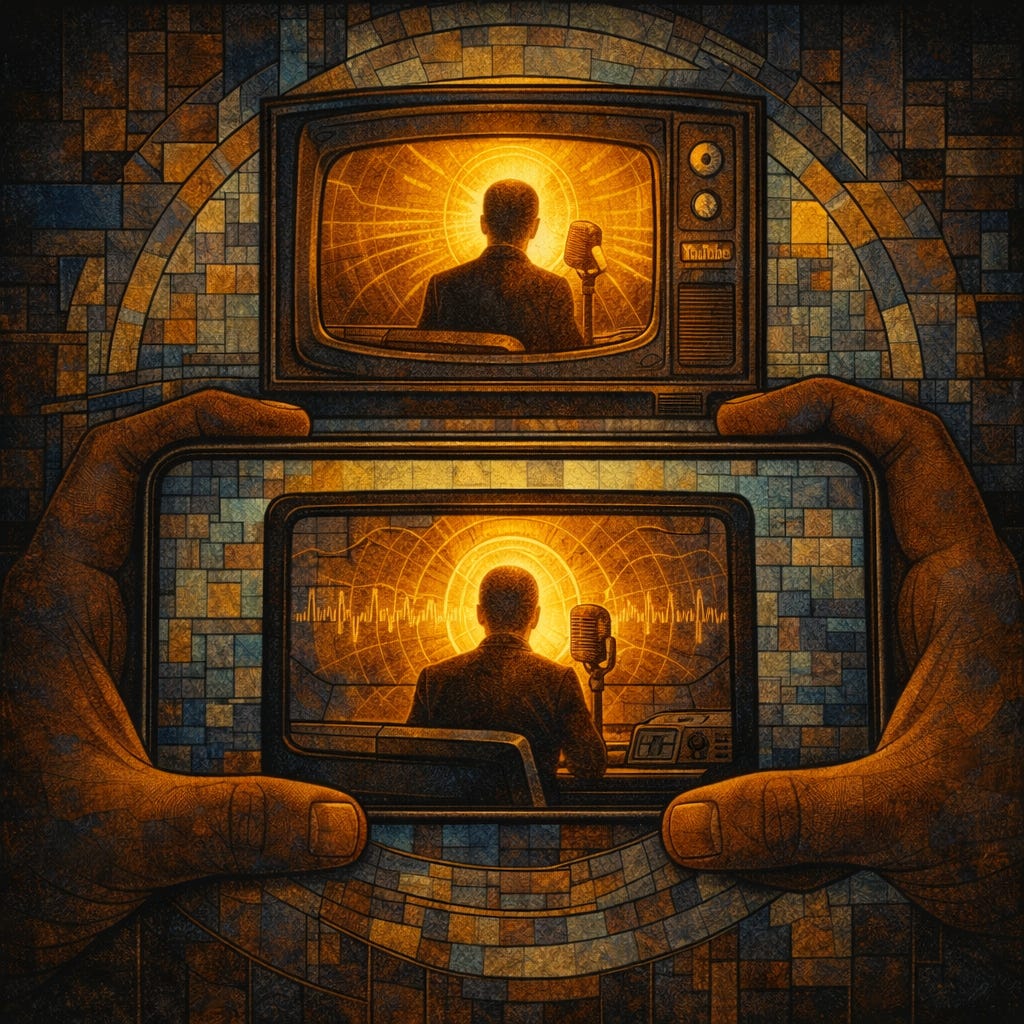
Generative AI now dissolves the distinction between witness and simulation. The result is a public that often receives moral psychology as entertainment, therapy as prophecy, and synthetic authority as wisdom.
McLuhan and Postman saw the medium problem early. AI has radicalized it.
So the task now is not to become anti-technology in some simplistic sense. The task is to recover discernment.
That means asking at every stage:
What is the source?
What discipline does this term come from?
What changed when it crossed over?
What incentives govern the current speaker?
Is this explanation clarifying behavior or manufacturing identity?
Is it testing itself against reality, or creating a closed loop?
Does it move me toward sobriety, repentance, and straight dealing, or toward intoxicating certainty?
The “narcissist versus empath” theory rose because it gives language to many people who have genuinely been destabilized. That should not be mocked.
It names real pain. But because it rose through the machinery of digital simplification, it tends to overstate, over-identify, and over-dramatize.
It is strongest when it says, “Some people twist words, invert blame, and exploit relational goodwill.” It is weakest when it says, “Here is the final binary by which all your suffering can now be decoded.”
Biblical discernment is sterner and safer. It lets a man call crooked what is crooked. It lets him prize the upright without canonizing himself. It lets him step away from treachery without needing to claim infallible psychological omniscience. It gives him moral clarity without surrendering to internet mythology.
And in an age where dead voices can be made to preach new doctrines, that older straightness is not a retreat from modern knowledge. It is the condition for using modern knowledge without being ruled by it.
Straight Ahead
The future will likely produce even more persuasive simulations: more AI Jordans, more AI Lewises, more synthesized sages explaining human wounds in perfect cadence.
The answer is not merely better warning labels. The answer is recovering a people able to judge words by truth rather than by fluency, by fruit rather than by virality, and by uprightness rather than by charisma.
In that sense, the problem is not finally technological. It is moral and civilizational.
We have built machines that can mimic wisdom while our culture has grown less capable of testing wisdom against the straight edge of reality. This is where “upright” and “crooked” are better than the fashionable polarity. They do not deny the reality of manipulation. They do not deny that some people repeatedly bend truth while others genuinely seek communion. They simply refuse to outsource discernment to psychobabble.
They restore the moral center. They let a man hear a modern framework, take what is true, and throw the rest away. In a collapsing information order, that is not a small gain.
It is the one discipline by which a normal person can remain sane.


Thank you Pastor. Man is not misunderstood, he is dead to sin. We do not need to understand ourselves but to seek the word. We were dead…God has spoken…Christ is Risen. Believe this!