Work out what God has worked in.
Philippians 2 is not a decorative chapter for Christians who need a little humility added to their personality. It is the architecture of the new man. Paul is not offering a moral improvement plan. He is showing the church the mind that belongs to those who have been purchased by Jesus Christ, joined to His life, and set loose in a crooked and perverse generation as lights in the world.

The chapter begins with consolation, comfort, fellowship, affection, and mercy.
Paul does not begin with threat. He begins with what grace has already done. “If there is any consolation in Christ,” he says, “if any comfort of love, if any fellowship of the Spirit, if any affection and mercy,” then fulfill his joy by being like-minded, having the same love, being of one accord, of one mind.
That is not sentimentality.
It is not the shallow agreement of people who have decided to avoid hard things.
“One accord” is harmony. It is musical. It is concord, not sameness.
The church is not made one because everyone has the same temperament, the same history, the same gifts, or the same opinions about every lesser matter. The church is made one because Jesus Christ is Lord, because mercy is not optional, because affection has been restored to the children of God, and because the Spirit gives one song to many throats.
Then Paul strikes the root:
“Let nothing be done through selfish ambition or conceit.”
There is the old world. There is Adam’s panic. There is the grasping creature, always measuring, always climbing, always defending reputation, always demanding to be seen, always afraid that if he descends he will disappear.
But the mind of Christ does not grasp.
Paul says, “Let this mind be in you which was also in Christ Jesus.” He does not mean, “Try harder to be nice.” He means that the risen King has opened to you the only sane way to be human.
Jesus Christ, being in the form of God, did not consider equality with God a thing to be seized, exploited, or used for reputation. He made Himself of no reputation. He took the form of a bondservant. He came in the likeness of men. He humbled Himself. He became obedient to the point of death, even the death of the cross.
This is the great descent.
The Son of God did not become less holy by becoming man. He brought holiness into our flesh.
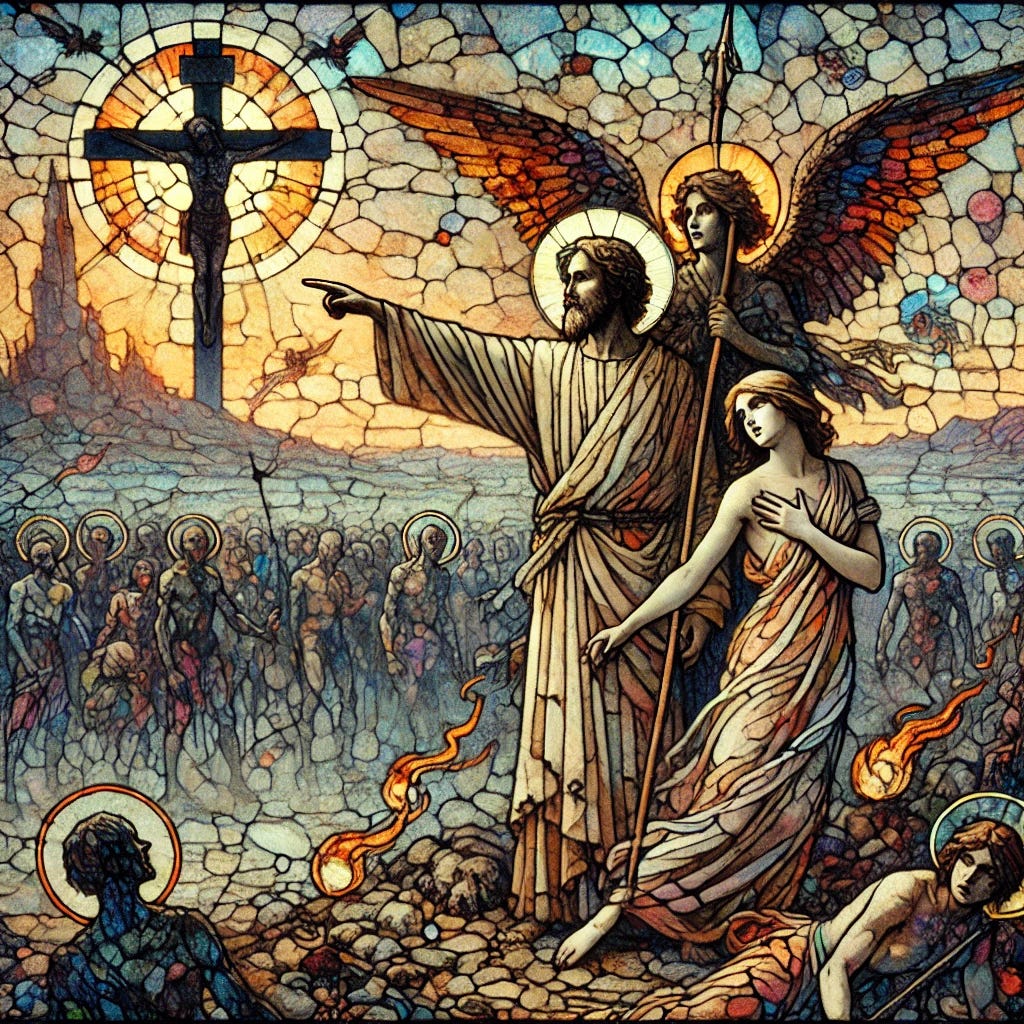
He did not pretend to be a servant. He took the form of a bondservant because man was always created to live under God. Slavery to men is a horror. Slavery to sin is death. Slavery to God is creaturely sanity. It is the only freedom that does not rot into self-worship.
Modern man hates this because modern man believes freedom means belonging to no one. That is a lie. The man who belongs to no one is quickly purchased by appetite, fear, money, reputation, lust, algorithms, grievance, and the need to win. The only man who becomes free is the man who belongs to Jesus Christ.
This is why the gospel is not merely pardon.
It is power.
Grace does not sit inert in the soul like a legal receipt tucked into a drawer. Grace raises the dead. Grace melts the heart. Grace gives the mind of Christ. Grace teaches the lungs to breathe again.
So Paul can say, without contradiction, “Work out your own salvation with fear and trembling.”
He is not sneaking works-righteousness through the back door. He is not telling the baptized to save themselves after Jesus has done the difficult part. He is saying that what God has worked into you must now be worked out through you. The life placed inside the man must become visible in his hands, tongue, habits, patience, courage, and mercy.
“For it is God who works in you both to will and to do for His good pleasure.”
God works in.
Therefore you work out.
Being precedes doing.
Gift precedes obedience. Regeneration precedes fruit. The new obedience is not the old Adam climbing toward heaven. It is the new man breathing the air of the kingdom.
Fear and trembling are not the terror of a slave before a cruel master. They are the awe of Abraham under the night sky, surrounded by the pieces of the covenant sacrifice, as the smoking oven and burning torch pass through. They are the trembling of a creature who has discovered that the living God is near, that His promises are true, and that His mercy is weightier than the mountains.

A man who never trembles before God has not become brave. He has become dull.
Paul then brings the doctrine down into the mouth: “Do all things without complaining and disputing.”
The battlefield is not first in the empire. Not first in the courts. Not first in the market.
First in the tongue.
The crooked generation complains because it does not confess. It disputes because it does not trust. It narrates grievance because it will not bow. Complaint is not merely sound. It is a liturgy of unbelief. Disputing is often the old Adam’s attempt to keep himself enthroned by making every room orbit his wound, his preference, his accusation, his reputation.
The tongue can become a world of evil because the tongue builds worlds. A household can be darkened by a tongue. A congregation can be poisoned by a tongue. A friendship can be weakened by a tongue. A man’s own soul can be harried, cornered, and accused by the tongue inside his own head.
So Paul says to stop.
Not because words do not matter, but because words matter terribly. The children of God are to be blameless and harmless, without fault in the midst of a crooked and perverse generation, among whom they shine as lights in the world, holding fast the word of life.
The answer to the age is not to win. The answer is to hold fast.
This is why the absence of Scripture in the church is not a small problem. It is not an aesthetic preference. It is not a worship-style dispute. If the word of life is not held fast, then the church does not shine. It borrows the darkness and calls it relevance. It becomes a religious social club with a Christian vocabulary and a crooked imagination.
Paul is not embarrassed by the old words. He is not trying to escape the Scriptures into something more impressive. He stands under the words.
That is obedience.
The word for obedience carries the sense of hearing under. The obedient man is not first the man who has mastered a checklist. He is the man who has been brought under the voice of the Father. Jesus Christ is the obedient Son. He hears the Father. He does the Father’s will. He is the Big Brother who has gone before us, through death, into glory.
Therefore God has highly exalted Him.
The descent is not the end of the song. The cross is not defeat with a religious interpretation placed on top. The crucified Jesus is risen. The bondservant is enthroned. The One who made Himself of no reputation has received the name above every name, that at the name of Jesus every knee should bow, in heaven, and on earth, and under the earth, and every tongue confess that Jesus Christ is Lord, to the glory of God the Father.
Paul’s cosmology is total.
Heaven. Earth. Under the earth. The seen and the unseen. The heights and the depths. Angels, men, demons, the living, the dead, the powers, the rulers, the forgotten, the famous, the terrified, the proud. No realm is exempt. No darkness is outside His authority. No hidden place remains unclaimed.
This is why Christian obedience is not fragile. It is not an anxious attempt to prove that we are real Christians. It is the exercise of immortality. You are paid for. You are not your sin. Sin clings, but it does not define the man who is in Christ. The old Adam still grabs, complains, disputes, performs, and panics. But he is not lord.
Jesus Christ is Lord.
Paul then gives us Timothy and Epaphroditus so that no one can pretend this doctrine is too high for ordinary life.
Timothy is like-minded. That is rare. Paul says he has no one else like him, no one who will sincerely care for the state of the Philippians. Many seek their own, not the things of Christ Jesus. That line should sober every preacher, teacher, leader, father, and friend. The early church was not free from agenda. Men sought their own even then. Ministry could become platform even then. Reputation could masquerade as service even then.
Timothy is different. He cares for the people themselves. Not the idea of the people. Not the usefulness of the people. Not the reputation gained by being associated with the people. He cares for their state. That is the mind of Christ in quiet form: sincere concern without self-display.
Epaphroditus shows the same mind under another form. He is Paul’s brother, fellow worker, fellow soldier, messenger, and minister. He comes near death for the work of Christ. He does not regard his life in order to supply what was lacking in the Philippians’ service. Yet the most striking detail is not only that he was sick almost unto death. It is that he was distressed because they had heard he was sick.
He is burdened by their burden over him.
That is not natural man. Natural man wants his suffering noticed, centered, leveraged, and repaid. Epaphroditus is worried that his suffering has troubled the church. His concern bends outward even while his body is failing. That is not weakness. That is the mind of Christ in a mortal body.
In an age addicted to power without weakness and vulnerability without obedience, Paul gives proclaims this mind of Christ: lowliness without self-hatred, courage without swagger, obedience without legalism.
Our times are crooked not because we lack information, but because the straight line of confession has been obscured by the babel of it all. The age is perverse not because it is unintelligent, but because it twists the good knowledge with hubris. Accusation tells men to grasp for reputation. Envy tells them to complain until their identity hardens around grievance. Pride says to belong to no one, then sells them into slavery by another name.
Paul’s answer is not despair. It is not retreat into private spirituality. It is not the invention of a new program.
It is the mind of Christ.
Have this mind among yourselves.
Receive consolation in Christ. Receive the comfort of love. Receive the fellowship of the Spirit. Receive affection and mercy.
Refuse selfish ambition. Refuse conceit. Esteem others as better than yourself, not because you are nothing, but because Jesus Christ has freed you from needing to be the center.
Look not only to your own interests, but also to the interests of others.
Stop grasping. Stop complaining. Stop disputing.
Hold fast the word of life.
Work out what God has worked in.
The world does not need a church that has learned to imitate its discontent with a religious accent. The world needs men and women who shine because they are no longer fighting for their own name.
The Name above every name has already been given.