

The courtroom in Caesarea is not a detour.
It is a delivery system.
What appears in Acts 26 as a stalled legal proceeding would be seen by any normal person as the judgment of God, a burden and a plague, Jesus Himself turning His back on you. But it is, to St. Paul, a precision movement of the Gospel through the arteries of empire.
A man in chains stands before governors and kings, not because the system has trapped him, but because God has positioned him. The machinery of Rome, skeptical, bureaucratic, self-protective, becomes an unwitting servant. The lynch mob in Jerusalem cannot reach him. The appeal to Caesar cannot be undone. The path to Rome is sealed.
And Agrippa has to listen.
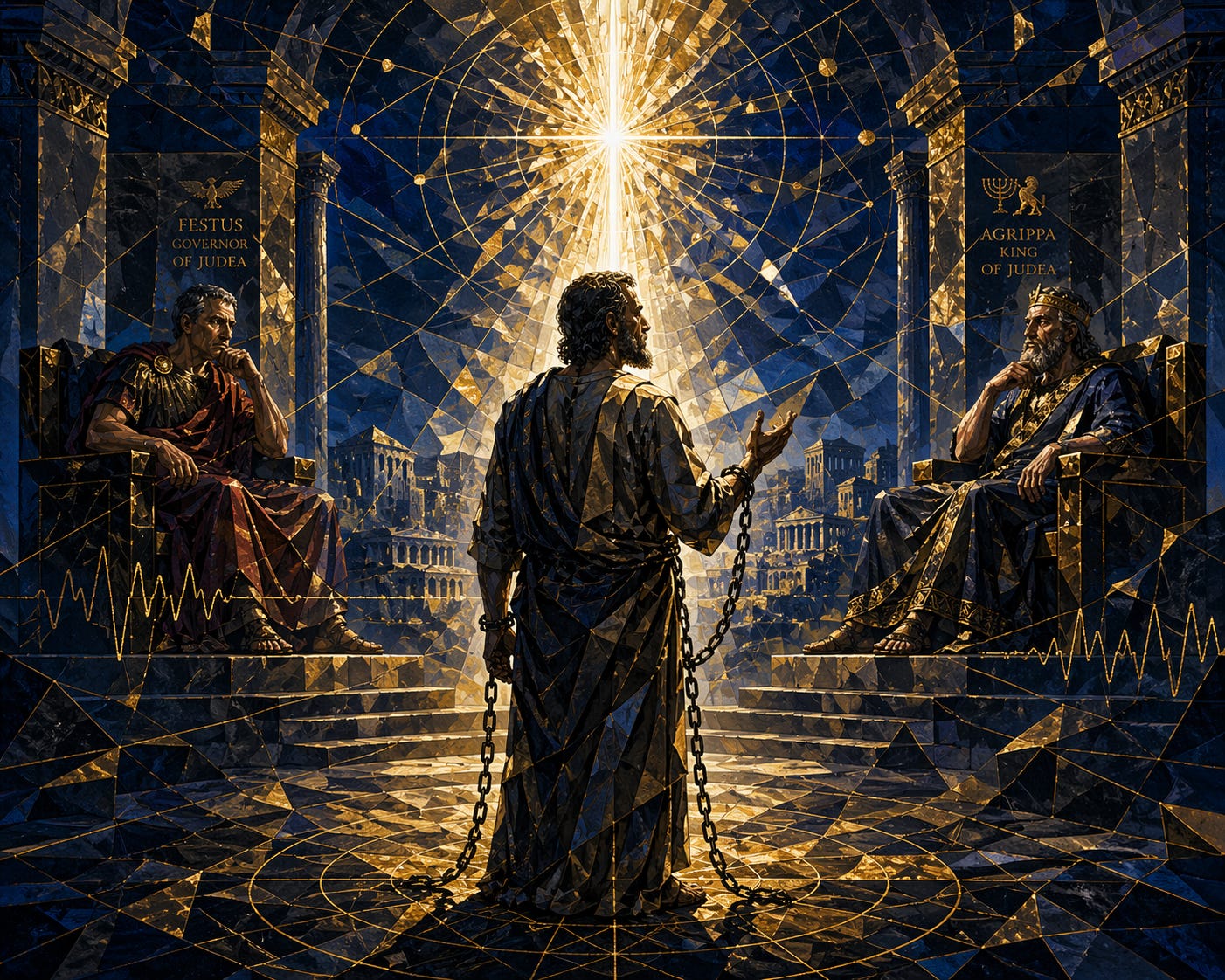
This is the reversal of the Gospel. The cross of prison is not a problem to Paul. It is protection. It is a platform. It is certainty.
Paul understands. That is why he does not begin with defense. He begins with a confession that sounds bizarre.
“I think myself happy.”
He is in chains.
But he is not a man deluding himself, nor a man numbing his pain. He is one who has been placed, precisely and immovably, under the hand of God.
He is not talking about emotional elation. Paul is not happy because the circumstances are pleasant. He is happy because the coordinates are correct. This is Makarios. Blessedness. The state of standing where you are supposed to stand.
The court is filled with power.’
Festus, the Roman governor, carries the cold logic of empire. He needs charges, not theology. Stability, not truth. His world is iron, roads, taxes, order. Resurrection does not compute. It threatens the system’s assumptions.
Agrippa, by contrast, knows the language. He is fluent in the Law, the Prophets, the hope of Israel. He is a king in name, a scholar in practice, and a captive of his own political reality. He understands what Paul is saying. That is why Paul addresses him directly. Not to win a case, but to press a conscience.
Paul exposes the fault line.
One man rejects the possibility of resurrection outright. The other recognizes its plausibility but cannot yield to it. Between them stands a prisoner who claims to be free in chains.
To understand that freedom, Paul takes us backward. Before he was a witness, he was a weapon. He names it plainly. He was not merely mistaken. He was enraged. He hunted Christians, imprisoned them, forced them to blaspheme, cast votes for their execution. This was not passive error. It was active violence, fueled by a zeal that believed itself righteous.
He was, in his own terms, a Pharisee of Pharisees. A constitutionalist of the Law. Not just obedient, but aggressive in enforcement. Identity defined by boundary. Purity defended by force.
Then came the break.
On the road to Damascus, the world did not gently shift. It collapsed. Light brighter than the sun. Body to the ground. Voice in his own tongue.
“Saul, Saul, why are you persecuting me?”
Not “them”.
Me.
In that moment, categories shattered. The Church is not merely a group. It is a body. To strike the believer is to strike Christ Himself. The persecution was not horizontal. It was vertical.
The line that explains everything follows:
“It is hard for you to kick against the goads.”
The image is agricultural. An ox, resisting the plow, kicking back against the spike that is meant to guide it. The more it resists, the more it wounds itself. Strength turned backward. Effort producing pain.
Paul’s entire former life is named in that sentence. He was not advancing righteousness. He was fighting the direction of God. Every act of violence was a deeper wound. The Law was not failing. It was driving. And when it finally broke him, the Gospel did not negotiate.
It commissioned.
“Rise. Stand on your feet.”
Not crawl away. Not hide. Not “pay me what you owe.”

Stand.
Then two more words: minister and witness.
A minister is not a strategist. He is an under-rower. A man beneath the deck, pulling the oar assigned to him. Direction comes from above. His strength is not autonomous.
A witness is not an innovator. He does not craft the message. He repeats what he has seen and heard. Accuracy, not creativity, is the task.
Paul loses control of his life in that moment.
He loses it, and he gains it.
From that point forward, everything is reinterpreted through a single axis: he belongs to another Master. That is why chains do not define him. The modern instinct is to locate freedom in the removal of constraints. Remove the chain, then you are free. Solve the problem, then you can be at peace.
Paul’s life is Christ Jesus, the Lord, rejecting that entire framework.
So Paul does not call the chains good. He does not romanticize suffering. He names them plainly. “Except for these chains.” But they are not decisive. They are not his identification. Because the decisive question is not, “What is binding you?” but “Who is governing you?” If the answer is Christ, then the location, even a courtroom, even a prison, becomes secondary.
This is where his happiness comes from.
Not from denial, but from alignment.
This is where Christ said he would be. This is doing what Christ told him to do. This is speaking to the kinds of men Christ said he would face.
The prophecy is unfolding in real time. That produces a form of contentment that does not fluctuate with conditions, as gratitude becomes muscle memory.
This is not sentimental. It is discipline. What you rehearse, you inhabit. If you rehearse grievance, you deepen grievance. If you rehearse fear, you multiply fear. Paul rehearses placement.
“I am here because I was sent.”
That is enough to anchor him. From that anchor, he speaks the core of his message: the hope of the promise. He insists that he is not introducing something new. He is standing in continuity with Israel. The twelve tribes, the sacrifices, the prayers night and day, all of it has been oriented toward one outcome.
Resurrection.
Life overcoming death.
He presses the simplest question in the room. Why should it be thought incredible that God raises the dead? If God exists, resurrection is not the strange claim. It is the expected one.
This is where Festus breaks. “Paul, you are out of your mind.”
To a world built on material continuity, death is the final boundary. To speak of resurrection is to violate the rules. It sounds like madness. Paul does not escalate. He does not defend himself emotionally.
“I am not mad… but speak the words of truth and reason.”
He remains calm because his identity is not under threat. The verdict of the court cannot overturn the verdict of heaven. Then he turns again to Agrippa.
“Do you believe the prophets?”
He does not ask for a philosophical concession. He asks for consistency. If you believe the texts, then you must face their conclusion.
Agrippa answers with a most revealing line. “Almost you persuade me.”
Almost.
He is caught. Intellectually aware. Existentially unwilling. The cost of belief is too high. The system he inhabits cannot absorb the confession. So he remains in the threshold.
And Paul, still in chains, declares his desire: “I would to God [that you did!]”
“I would to God that not only you, but also all who hear me today, might become both almost and altogether such as I am—except for these chains.”
It is the paradox. The man bound in iron invites the free men to become like him. Because he knows something they do not. Freedom is not the absence of chains. It is the presence of the right Master.
The trial ends with a legal conclusion. No crime. Nothing deserving death or imprisonment. The system itself declares him innocent. And yet the chains remain. Not because justice failed, but because the mission continues. Rome is still ahead.
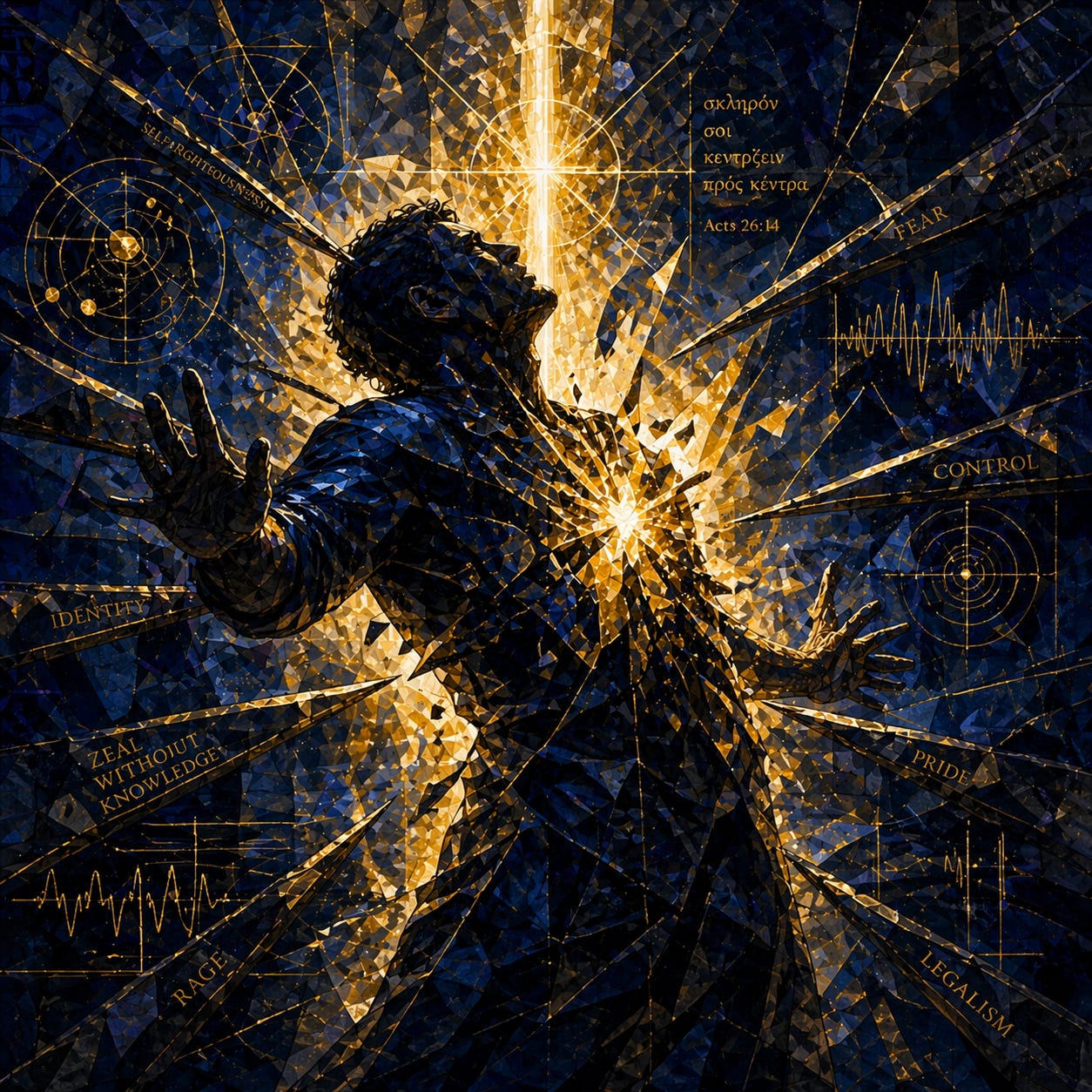
The lesson is not subtle.
You will not always be released from the conditions you would choose to escape. The chain may stay. The pressure may remain. The setting may not change. But the axis has already shifted. You are already moved from darkness to light. From one power to another. From self-governance to Christ’s lordship. That transfer does not wait for ideal circumstances. It is declared.
It is already a given.
Stay in the fire. That is where the holiness forms.
Clarity without ease. Peace without resolution. Happiness without escape.
Not because the world has improved, but because you are in the right place. Exactly where God put you.
Upright.

Inspiring to say the least. Glad I stopped in this morning.