

At 03:00 GMT on Thanksgiving Day, the global derivatives engine shut down.
Not from hacking. Not from a liquidity break. Not from regulatory shock.
It froze because the silicon got too hot.
The failure was thermodynamic: a single cooling-system failure at an Illinois data center leased by the CME Group took down the core machinery that prices the modern world: Treasury futures, crude, precious metals, equities, currencies, agricultural contracts. (As if that isn’t enough spice on its own, CME had sold this data center in 2016 for ~$130M, then leased it back; they did not own or control the infrastructure when the failure occurred, meaning recovery required outside technicians. CME waited—just like every other participant in the global market—on an exclusively American holiday.)
This sent shockwaves through global derivatives as the machines failed to reject the heat produced by their own computation. The system hit a physical boundary, not a financial one. The machine faltered because the denominator is testing its load limit. (Think: numerator = asset prices where the denominator = the currency base.)
AI computational load has been rising faster than the infrastructure that carries it, workloads now growing at 30% annually. AI doesn’t merely compete for electricity—it multiplies controlled burn across every rack in every data hall. Every watt becomes heat. Every server must live inside that heat. And the global financial engine—still built largely on 2015 infrastructure—cannot bear 2025 demand.
On Turkey Day, the pipes broke at the point of greatest strain.
This demonstrates how post-AI liquidity itself now depends as much on cooling capacity as on hot gaming chips. As Wall Street hooks itself to the hot bubble of the NVIDIA temple, global markets now depend on cooling capacity. The tools that are inflating the AI bull run are the same toys that push the boys’ Origins toward thermal saturation while dungeon running.
Price discovery for everything except gold and land depends on thermal regulation technology. Even and especially the paper fiat “economy” depends on the physics of silicon itself.

WEEKLY ASSET ANALYSIS
Bitcoin: The CME freeze revealed that Bitcoin is only as fragile as fiat’s digital machinery to discover its price. While BTC’s volatility preceded the event, it is the pile-on game wrestling with denominator instability that waged an under-the-hood attack on its recent highs. Compared to its value one year ago, Bitcoin continues to demonstrate that scarcity is the true asset class that fiat cannot compete with.
XRP: The political pivot is unmistakable for those watching the long game. With Treasury leadership removing regulatory barriers, the settlement layer is being positioned as the official alternative to legacy rails. Ripple remains the velocity layer targeted in late 2020, and (“they” say) prepared to operate beyond the constraints of legacy market plumbing.
Gold: Gold is the head of the statue—precise, ancient, sovereign. Motionless in the storm. Price this week did not react, in part because it does not rely on computation, liquidity windows, or global permission. Gold ever proves that until water, bullets, cigarettes, and caps become the real-world value assets, the Lindy memory of civilization outperforms the output of our modern algorithms.
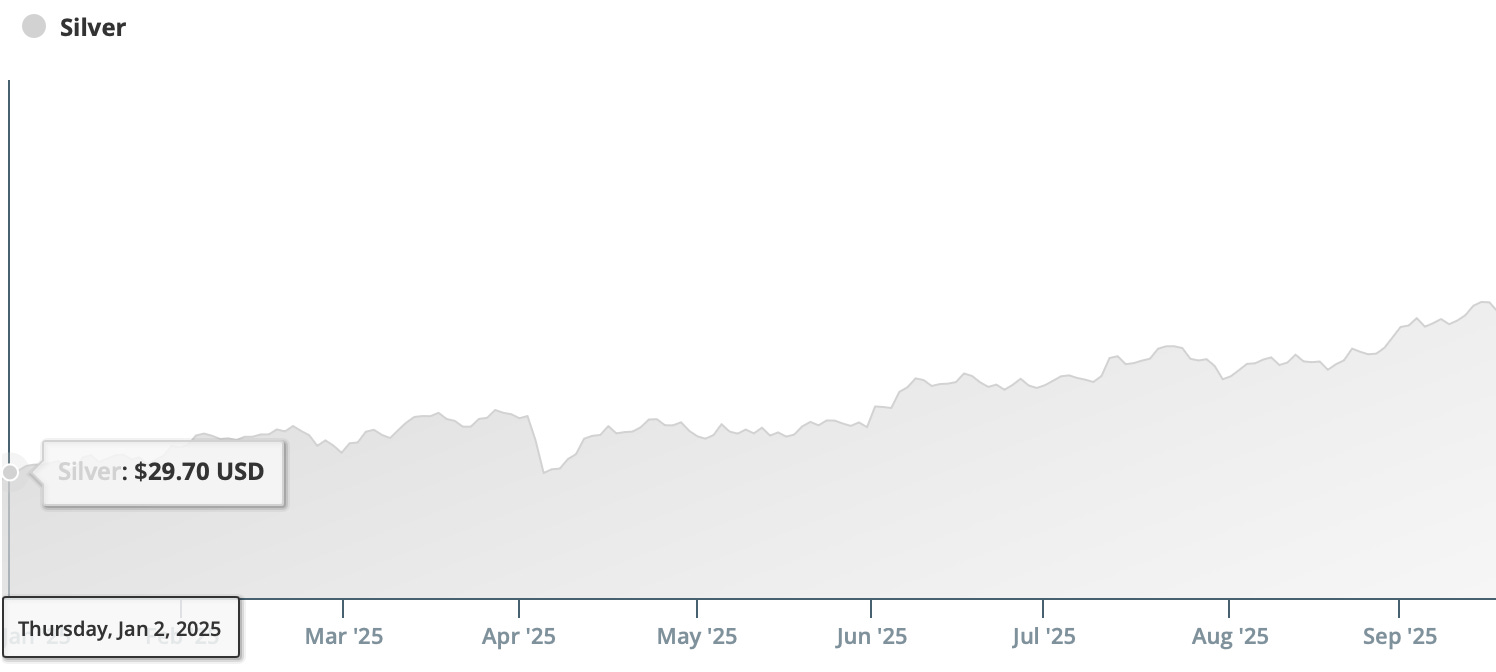
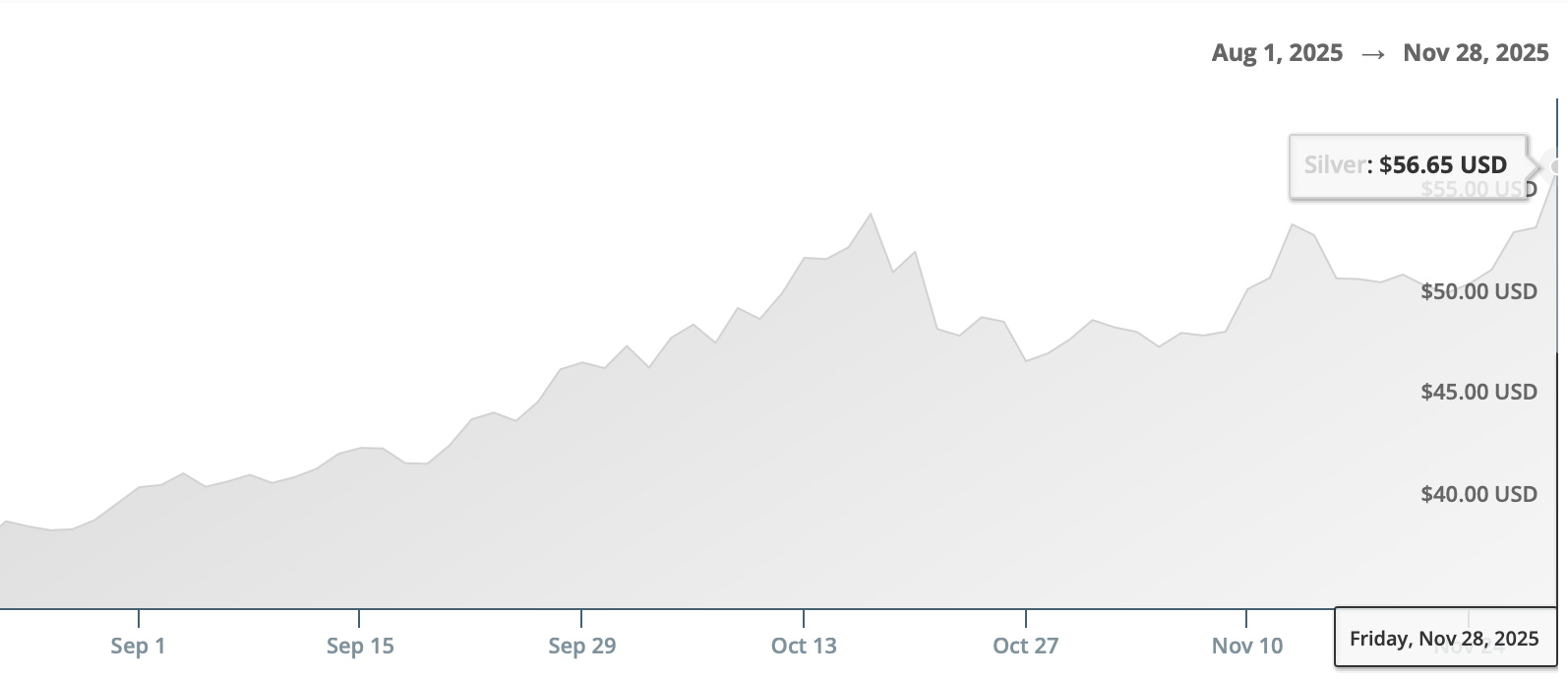
Silver: Silver spoke clearly. After decades of compression beneath the 1980 and 2011 ceilings and hitting a new all-time hight at $54.34 mid-October, silver broke into the open Friday, clearing $56/oz for the first time ever. This week saw a retrace into the low $50s, but that pullback comes after this year’s radical breakout, not instead of it. Silver has already printed the signal. The metal has crossed the boundary; the denominator is the part that’s slipping.
Copper/Nickel: Nickel remains the most honest low-denomination witness in the monetary ecosystem: a true coin worth six cents on the fiver if you’re ever allowed to melt them down without federal penalties—like prison.
Stablecoins: When CME halted, stablecoins did their job. The microband stayed narrow, revealing the true nature of USD liquidity. The digital dollar—outside the banking system, outside derivatives—functioned while the core legacy engine froze. Stablecoins are now the operational center of the USD.
Land: Land continues unaffected by computational failures. It remains the glacial denominator: immune to thermal ceilings, immune to systemic panic, immune to policy whiplash. The interior regions maintain upward pressure as America’s covenantal collateral.
THE GEOMETRY
The week resolves into a three-part structure: the thermal failure itself, the liquidity’s response to that failure, and the reaction of scarce assets to the deeper truth exposed:
Macro Catalyst: A Thermodynamic Failure: The global market halted because physical infrastructure could not manage the heat of modern liquidity. This is the first failure of its kind in the digital financial era, a small black swan to keep an eye on.
Liquidity Response: Scarce Assets Signal the Fracture: Bitcoin pulsed upward. Silver shattered its historical cage. Gold held its sovereign line. Stablecoins maintained the USD heartbeat. This is liquidity acknowledging physical fragility.
Scarce-Asset Reaction: Numerator Truth in a Denominator Crisis: When the denominator fails, the numerator reveals reality. Silver. Bitcoin. Gold. Land. These are as “real” as the epoch gets.
They do not scream—they testify.
But to understand what I’m getting at, let’s consider the shape of this moment. Along with Solomon’s Proverbs and our Lord’s view of charity, the Kingdom Capital Report bases the read on five governing lenses: Ray Dalio’s work, Roy Williams’ considerations in Pendulum, the historic relationships found in Precious Metals, the mathematical honesty built into original Crypto, and Land. Each lens explains a different portion of the fracture:
1. Dalio — The Debt-Cycle Exhaustion Frame: Ray Dalio’s long-term debt-cycle model teaches that economies do not collapse because of one shock; they collapse because they reach the end of a multi-decade credit expansion.
Debt saturates the system. Interest expenses consume growth. Liquidity must be injected simply to preserve yesterday’s structures. When the system reaches this exhaustion point, small disturbances reveal the whole weakness.
The CME thermal failure is such a disturbance. It didn’t cause the instability—it exposed it. The machine was already overloaded. The heat simply made that visible.
2. Pendulum — Peak Collectivist Instability: The Pendulum cycle positions our cultural moment at the apex of a “We” era: narrative enforcement, institutional overreach, fear-driven conformity, centralization of authority.
At the peak of collectivism, systems become brittle. Large structures depend on universal belief, not functional resilience. When the CME engine overheated, the system had no slack—because “We-peak” cultures trust structure more than margins. The moment something breaks, everything pauses.
3. Metals — The Ancient Witnesses Rising: Gold and silver are not assets; they are civilizational instruments. When fiat weakens, metals awaken.
Silver’s breakout above its 1980 and 2011 ceilings—both previous peaks of fiat stress—shows that the ancient witnesses are speaking. Metals rise when the denominator decays. They testify to truth beyond computation, beyond derivatives, beyond policy, beyond narrative.
4. Crypto — Ledger Truth Outpacing Machinery: Bitcoin and Ripple represent two sides of the emerging ledger era: Bitcoin = scarcity numerator; Ripple = settlement velocity gamble/sure-thing (depending on which global insider you’re talking to.)
Both operate outside the overheating machinery of the old system. When the CME servers froze, Bitcoin did not. When derivatives halted, ledgers moved. Crypto showed that truth on a ledger can outpace truth in a data center.
This week’s signal is simple: the computational rails of fiat are now more fragile than the cryptographic rails of scarcity and settlement.
5. Land — Covenant Scarcity Unmoved by Digital Collapse
Land does not care about silicon. Land does not care about derivatives. Land does not care about liquidity windows, ETFs, or server racks. Land is the original denominator—covenantal, geographic, immovable.
While the machine overheated and the digital layers flickered, land continued its slow ascent, untouched. This is the most important truth for any reader: the world of atoms is stable; the world of harnessed electrons is not.

Taken together, these five lenses reveal the whole architecture of the week: Dalio shows the cycle is at its terminal stage. Pendulum shows culture is at its brittle apex. Metals show fiat decay is no longer masked. Crypto shows ledger truth is strengthening while infrastructure weakens. Land shows God’s scarcity remains the one denominator that cannot crash.
The geometry in brief: the new machine overheated, and the ancient truths stood firm.
The work of our hands has its limits. The denominator of modern “currency” did not wobble because of rates, debt, or politics. It faltered because the hardware running fiat reached its thermal ceiling. This is an excellent symbol of the times: a global system overclocking the engine will need excellent pit teams.
Kingdom Take Away
The Scriptures spoke this whole story long before the silicon proved it: dishonest scales destroy themselves. The poor suffered inflation whenever the elite hollow out the base.
“The borrower is slave to the lender.” — Proverbs 22:7
This does not tell you what to buy, sell, or hold. Kingdom Capital is not about investment strategies. It is reading the architecture of a faithful life:
No one can see tomorrow’s prices, and no earthly market can guarantee safety. Bigger barns will not protect you. But Wisdom is older than trading screens, and the Scriptures have proven for millennia that the stewardship of life, time, and treasure is rooted in trust, not works.
The Week’s Officials and Review
Bitcoin ≈ $91,324: Bitcoin’s volatility widened during the CME freeze, not because Bitcoin changed, but because fiat’s discovery engine seized.
Ripple ≈ $2.20: Ripple held steady through the week. Treasury signals from Washington showed a clear pivot: regulatory barriers against crypto removal are now policy statements, not speculation. Settlement-layer assets respond to this posture with quiet, deliberate firmness.
Gold ≈ $387.88: Gold remained in sovereign stillness. It neither surged nor slipped. This is the behavior of civilizational memory.
Silver ≈ $51.21: Silver is down from its historic high of $55/oz. This remains the clearest metallic testament to structural strain.
Copper ≈ $11,004/tonne / Nickel ≈ $14,660/tonne: Copper and nickel showed divergence. Copper held its muted industrial curve; global demand is uneven. Nickel continued to demonstrate melt-value pressure beneath the fiat veneer, exposing the truth that physical coinage retains more honesty than the currency that claims to measure it.
Stablecoins keep the pulse of the system—but they do not testify to the strength of the dollar, only to the strength of the plumbing that carries it. The USDT/USDC microband did not break during the CME outage; as up to 90% of global derivatives froze for the holiday, the synthetic dollar held its peg to the “true” paper-fiat. This does not prove that the dollar is sound (3% inflation on average is not a good “long hold,” no matter what Warren Buffet’s short-term strategy may imply.)
Land continued its slow, covenantal ascent, with a mild rise over the quarter, the expected long arc upward intact and the barometric pressure of quiet consolidation holding as big investment continues to sink excess cash into homes the average man can no longer afford to buy.
• The Midwest and Plains remain stable with soft upward drift.
• The Rust Belt shows compression under demographic fatigue.
• Coastal markets fluctuate with policy turbulence.
• Interior regions continue to strengthen as long-horizon havens.
Do not lay up treasures on earth, where moth and rust destroy… but lay up treasures in heaven…. Seek first the kingdom of God and His righteousness, and all these things will be added to you.
Seek first the kingdom of God and all His righteousness. All thanks glory and honor be to God. Amen. God's peace be with you. Amen.