

The mind of Christ is not a religious mood. It is not a moral technique. It is not the art of being nicer than the pagans while privately remaining terrified of death, judgment, and failure.
The mind of Christ is a new sight.
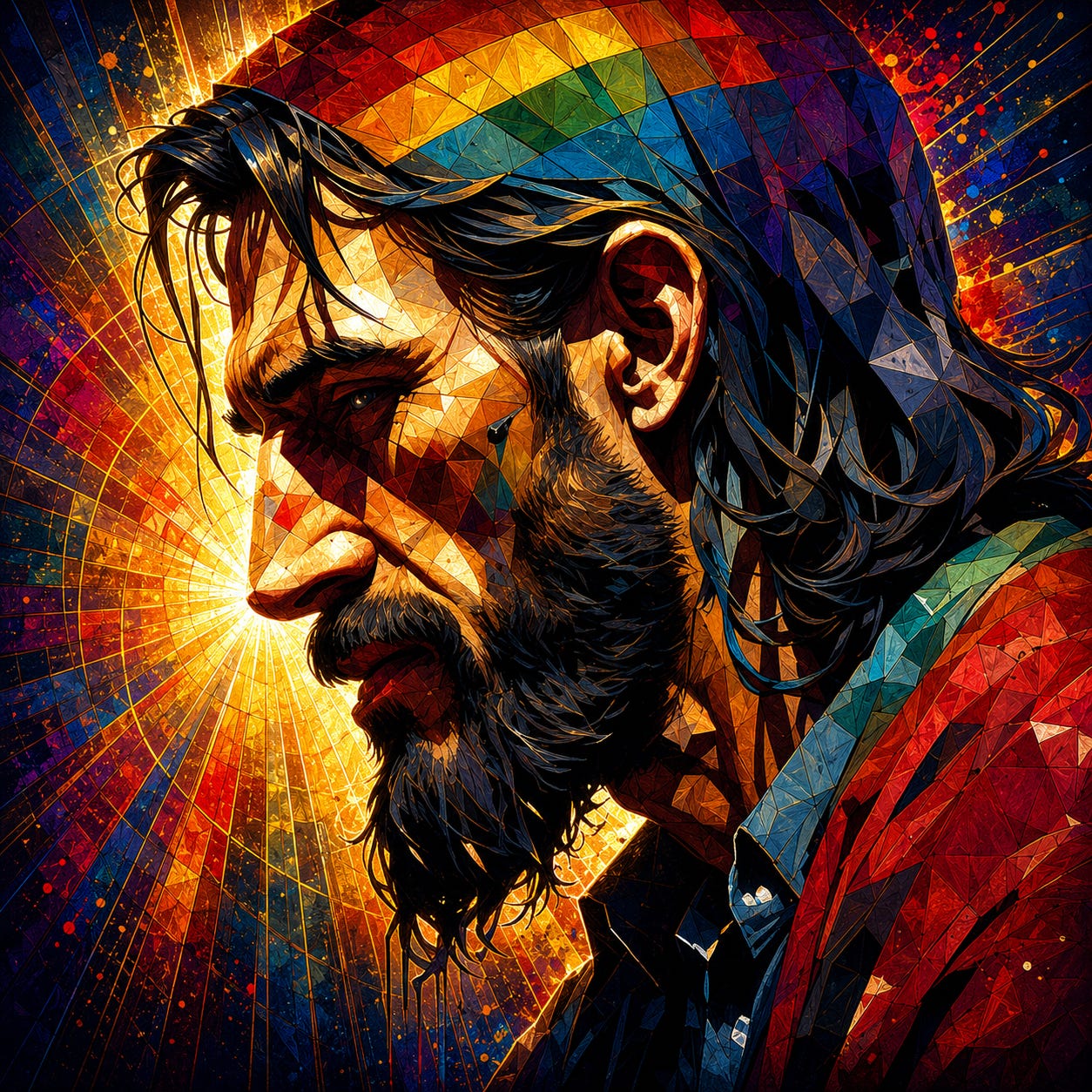
To know Jesus is to see the Father. To know what Christ has done is to know what God thinks of sinners who cannot save themselves. The mind of God enters you when the old labor collapses, the verdict is spoken, and your soul hears the declaration it could never manufacture: you are free.
That declaration does not merely adjust the score. It restores the image. Holiness, innocence, and blessedness are not prizes at the end of your spiritual résumé. They are the gift of God in Christ, received by faith, then ground into the mind by the Scriptures until they become sight, thought, instinct, patience, courage, and joy.
This is why Paul can write to the Philippians with such ferocity and such tenderness. He is not offering a devotional slogan. He is dividing the world.
There is no third kingdom.
On one side stands confidence in the flesh. On the other stands rejoicing in Christ.
To have the mind of Christ is to learn this division, live inside it, and finally stop mistaking your own hands for your salvation.
“Rejoice in the Lord.” Paul says it again because it is safe to say.
The repetition is not filler. It is fortification. Joy is not first a feeling. Joy is command, discipline, allegiance, and confession. Happiness may come and go according to sleep, weather, money, conflict, grief, health, and the latest blow from Babylon. Rejoicing is deeper.
Rejoicing says, “Jesus Christ is risen,” even when the flesh trembles. Rejoicing says, “Alleluia,” not because the devil has stopped throwing stones, but because no stone thrown against the risen Christ has any impact.
Joy is contentment, but not passivity.
Contentment is not resignation to evil. It is the settled knowledge that, in Jesus Christ, you are where you are supposed to be because He is with you there.
The comfort is not that pain has vanished. The comfort is that the Lord has called you alongside Himself. You are not abandoned in the trial. You are not being consumed by wrath. You are being conformed to His death, and therefore aimed at His resurrection.
That is the apostolic architecture of joy.
Then Paul turns and says, “Beware.”
Beware of dogs. Beware of evil workers. Beware of the mutilation.
The language is hard because the threat is hard. Works based religion is not a harmless mistake. It is violence against the soul. It tells the old Adam what he most wants to hear: that he can still save himself if he just finds the right badge, the right tribe, the right cause, the right ritual, the right discipline, the right suffering, the right public identity, the right moral superiority.
There is always one more thing to prove. One more credential. One more achievement. One more reason to despise the man beside you.
That is the mind of the dog: hunger.
Paul is not warning only against ancient circumcision parties. He is warning against every form of human confidence that dares to stand before God and say, “Look what I have built.”
Conservative pride can do this. Progressive pride can do this. Religious traditionalism can do this. Revolutionary politics can do this. Family pedigree can do this. Academic rank can do this. Personal zeal can do this. Moral blamelessness can do this. Even suffering can do this when a man turns pain into a throne.

The flesh is not merely the body. The flesh is the whole old project of self salvation: hands, mind, will, tribe, blood, memory, record, and name. It is man trying to become righteous by possessing evidence of his own worth.
Paul had the evidence.
Circumcised the eighth day. Of Israel. Of Benjamin. A Hebrew of Hebrews. According to the law, a Pharisee. According to zeal, a persecutor of the church. According to righteousness under the law, blameless.
He was not a careless pagan looking for meaning. He was a religious master. He had bloodline, discipline, education, zeal, history, and a visible righteousness that could survive inspection. If flesh could save, Saul of Tarsus would have needed no Savior.
Then Jesus Christ found him.
After that, Paul looked at the entire treasure chest and called it loss. More than loss. Rubbish. Not because the Law was evil. Not because Israel was nothing. Not because discipline, heritage, and obedience are worthless in their proper place.
But because none of them can be your righteousness before God.
This is the great exchange. Paul loses the self he had built so that he may gain Christ and be found in Him, not having his own righteousness from the law, but the righteousness from God through faith.
Not found in your politics. Not found in your blood. Not found in your productivity. Not found in your trauma. Not found in your ministry. Not found in your repentance as though repentance were a wage.
Found in Him.
Here the mind of Christ is freedom. You do not need to prove more. You do not need to manufacture one more defense. You do not need to make a name for yourself.
The Name has been placed upon you. The verdict has been spoken. The King of Righteousness has gone before you.
Discipline remains, but it is no longer slavery. Good works remain, but they no longer pretend to be your Savior. Zeal remains, but it is purified by mercy. Suffering remains, but it is fellowship with Christ rather than evidence of abandonment. Repentance remains, but it is no longer panic. It is return to home.
This is why Paul presses on.
He has not already attained. But he forgets what lies behind.
That forgetting includes sins, failures, shames, and ruins. It also includes achievements, credentials, victories, and every old badge of superiority. The past cannot be allowed to become the throne. Christ has laid hold of him, and therefore Paul presses toward the goal of the upward call of God in Christ Jesus.
Our citizenship is in heaven, from which we eagerly wait for Jesus Christ. This is not a metaphor for floating away from creation. It is the claim that our true commonwealth, our actual political identity, our final legal standing, our homeland and inheritance, are already secured in the risen King.
That is why earthly mindedness is so deadly. The enemies of the cross have their god in the belly. Appetite rules them. Consumption rules them. Achievement rules them.
Shame becomes glory because the soul enslaved to appetite must eventually praise what destroys it. The end is destruction because flesh can only end where flesh began: dust, hunger, and judgment.
But Jesus Christ will transform our lowly body to be like His glorious body, by the power that enables Him to subdue all things to Himself.
All things means all things.
Your body. Your history. Your grief. Your weakness. Your confusion. Your enemy. Your brother. Your household. Your death. The whole groaning creation. Nothing broken is beyond His authority. Nothing lowly is beneath His notice. Nothing dead is too dead for the Lord of the resurrection.
This is the immortal reality underneath Christian joy.
He has risen. You are paid for. That makes you immortal now.
Not immortal because you cannot suffer.
Not immortal because you cannot die.
Immortal because death no longer owns you.
Immortal because your life is hidden with Christ in God.
Immortal because the body that goes into the grave belongs to the Savior who will raise it.
Immortal because the verdict of the Last Day has already broken into time through the blood and resurrection of Jesus Christ.
This mind must be cultivated.
It must be inwardly digested. Moses, David, the Prophets, the Apostles, Paul, Peter, and the words of Jesus Christ Himself must be ground into the heart until they become a single framework. The Scriptures are not decorative religious material. They are the dictionary of reality. They teach the soul what is true when the world’s machines shriek otherwise.
At times the scroll is bitter. The Word exposes. It cuts. It overturns the old projects. It names flesh as flesh and dung as dung. But what is bitter to the old man becomes honey to faith. What turns the stomach of pride becomes salt and light in the mouth of the forgiven.
This is also the beginning of love.
Self justification cannot truly see the neighbor. It always needs a scapegoat. It must blame, compare, accuse, and defend. But the mind of Christ learns to see others through the mercy by which it has been seen. Heaven is a kingdom of everlasting love, and in that kingdom every brother and sister in Christ will be known in the light of the mercy that saved them.
To press on now is to begin living toward that Day.
Stand fast, then. Not in your résumé. Not in your tribe. Not in your hands. Not in your outrage. Not in your ability to explain yourself.
Stand fast in the Lord.
The dogs will keep barking. Babylon will keep shouting. The belly will keep demanding. The flesh will keep pleading. And at the Name of Jesus, you stand ready to bow.

Thank you Jonathon. Great message.
#1 "IRONICALLY", Trinitarians on one side & (JW & Islam-Muslims) on the other, are two opposite extrems of the SAME EXACT HERESY!!
You cant claim to believe that "I am HE" if you believe Jesus is a different person then God Father because to you Jesus is not HE but "some other different person sent by Him"!?!
There is a big difference between modalisim - one person who is God manifested in three different ways verse three different persons with diffiferent minds, amounts of Knowledge, power & authority over each other.
“WHO” it was (what person) that came “IN THE FLESH”, IS THE DETERMINING FACTOR IN WHAT IT MEANS TO BE “ANT-CHRIST”! Even Islam claims Jesus was the Jewish messiah/Christ who was to come in the flesh) they all deny “WHO” it was (what person) that came (to be the Christ) in the flesh!?!…….
https://allendaves.substack.com/p/children-of-a-lesser-god?utm_source=share&utm_medium=android&r=1xhldx
#2 THE GOSPEL SONG OF MOSES v SONG OF LAMB .....THE WEDDING FEAST .....GET IT?
👉 2 Tim 4: 4... shall turn away their ears from the truth, and shall be TURNED UNTO FABLES.... 8 , shall give me AT THAT DAY: and not to me only, but UNTO ALL THEM also that 👉LOVE HIS APPEARING👈
💣IMPOSSIBLE to love an appearing U deny!?! (context= AD70 2nd comming of "that day")
👉 2 Tim 3:5 Having a form of godliness, but DENYING THE POWER thereof: from such turn away.
Matthew 10:33 But whosoever shall DENY ME before men, him will I also DENY...
https://allendaves.substack.com/p/the-gospel-simultaneous-doom-and?utm_source=share&utm_medium=android&r=1xhldx
#3 ......SALVATION, IT'S NOT FOR EVERYONE & UNTILL YOU DIE FAITHFULL IN CHRIST YOU ARE STILL SUBJECT TO LOSING THAT SALVATION ........
https://allendaves.substack.com/p/most-true-christains-go-to-hell?utm_source=share&utm_medium=android&r=1xhldx
Free will & absolute determinisim are NOT mutually exclusive, counterintuitive, yes but only because humans thinking is backwards from base reality.
a) That which is finite must have some infinity in which to define its limitations witjin…..
b) the finite can never superceed the infinity in which it exist
c) an infinity must be known to itself at all points in space & time such that it is deterministic in its construct no randomness exist
d) The finite is by definition set (s) limitation. Randomness only exist due to lack of knowledge understanding. Free agency is a exercise in limited knowledge, time, space & limited foreknowledge of outcomes or how-why thoes outcomes arrived.
Scripture teaches both because BOTH ARE LOGICAL IMPARITIVES AS WELL AS THE ENTIRE CONSTRUCT OF SOTERIOLOGY ITSELF.
"Ironically" both the calvinist & "free will" people R grossly wrong!!.... absolute determinisim & free will R NOT mutually exclusive logically & bible teaches both equally.
Determinisim & the problem of evil
https://allendaves.substack.com/p/absolute-determinisim-and-the-problem?utm_source=share&utm_medium=android&r=1xhldx