

The modern Church imagines that its survival depends upon institutional sophistication: strategic plans, branding architecture, political maneuvering, demographic targeting, managerial efficiency, therapeutic accessibility. But Acts 2 begins with none of these things. The Church does not emerge from a committee room. It emerges from terror.
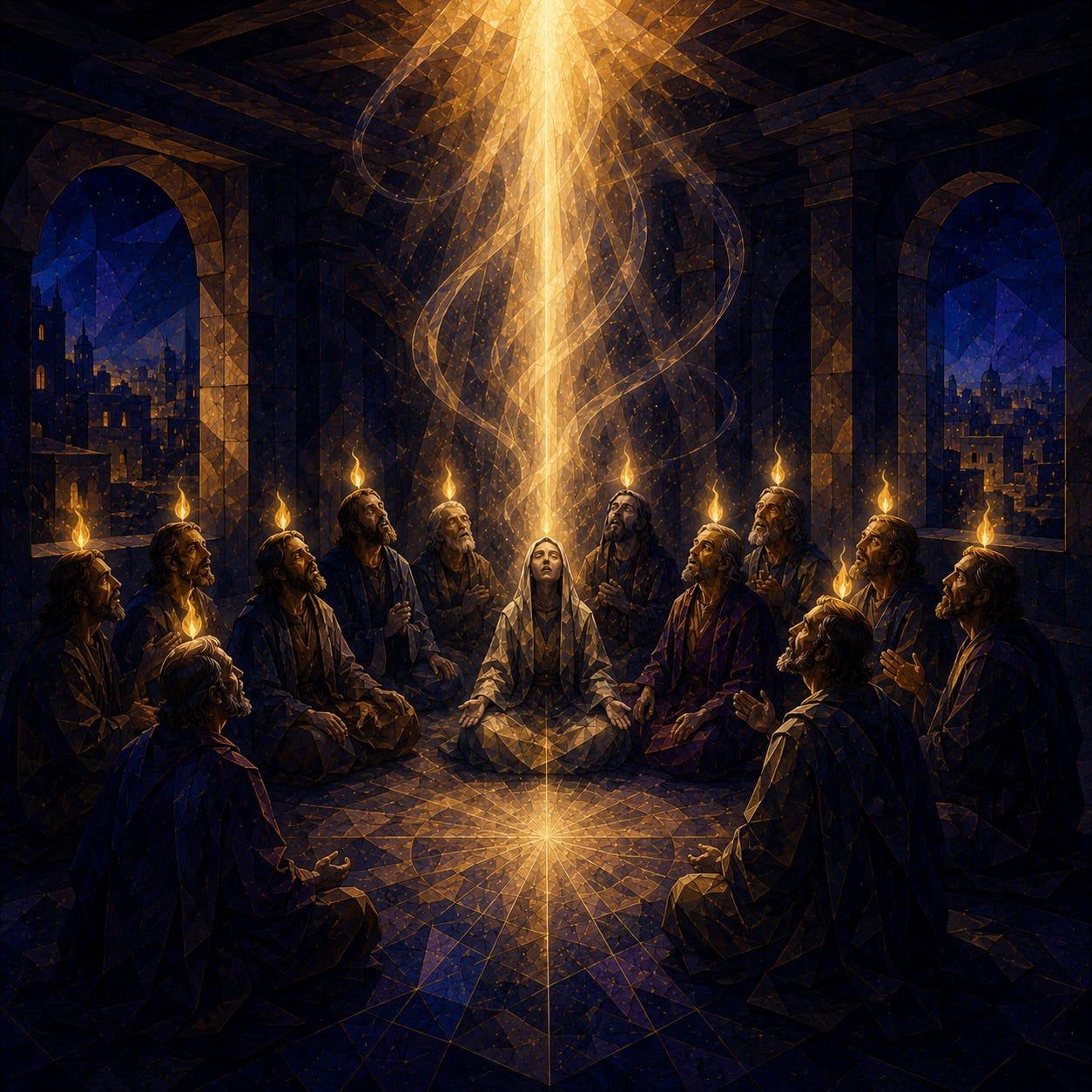
Jerusalem shakes.
The sound is not symbolic sentimentality but atmospheric rupture, a rushing violent wind that transforms a hidden gathering into a public disturbance. Fire appears over human heads. Languages erupt through the mouths of Galilean laborers. Crowds gather because something visible has happened in the real world.
Pentecost is not the founding of a religious nonprofit. It is the invasion of creation by the Spirit of Jesus Christ.
The first Christians were not constructing an institution for self-preservation.
They were seized by proclamation.
Acts 2 confronts nearly every modern instinct about ministry. The apostolic Church did not begin with branding, consensus-building, personality cultivation, bureaucratic scaling, or managerial optimization. It began with the resurrection of Jesus Christ announced into history as a public fact. Everything else flowed downstream from that center.
The Church, therefore, is not first an organization.
It is first a people inhabited by a Word.
Before the wind came, the disciples were already “in one accord.” Modern ears often hear this as emotional harmony or political agreement. But Acts presents something much deeper. Their unity did not emerge from campaigning or negotiated compromise. It emerged from submission to the words already spoken by Christ. They searched the Scriptures together. They prayed the Psalms together. They waited under promise together.
The Church exists as a spiritual reality before it exists as an institutional reality.
The body precedes the bureaucracy.
That is why the selection of Matthias before Pentecost matters so profoundly. The apostles rejected the machinery of human politics. They cast lots because they believed Christ ruled even the outcome,
The modern obsession with procedural control reveals a deeper theological anxiety: we no longer believe Jesus governs His Church. We trust systems because we no longer trust sovereignty.
Acts initiates the opposite assumption. Christ reigns now.
Therefore the Church can wait.
When the Spirit arrives, the miracle immediately centers on language. This too has been badly distorted in modern imagination.
Pentecost is not the celebration of incoherence. It is not ecstatic babble elevated above meaning. The miracle is precisely the opposite. Human speech, fractured at Babel, is miraculously healed for proclamation.
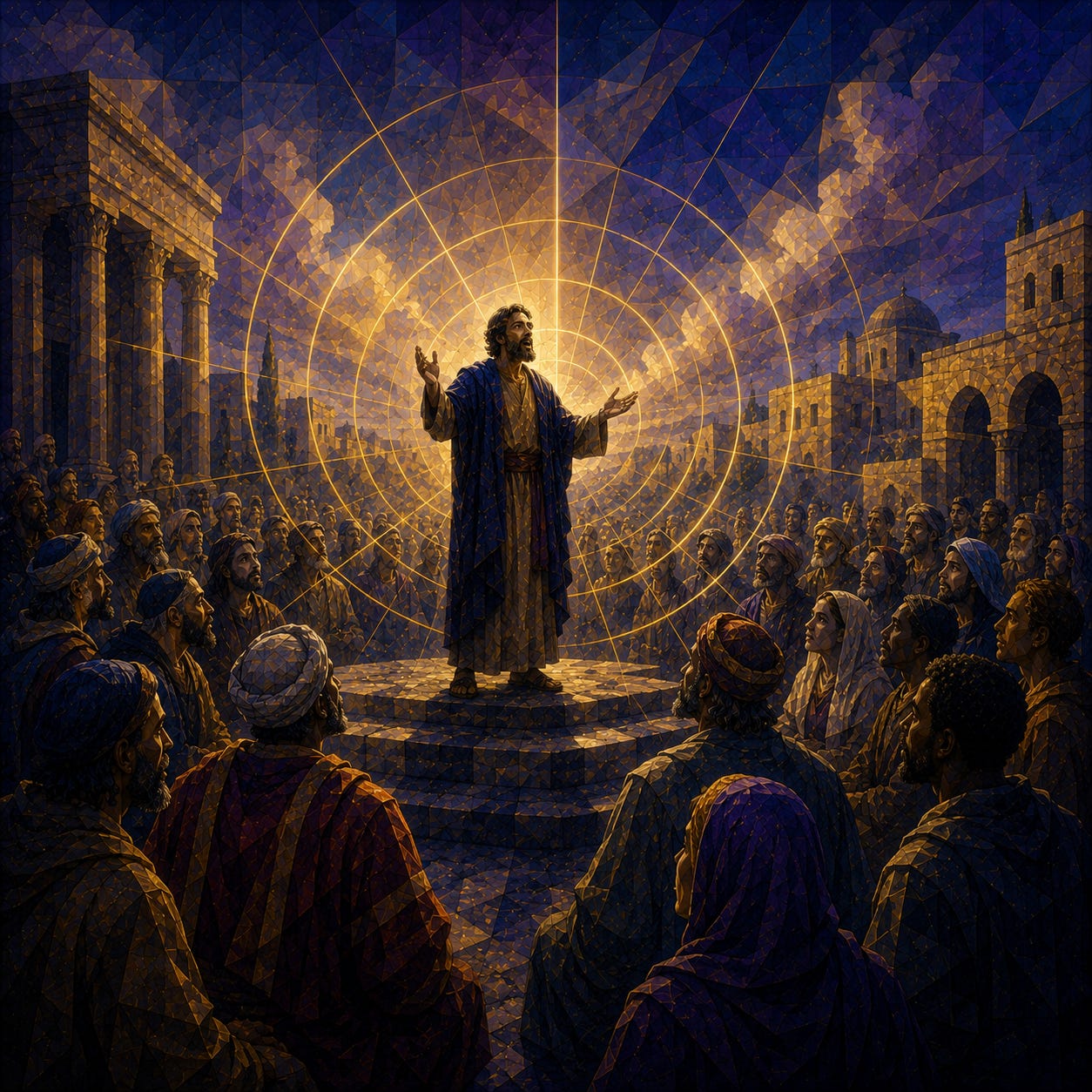
Parthians hear. Medes hear. Elamites hear. Romans hear. Arabs hear.
Not gibberish. Not private emotional release.
Actual language. Ordered speech. Human communication governed by meaning.
The Spirit does not destroy language. He redeems it. This reversal of Babel reveals something fundamental about Christianity itself. The Gospel is not an esoteric mystery cult reserved for insiders. It is announcement. It is declaration. It is witness.
The “wonderful works of God” are spoken publicly into the languages of men. The apostles are not escaping creation.
They are reclaiming it.
The crowd divides immediately between hearers and mockers. This pattern never changes. The Word of God never arrives neutrally. Some hear the works of God. Others hear drunkenness. Revelation simultaneously gathers and judges. The same proclamation that cuts one man to the heart hardens another into scorn.
Peter’s sermon stands directly against the modern reduction of Christianity into therapeutic spirituality. He does not begin with self-improvement techniques, emotional affirmation, or institutional recruitment. He begins with history.
Jesus of Nazareth existed.
You crucified Him.
God raised Him.
We witnessed it.
Everything hinges upon the resurrection.
Peter’s argument through David is devastating precisely because it is concrete. David’s tomb still occupied Jerusalem. His bones remained in the earth. Therefore the Psalms pointing toward incorruption could not terminate in David himself. The patriarch spoke prophetically concerning another Son, one whom death could not contain.
Christianity stands or falls here. If Christ remains dead, the Church is a theater troupe preserving ancient sentiment. If Christ is risen, history itself has changed.
Cosmic regime change.
This is why Peter announces that God has made Jesus both Lord and Christ. The crucified one now reigns above every throne, every empire, every priesthood, every bureaucracy, every spiritual principality, every death mechanism. Pentecost is therefore political in the deepest possible sense. Not partisan. Not electoral.
Earth-shaking.
Caesar still sits in Rome.
The Sanhedrin still functions in Jerusalem.
But another King now rules the world.
The crowd’s response reveals the true function of preaching. They are “cut to the heart.” The Word wounds before it heals because it exposes reality. Their question is not speculative theology but existential desperation: “What shall we do?”
Peter answers with remarkable simplicity.
Repent.
Be baptized.
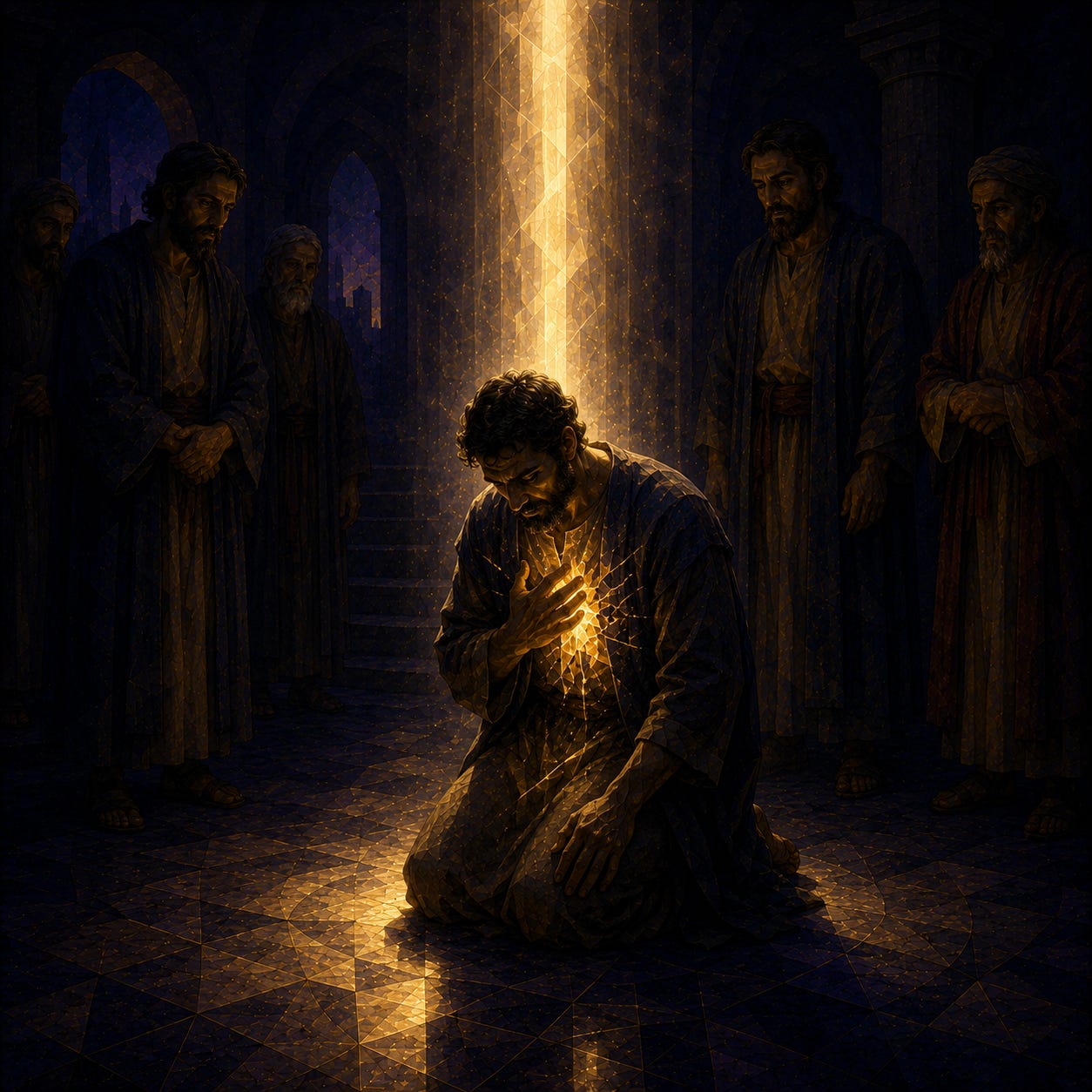
Repentance here is not theatrical self-hatred. It is reorientation. A turning. A change of mind severe enough to alter direction. The Greek concept carries the force of abandoning one interpretive world for another. The listeners must cease interpreting reality through the collapsing order that crucified Christ and instead enter the Kingdom vindicated by resurrection.
Baptism likewise refuses modern reductionism. It is neither magical ritualism nor empty symbolism. It is promise joined to material reality. Water and Word together become the place where the old man is drowned and the new man rises beneath the name of Jesus Christ.
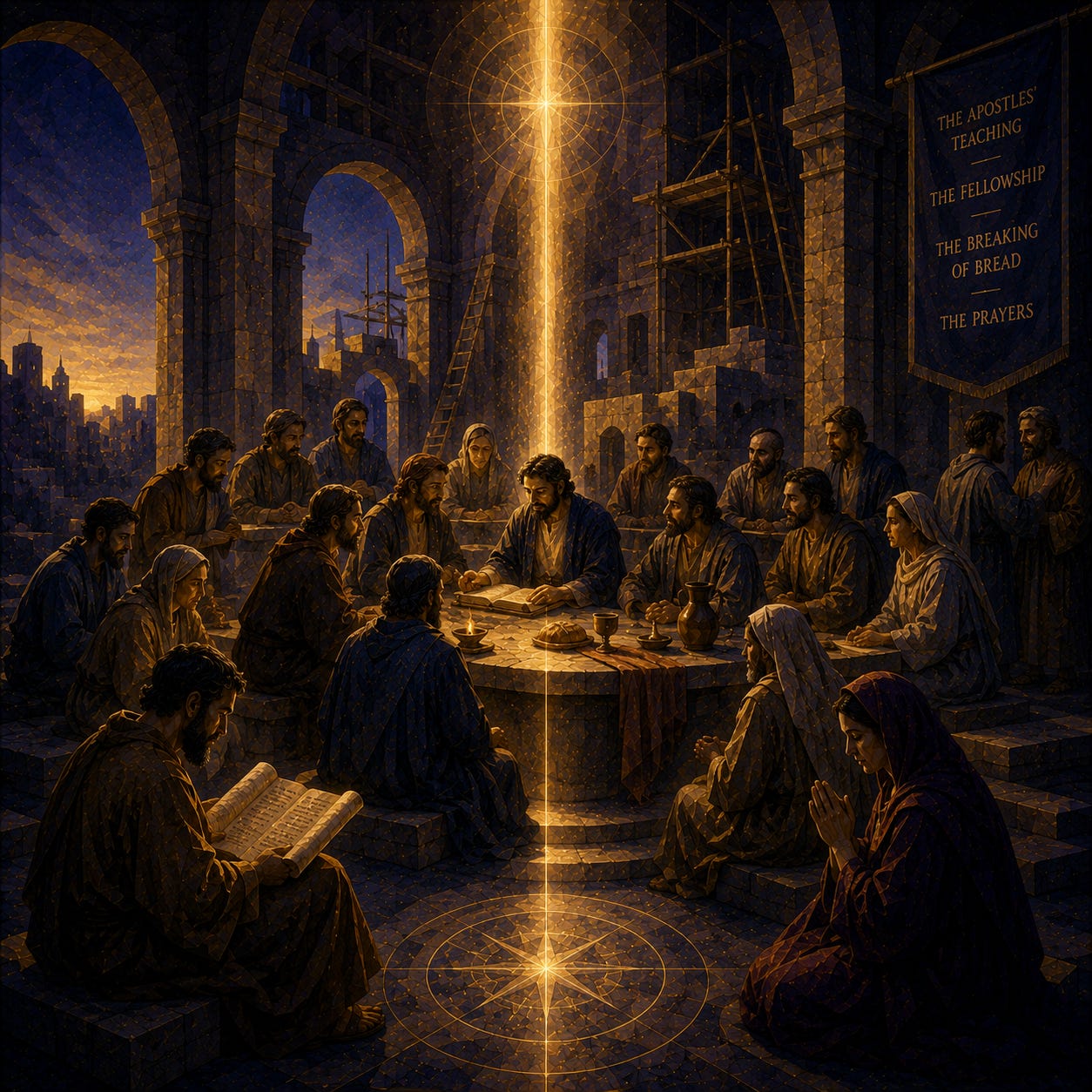
The result is not merely individual conversion but the emergence of an entirely new social organism. Acts 2:42 provides the architecture:
The apostles’ doctrine.
The fellowship.
The breaking of bread.
The prayers.
These are not optional accessories for religious enthusiasts. They are the skeletal structure of Christian civilization itself.
The apostles’ doctrine grounds the Church in a reality outside itself. The faith is received before it is expressed. Christianity is not the endless reinvention of private spirituality but submission to testimony handed down from witnesses.
Fellowship is not networking. It is shared life ordered beneath truth. Mutual consolation and correction become possible because the community is not organized around self-expression but around Christ.
The breaking of bread centers existence upon the resurrected body of Jesus rather than upon consumption, novelty, or appetite. Christianity is profoundly physical because resurrection is physical.
The prayers, especially the Psalter, train human speech away from chaos. The Psalms provide ordered language for grief, rage, joy, fear, repentance, longing, kingship, exile, thanksgiving, warfare, and hope. Modern people often imagine authenticity means emotional improvisation. Scripture teaches the opposite. Fallen man babbles. God teaches humanity how to speak again.
This fourfold life forms a direct counter-culture against what Scripture calls a “perverse generation.” The biblical meaning of perversity is not merely sexual deviance or moral scandal. It is crookedness. Twistedness. Deformation.
Righteousness, by contrast, is straightness.
Acts therefore presents the Church as a people being straightened beneath the reign of the risen Christ while the surrounding world collapses into increasing distortion. The Church does not survive by mirroring the world’s confusion more effectively. It survives by remaining ordered beneath the Word.
This also explains why Acts consistently prioritizes the growth of the Word rather than the growth of the institution. Modern ministries frequently measure success through scale: attendance, budgets, campuses, influence, visibility. Acts measures something stranger. “The Word of God increased.”
The proclamation spreads.
The hearing spreads.
The prayers spread.
The confession spreads.
The institution exists to serve this living amplification. Once the institution begins treating its own survival as primary, it mutates into what many churches eventually become: a legalistic beast feeding upon maintenance, reputation, and procedural control. The apostolic Church possessed structure, but the structure remained subordinate to the living Word.
Peter’s address to the “Men of Judea” is not accidental embarrassment from an unenlightened age. It reflects the order of creation. Scripture consistently distinguishes between equality of worth before God and the obliteration of creational distinctions. Sons and daughters both receive the Spirit. Men and women alike belong to Christ. Yet creation itself remains meaningful rather than infinitely malleable.
The modern world increasingly treats all givenness as oppression: sex, fatherhood, motherhood, inheritance, biological limits, covenant, nation, even creaturehood itself. Acts moves the opposite direction. Redemption restores creation; it does not erase it.
Therefore Christ gives greater external words.
“I forgive you.”
This is not clerical domination. It is mercy.
The modern Church frequently searches for renewal through novelty. Acts directs us elsewhere. The apostolic model is shockingly ordinary once the supernatural center is restored.
The Word proclaimed.
The Scriptures searched.
The Psalms prayed.
The sacraments received.
The resurrection confessed.
The conscience absolved.
The fellowship inhabited.
The nations addressed.
The risen Christ announced.
This is the blueprint.
Not because it produces efficient institutions, but because it produces living witnesses.
Pentecost ultimately reveals that Christianity is not fundamentally a survival strategy for civilization, though civilizations may indeed survive because of it. Christianity is the announcement that death itself has been breached by the resurrected Son of God.
That is why Acts carries such urgency. The apostles believed history had already entered its final age. The world was passing away. Treasure could not save. Empire could not save. Ritual could not save. Human politics could not save.
Only Jesus Christ.
And because He lives, the Church becomes a people who no longer organize themselves around fear of death.
The Word continues to grow because the tomb remains empty.
“I believe that I cannot by my own reason or strength believe in Jesus Christ, my Lord, or come to Him; but the Holy Spirit has called me by the Gospel” - M Luther
Redemption ….very beautifully said
Extremely encouraging. Thank you.