

Mark does not begin gently.
He gives us no manger, no genealogy, no slow introduction, no sentimental family history. He begins with a strike of thunder:
“The beginning of the gospel of Jesus Christ, the Son of God.”
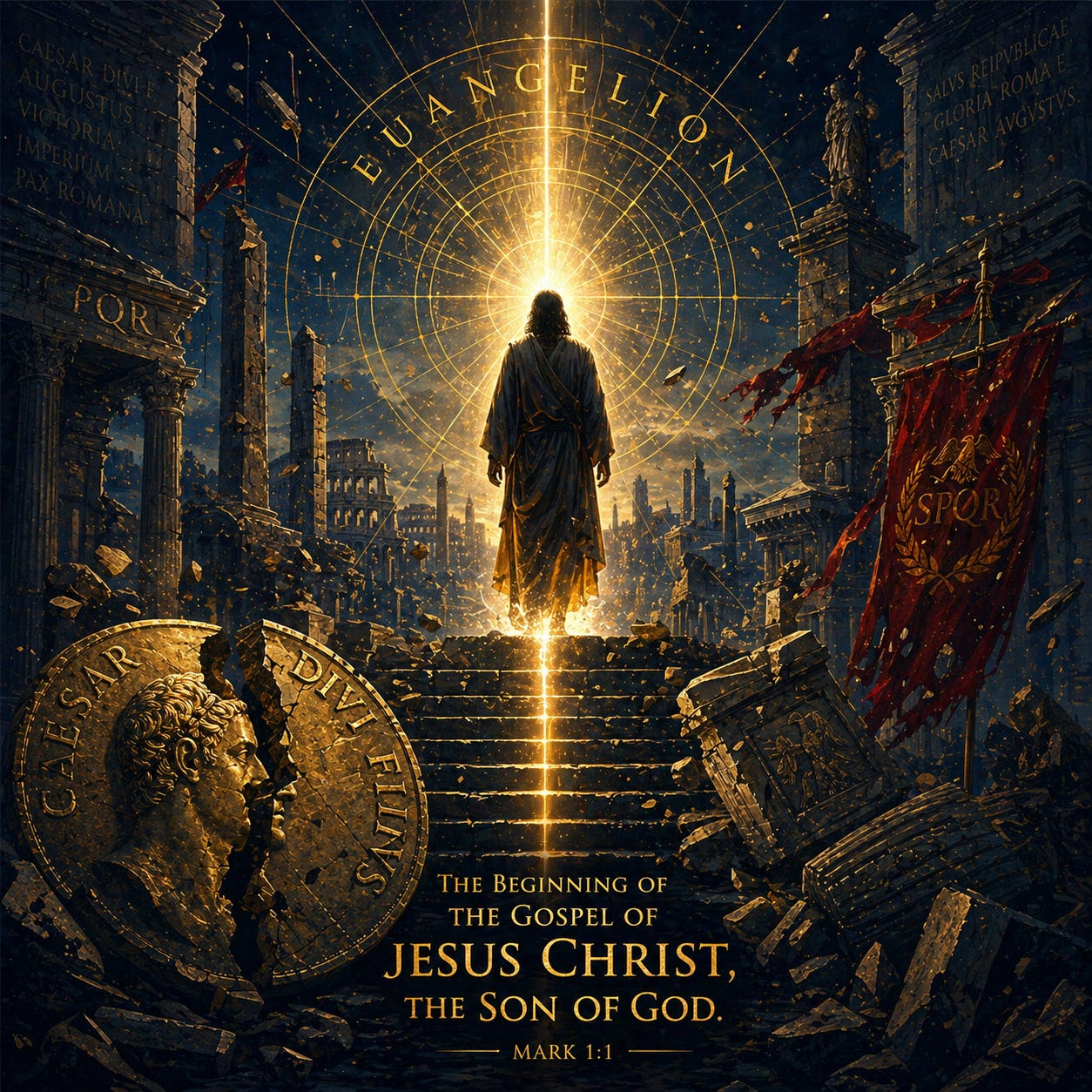
That sentence has been softened by centuries of religious familiarity, but in the first century it was dangerous language. Mark is not opening a private devotional booklet. He is announcing regime change.
Rome had its own gospel.
The empire used euangelion, “good news,” for imperial announcements: the birth of Caesar, the accession of Caesar, the victory of Caesar, the triumph of Caesar. The word belonged to the machinery of power. It was the state broadcast. It was the official announcement that Rome had acted, Rome had conquered, Rome had improved the world.
Mark takes that word and hands it to Jesus Christ.
That is not decoration. That is theft. Holy theft. Linguistic rebellion.
The “good news” is not that Caesar has won another battle. The good news is that Jesus Christ has come. The world is not saved by the throne in Rome. The world is saved by the King from Nazareth.
Rome thought history began again whenever a new emperor took the throne. Mark says no. History begins again with Jesus Christ.
That means the Gospel is not an ornament added to the old world. It is not a religious improvement plan. It is not spiritual advice inside Caesar’s empire. It is the demolition of the old order and the arrival of the true Kingdom.
The empire stamped Caesar’s face onto coins. Mark stamps the title “Son of God” onto Jesus Christ. Augustus claimed Divi Filius, son of the divine. Mark strips the title from the palace and gives it to the Crucified One.
Caesar rules by sword, taxation, spectacle, and fear.
Jesus Christ reigns by the Word, the Spirit, the Cross, and the resurrection.
Mark’s opening is therefore political, cosmic, and deeply personal. If Jesus Christ is King, then every rival sovereignty has already been judged. Rome. Herod. The temple establishment. The idols of the age. The inner tyrannies of habit, fear, appetite, and self-justification.
The regime has fallen.
Now the road must be built.

A New Beginning
Mark’s first word sharpens the claim even further: archē, “beginning.” The echo is unmistakable. Genesis begins, “In the beginning.” Mark begins, “The beginning of the gospel.” This is not merely the start of a book. It is the announcement of a new creation.
The first creation began when God spoke into the darkness. The new creation begins when God speaks His Son into the world.
Mark immediately turns to the prophets. He gathers Exodus, Isaiah, and Malachi into one prophetic chord: “Behold, I send my messenger before your face, who will prepare your way, the voice of one crying in the wilderness: Prepare the way of Jesus Christ; make his paths straight.”
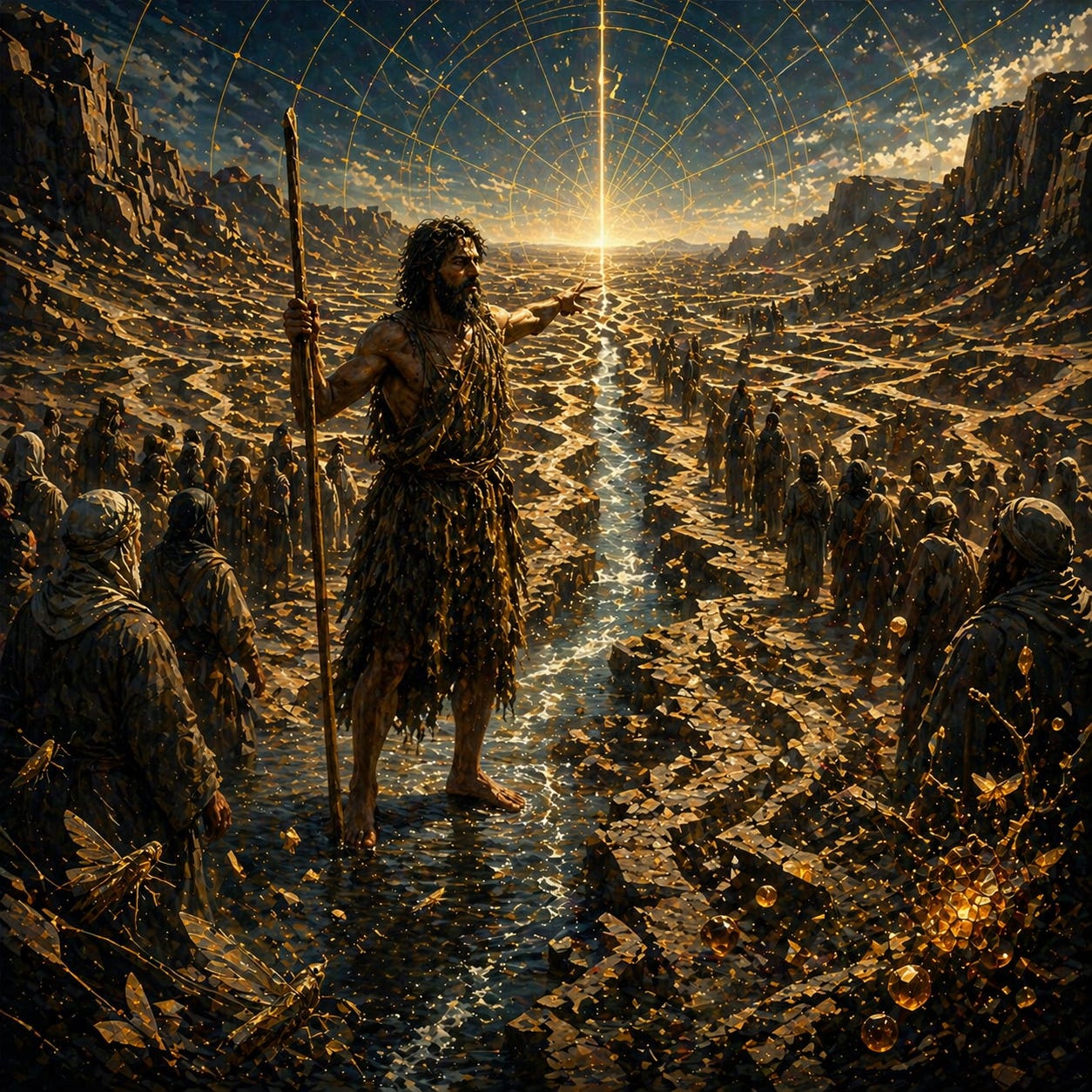
The messenger is John the Baptist. But John is not a random desert preacher. He is the prophetic forerunner, the malakh, the angelos, the messenger sent ahead of the King.
In Exodus, the messenger goes before Israel in the wilderness. In Isaiah, the voice cries out to prepare the way of Jesus Christ. In Malachi, the messenger comes before the Lord Himself. Mark binds these together and tells us what is happening: a new Exodus has begun.
Jesus Christ is leading His people out of bondage.
Not merely out of Egypt. Not merely out of Rome. Out of sin, death, Satan, false worship, false identity, and the circular ruts of the old creation.
The key word is “way.” In Hebrew, derek means road, path, way of life. A path is formed by repeated walking. Step in the same place long enough and the ground hardens. What began as a choice becomes a rut. What began as a rut becomes a road. What began as a road becomes a life.
This is why repentance is not vague religious sadness. Repentance is roadwork.
John does not come saying, “Feel bad.” He comes proclaiming a baptism of repentance for the forgiveness of sins. The Greek word is metanoia: a change of mind, a reorientation of perception. The Hebrew counterpart is shuv: turn back, return.
Repentance means the old road no longer gets to define reality.
It is the moment the traveler sees that his path leads to death. It is the hard mercy of recalculation. Not self-pity. Not theatrical remorse. Not emotional fog. A turn.
Then Comes Confession.
The Greek word homologeō means “to speak the same thing.” Confession means the mouth stops defending the lie and begins agreeing with God. The Hebrew root yadah carries the force of acknowledgment. The sinner no longer runs a public relations campaign for the old self.
He tells the truth.
This is why confession is not groveling. It is alignment. God names sin. The sinner stops renaming it. God exposes the wound. The sinner stops decorating it. God declares the need for mercy. The sinner says amen.
Then Comes Remission.
The Greek word aphesis means release, sending away. It carries the force of liberation. The Hebrew idea of nasa, to lift or carry away, stands behind the great scapegoat image of Leviticus. The guilt is placed on another. The burden is carried away. The weight disappears into the wilderness.
Forgiveness is not God pretending sin did not happen. Forgiveness is God lifting the guilt and sending it away through the One who bears it.
That is why John can only prepare. He can wash with water, but he cannot give the Spirit. He can point to the road, but he cannot be the road. He can preach repentance, but he cannot carry away the sin of the world.
Only Jesus Christ can do that.
John’s whole body preaches.
He wears camel’s hair and a leather belt. That is not costume design. It is Elijah. Second Kings describes Elijah as a hairy man with a leather belt around his waist. John appears in the same prophetic line: wilderness, austerity, confrontation, judgment, and restoration.
He is not dressed for the palace. He is not wrapped in soft linen. He is not eating at Caesar’s table. He is a living protest against luxury, compromise, and religious domestication.
His food is also a sermon.
Locusts carry the memory of judgment. Egypt knew locusts as plague. The prophets knew them as warning. John eats the locust. He consumes the sign of judgment. He internalizes the bitter truth that the old world stands under divine verdict.
But he also eats wild honey. Honey carries the taste of promise: the land flowing with milk and honey, the sweetness of the Word, the goodness of restoration. John’s diet holds both truths together. Judgment is real. Mercy is real. Wrath is coming. The Kingdom is sweeter than the empire.
John eats judgment and promise because his message contains both.
Turn, because the old road ends in death.
Come, because the King has arrived with life.
Then John speaks the sentence that reveals the full hierarchy of the Kingdom: “After me comes he who is mightier than I, the strap of whose sandals I am not worthy to stoop down and untie.”
Untying sandals was slave work. The lowest work. John says he is not worthy even to perform that task for Jesus Christ. The prophet who stands like Elijah, draws crowds into the wilderness, confronts Israel, and announces the new Exodus says he is lower than the lowest servant before the coming King.
John is great because he knows he is not the Christ.
That is the first mark of a true messenger. He disappears into the glory of the One he announces.
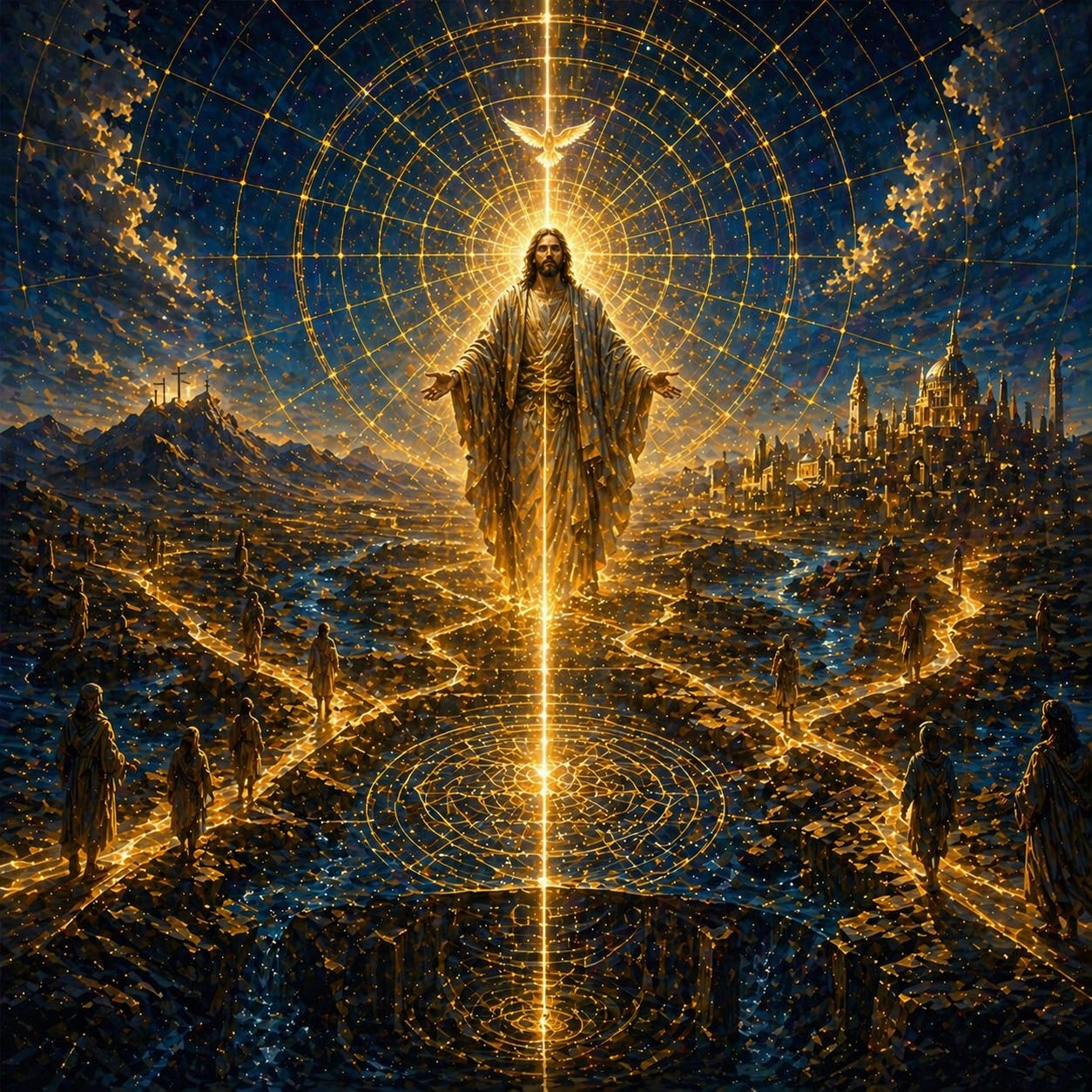
“I have baptized you with water,” John says, “but he will baptize you with the Holy Spirit.”
Water prepares. The Spirit creates.
Water marks repentance. The Spirit gives life.
Water washes the outside. The Spirit raises the dead.
This is the engine of Mark’s Gospel. The same Spirit descends on Jesus Christ. The same Spirit drives Him into the wilderness. The same Spirit speaks through the persecuted when they stand before rulers. The Kingdom does not advance by imperial force. It advances by the breath of God.
Mark’s opening still cuts.
Every age has its Caesars. Every age has its official “good news.” Every age has powers that demand the right to define reality: the state, the market, the algorithm, the mob, the expert class, the therapeutic script, the entertainment machine, the private appetite, the frightened ego. Each one says, “I will tell you what matters. I will tell you who you are. I will tell you what salvation looks like.”
Mark answers with one sentence: “The beginning of the gospel of Jesus Christ, the Son of God.”
The old biography is over. The new creation has begun. The road is open.
The King has come.

Awesome! I used this in Bible Class this morning.