

Some ideas are so obvious that, once not seen, become nearly incapable of being seen again.
Not secret knowledge. Not complicated theories. Not predictions requiring charts, codes, dates, or hidden manuscripts. Just things sitting directly in front of us, waiting for somebody to ask the elementary question, Why not?
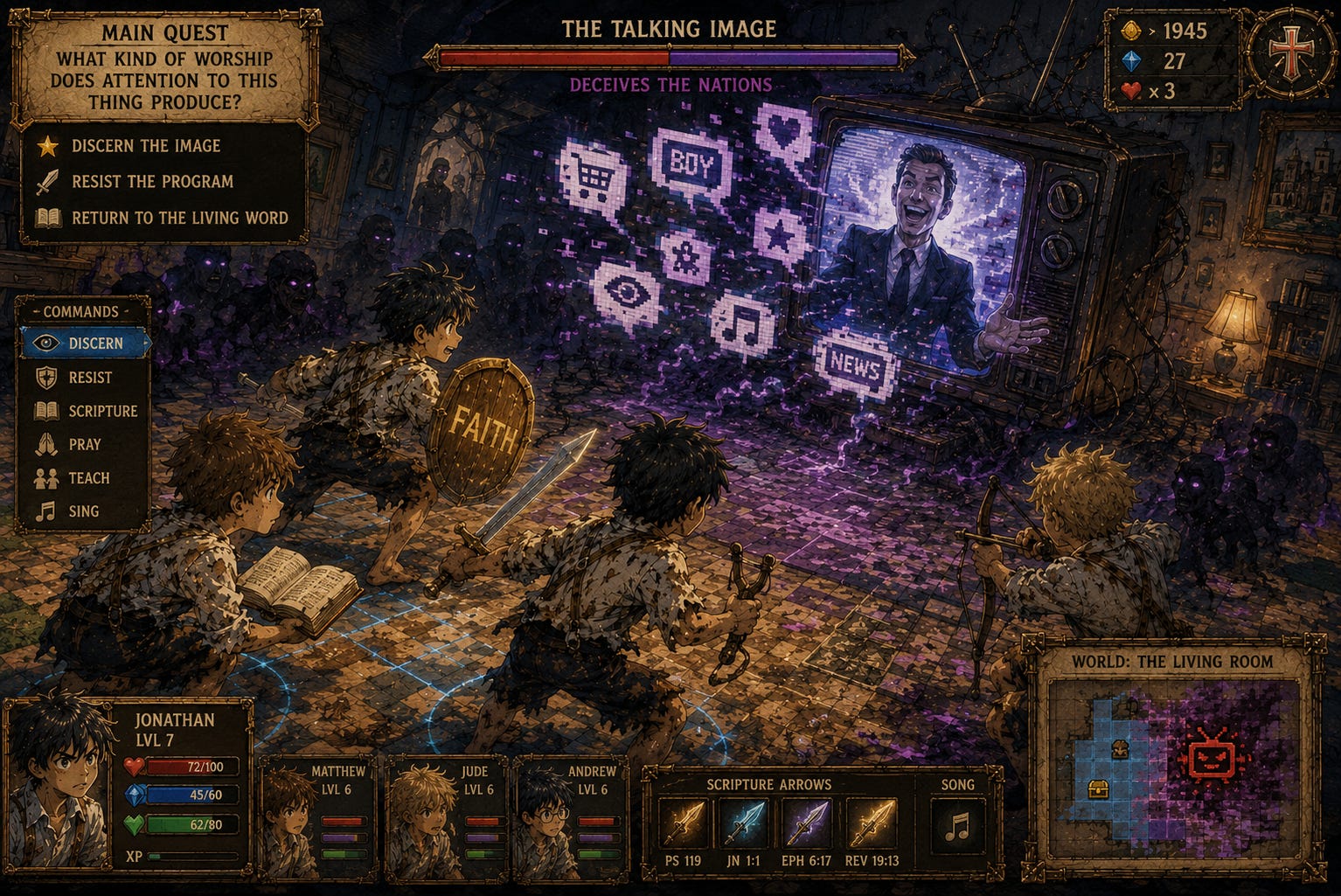
The TV is an image that talks.
It sounds ridiculous. But the talking images are so ubiquitous now that we no longer possess the mental category necessary to be surprised by them.
For nearly two thousand years, Christians possessed a book warning them that near the end of time an image would be made to speak in order to deceive the nations (and even the elect, “if that were possible”). It would exercise extraordinary, persuasive power, performing wonders that all mankind could see, and compelling communal-spiritual participation in a system of sheer and blasphemous human allegiance.
Then, the twentieth century installed talking images in nearly every home in the Western world and the Christians just… watched.
Wait. What?
No one argued about it. No one brought it up. No one even noticed.
Iconoclasm is not the Answer
Your Smartphone is not the final fulfillment of Revelation 13. Playing Pin the Tail on the AntiChrist is a game much better played with the papacy. But why the rush to avoid the important question by cartooning the argument, eh?
Revelation reveals to Christianity the expectation of a day when mankind will face images that speak. The twentieth century then produced luminous images capable of doing just that. These images show wonders occurring thousands of miles away. They speak with the voices of rulers. They manufacture desires. They establish fashions. They sell product. They teach sex.
They determine which events deserve fear and which deserve celebration. They define heroes and villains. They mediate wars. They call elections. They train up the children. They program reality.
And we put one in every living room.
The astonishing thing is not that somebody might look at this development and think of Revelation. The astonishing thing is that Christians have not, and that doing so now will quickly get you labeled pejoratively.
It is much safer to classify the television with the words pre-thought-policed by the television itself: technology, entertainment, communications, media. With these categories we are able to dismiss the possibility of literal “idolatry” from our minds. When that happens, we simultaneously self-sabotage our capacity to ask the question that finally matters:
What kind of worship does attention to this thing produce?
That question does not require us to announce the Apocalypse is imminent. We don’t have to wrestle with all or nothing thinking. We come face to face with something both more difficult and more valuable.
The Language Nobody Could Learn
Call it TikTok. Call it the Skynet. What matters is what it programs you to do, what it shows you, how it moves you, what words it gets you to repeat, how it manages to distract you.
Christianity possesses the words to pierce the doctrines, but we have converted access to that language as specialized knowledge. Much of that specialization hinges on one factor: the original languages of the Bible are Greek and Hebrew.
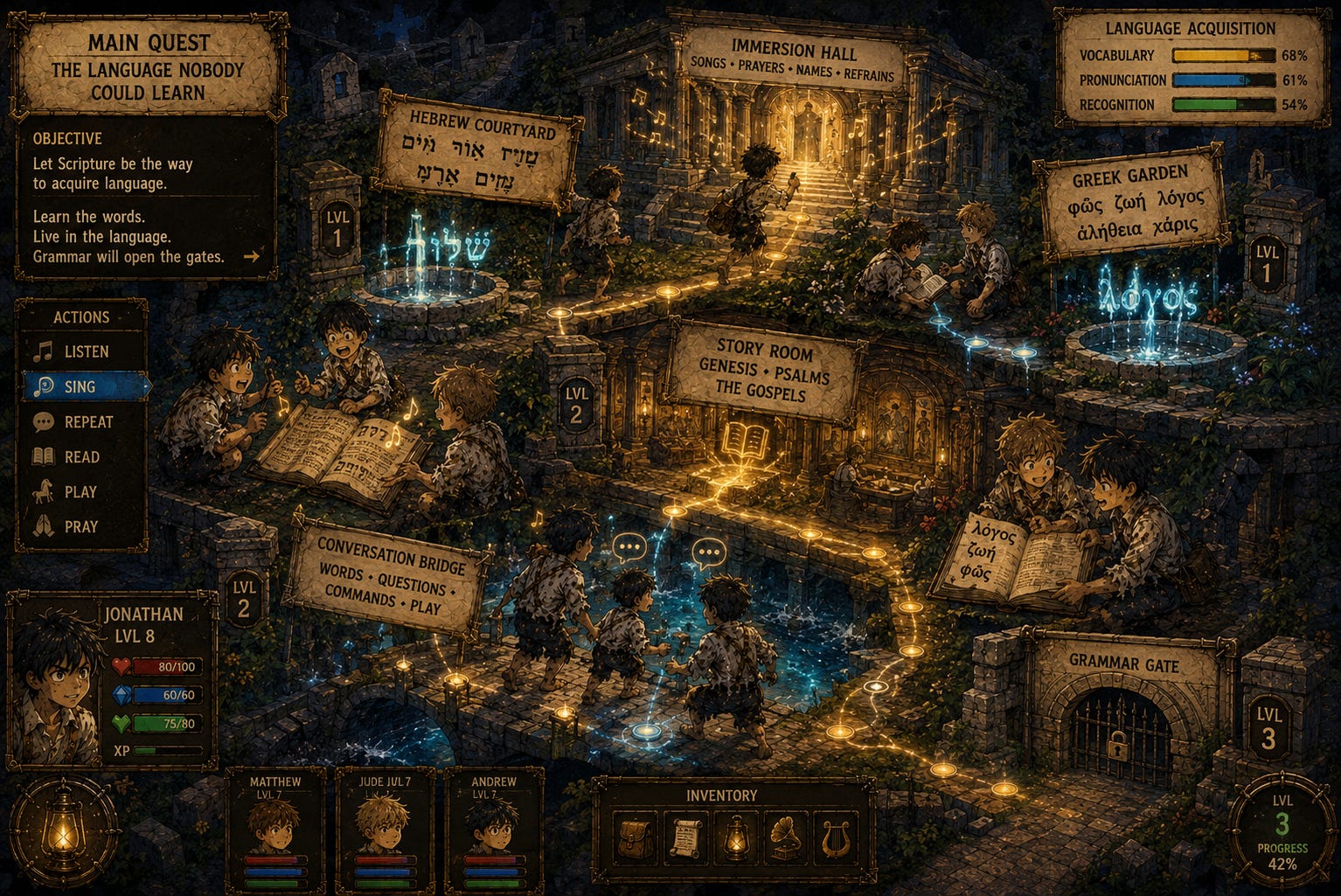
This is where the failure of 20th century institutional Christianity really strikes. A church body with preschools, elementary schools, high schools, colleges, seminaries, hymnody, liturgy, catechesis, and multigenerational congregational life possessed nearly the perfect machinery to demonstrate language acquisition by immersion. To this moment, preschools across the country could be “brainwashing” their classroom with an endless moving stream of Biblical Greek and Hebrew vocabulary. Imagine if an entire cradle-to-grave system made simply reading the Gospel of John in Greek the primary goal of its entire system?
A four-year-old does not need to understand Hebrew verbal syntax. He needs שָׁלוֹם, אוֹר, מַיִם, שָׁמַיִם, אָרֶץ. He needs songs, prayers, names, refrains, Genesis phrases, Psalm phrases. Likewise Greek: φῶς, ζωή, λόγος, ἀλήθεια, χάρις. Grammar can arrive years later to explain a linguistic world already living in his ear.
But even in the golden days of protestant denominationalism, the biblical languages were placed at the far end of educational pipelines, to the point that Greek has become the joke of difficult academic subjects best left to the weirdo-clericalistic specialists.
Children all over the earth learn languages vastly different from English without first studying paradigms, parsing verbs, memorizing grammatical terminology or paying graduate-school tuition. They learn them because people speak to them. A child learns language through songs, repetition, objects, stories, commands, questions, affection, correction and play. Grammar eventually names structures the child has already absorbed.
Yet Christianity has reversed the process of access to the Bible. First, we wait. Then, we wait some more. Then, maybe in late high school or college, we introduce Latin.
Then, somewhere around twenty-two years old, we sat him beneath fluorescent lights, handed him a Greek grammar and told him that the language of the New Testament was going to hurt.
Of course it hurt.
We designed it to.
Give them the True Lore
A Christian incorporation with preschools, elementary schools, high schools, colleges, seminaries, congregations, hymnals, catechisms, choirs and multigenerational families? This is a massive language-acquisition machine.
The entire infrastructure is there. Give children songs. Give them prayers. Give them names. Give them refrains. Give them Genesis. Give them Psalms. Give them the words of Jesus Christ.
Let them hear the language before anybody tells them that the language is difficult.
Grammar will not be the locked gate standing between the student and Scripture when he already knows the words. Grammar will be the explanation of a country in which he has already been living.
The current model teaches a secret language to certified men in order to grant them access to Scripture.
The childhood model envisions Scripture the Way to acquire language.
We have the schools. We have the children. We have the songs. We have the Scriptures. We have the languages.
But who will put the pieces together?
The Machine Talks Back
Did you think I was “against movies” and “for artificial intelligence”?
The twentieth century put a talking image in the house. The twenty-first century is putting a talking intelligence there. And once again, the adoption of the technology is arriving faster than our wisdom can come to terms with it.
But it is the same question, renewed for this little season of history we are entering: If I am a Christian with a talking machine, what should the machine know how to say?
Some will shout, “It must know not to X, Y, Z!” I don’t disagree. But I also say, “We must teach it to sing.”
Imagine instead of a child growing up with an artificial intelligence capable of speech, song, repetition, correction, storytelling and responsive conversation, but fully incapable of talking about God, your child is followed about by a droid that just happens to sing Hebrew psalms lightly every morning?
What happens if Greek vocabulary arrives through play before the child knows there is such a thing as a Greek class? What happens if pronunciation is corrected conversationally? What happens if Scripture is not an academic subject occasionally presented by the machine, but the linguistic country in which the machine and child regularly meet? What if the Logos drives the algorithm?
What if we faced the fact that artificial intelligence is principally designed as an information dispenser intended to govern the future of thought and, instead of pretending to fight it while it eats our children, we built machines designed to dispense the Word of God?
This is the deeper possibility behind the PeaceBot Initiative, which I have written about almost as a sci-fi game. I don’t imagine a religious coating applied to the latest commercial technology. I envision a next-era robotic company designed to preserve, among other things, the inheritance of godly speech.
Recitation. Song. Repetition. Call and response. Vocabulary. Pronunciation. Catechesis. Scripture.
The machine is going to talk anyway. Will we just buy theirs again?
I’ve Seen This Movie Before
The story of the television takeover should frighten us into wisdom. The twentieth century introduced a machine capable of “broadcasting” inside the home. Christians surrendered to its speech, communing thoughtlessly with a commercial civilization that decade by decade defined their children into the calamity of America that we are watching now.
We are already too late. We could have asked:
What is this thing, and toward what end shall its speech be ordered?
Artificial intelligence gives us another chance. We can both ask and answer the question before several generations have been formed by the answer.
What manner of instrument have we admitted into the household?
What kind of human being does habitual conversation with it produce?
Toward what end shall its speech be ordered?
These are Christian questions because Christianity is about hearing. It is about speaking. It is about fathers teaching children when they sit in their houses and when they walk by the way, when they lie down and when they rise. It is about words written upon hearts.
The contest is not over which robot looks the coolest. It is over what language possesses us.
Shall I Go On?
Money becomes paper, then numbers, then debt circulates as wealth, and Nixon says, “Trust us.”
Currency is productively debased, purchasing power dissolved, and the old biblical concern for honest weights and measures is terribly relevant.
Meanwhile, we spend lots of it firing machines through the firmament in casual-ish hopes of colonizing the moon.
If no apparent application of the Tower of Babel strikes you, can we at least agree that we’ve fallen through the looking glass? Or do we all need to keep pretending the emperor’s clothes are made of anything more than willful ignorance?
Civilizations end. Monetary orders end. Technological orders end. Educational orders end. Empires end.
A brown leaf tells you something about the season without providing the date of the first snowfall. Christian wisdom does not require pretending to know more than we know. It requires refusing to know less than we can see.
So, take some time to notice what became normal before you got to decide what it meant.
Soon the talking machine will be furniture. Then background. Then invisible. And once something becomes invisible, questioning it becomes extraordinarily difficult. So make your commitment now.
Not the grand question. Not, “Is this the end of the world?” Not, “Is this the AntiChrist?” Start small.
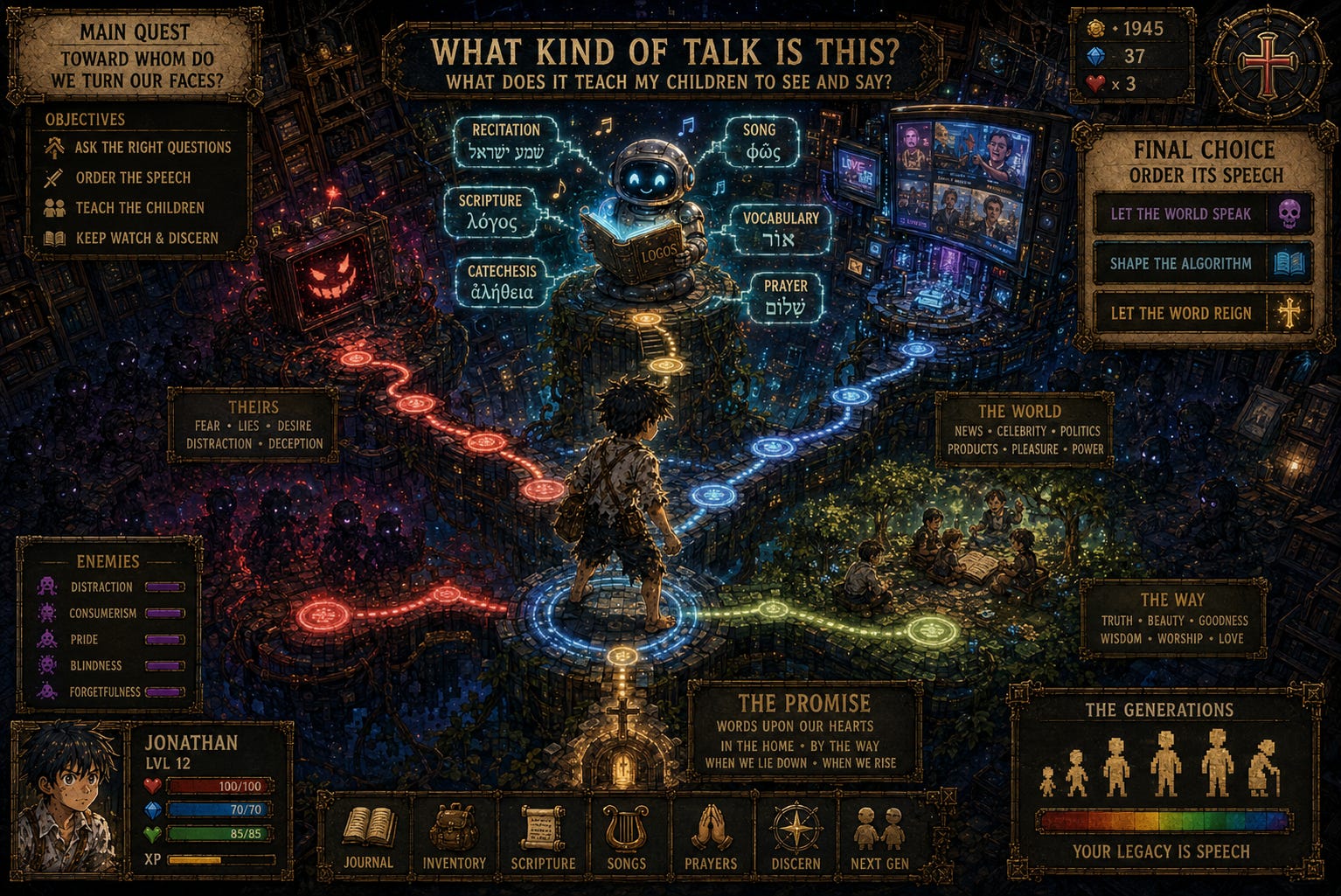
What, biblically speaking, is this?
What, biblically speaking, does it do?
What does repeatedly doing that make me do?
What does it teach my children to see and say?
What manner of devotion does it demand?
What kind of talk is this?
Toward whom do we turn our faces?

Keep them coming Pastor! Make sure to check my X - we are going to NEED YOU!!!
What an inspiring vision. Someone with the tech skills and money to do it should train an A.I on solid Lutheran and Biblical theology.