

Acts 15 and 16 are not an Afterthought
In the council, freedom is declared.
On the road, freedom is tested.
In Philippi, freedom is beaten, chained, and thrown into the inner prison.
The question running through the whole narrative is not whether Christians are free. Jesus Christ has already settled that. The question is, “Freed for what?”
The answer is not self-expression. It is not the right to demand our own way. It is not release from discipline, sacrifice, obedience, conflict, or pain.
Christian freedom is freedom to follow Jesus Christ.
It is the freedom to remove false burdens, surrender unnecessary rights, endure human conflict, accept divine redirection, confront spiritual bondage, and remain upright when the crooked world casts you down.
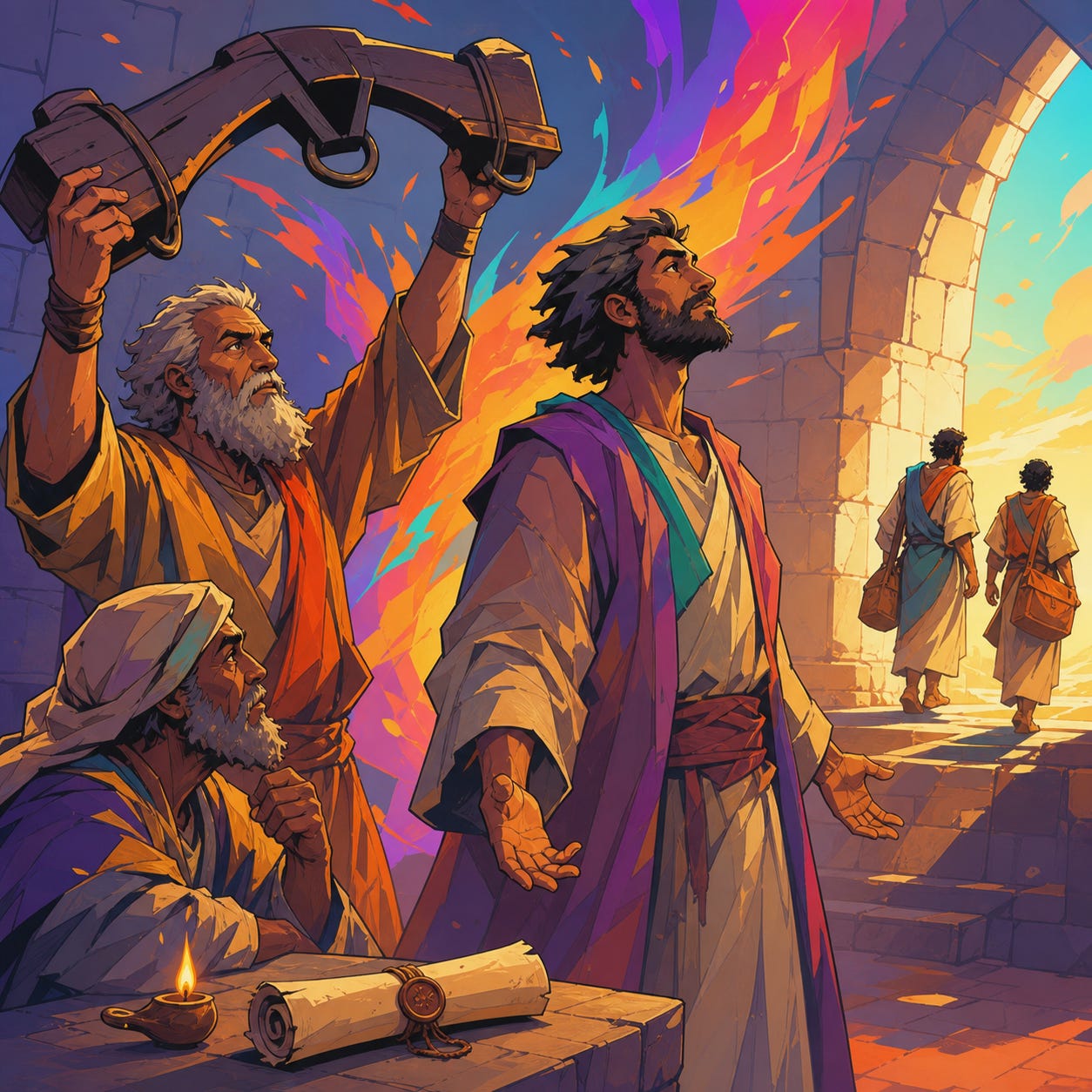
Acts 15 begins with a direct assault on the peace of the Gospel. Certain men come down from Judea and teach the brethren that unless they are circumcised according to the custom of Moses, they cannot be saved. Their message is not that circumcision is useful, honorable, ancestral, or culturally prudent. Their claim is that circumcision is necessary for salvation.
That is the point of conflict. The Gospel says that Jesus Christ has finished the work. These teachers say that Christ has begun the work, but Moses must complete it. They do not openly deny Jesus.
They add to Him.
That addition puts chains on the Gospel. Paul and Barnabas thus resist fiercely. The dispute becomes severe enough that the matter is taken to Jerusalem, where the apostles and elders gather. This is the only church council recorded in Scripture, and it establishes a pattern that the Church has struggled to remember ever since.
The council does not ask what burden will make Christians look serious. It does not ask how much of the old order and beauty can be preserved for institutional stability. It asks what the Gospel of Jesus Christ requires of His Church.
Peter speaks plainly. God gave the Holy Spirit to the Gentiles just as He had to the Jews. He purified their hearts by faith. Why, then, should the Church place a yoke upon the neck of the disciples that neither their fathers nor they had been able to bear? The Gentiles are not saved by becoming Jews. The Jews are not saved by having been Jews. Both are saved through faith in the grace of our Lord Jesus Christ.
The council refuses to impose the Mosaic order on the nations. But they did not abolish morality, nor refuse to teach it.
The Apostolic Decree
As the English reads, the pagan converts to Christianity are to abstain from things offered to idols, from blood, from sexual immorality, and from things strangled. These four commands have often been treated as a strange collection of temporary dietary compromises. But they make better sense as a compact boundary against pagan crookedness.
They reject idolatry, the worship of false gods.
They reject bloodshed, the destruction of innocent life.
They reject sexual exploitation and prostitution, the use of human bodies as commodities.
They reject what is strangled, twisted, bent, and perverted from the created order.
Freedom removes burdens that Christ has not commanded. But freedom does not make crookedness straight.
Apostles Are Still Men
The council ends in unity. The letter is written. Judas and Silas carry it to Antioch. The people rejoice.
And then, Paul and Barnabas fall into a quarrel.
Luke does not hide the collision. He does not soften it into a polite disagreement between two mature leaders who respectfully pursue different ministry priorities. He calls it a sharp contention. Paul wants to return and visit the brethren in every city where they preached the word of the Lord. Barnabas is determined to take John Mark. Paul refuses because Mark had departed from them in Pamphylia and had not gone with them to Pisidia.
Both positions are intelligible. Paul is guarding the mission. He does not want to entrust dangerous work to a man who has already abandoned it. Barnabas is guarding the man. He is the son of encouragement, the one who earlier stood beside Paul when the other disciples were afraid of him. He knows that failure need not be final.
But intelligible positions do not guarantee an upright quarrel. The first great missionary partnership of the Church is broken. The contention becomes so sharp that Paul and Barnabas separate. Barnabas takes Mark and sails to Cyprus. Paul chooses Silas and departs through Syria and Cilicia.
Christians are always tempted to mythologize their leaders. We imagine that inspired men must have moved through every disagreement with perfect composure, free of ego, temperament, frustration, and inherited weakness.
Luke will not let us maintain that illusion. The apostles are holy men. They are also men. They carry treasure in earthen vessels. They preach a perfect Christ while remaining themselves imperfect.
The Church does not survive because its leaders never quarrel. The Church survives because Jesus Christ remains Lord when they do. God even multiplies the work through the fracture. One missionary team becomes two. Mark, whom Paul refuses, is not lost forever. Paul later calls him useful for ministry.
This does not make the quarrel good. Providence does not excuse immaturity. God’s ability to bring fruit from failure does not turn failure into wisdom.
The lesson is sharp.
Conflict is inevitable wherever men carry weight together. But a quarrel only requires one mature man to end it. Any fool can feed contention. The upright man must learn when the mission matters more than the satisfaction of winning.
Paul comes to Derbe and Lystra and finds a disciple named Timothy. His mother is a believing Jewish woman. His father is Greek. Timothy is well spoken of by the brethren, and Paul wants him to join the mission.
Then Paul circumcises him.
The timing is startling. Paul is carrying the decrees of the Jerusalem Council. The central controversy of that council was whether Gentiles must be circumcised in order to be saved. The answer was no. And now the apostle who fought against compulsory circumcision circumcises his new companion?
A shallow reading sees contradiction. A careful reading sees freedom.
Timothy is not circumcised to obtain salvation. He is already a disciple. He is not circumcised because the Law of Moses must complete the work of Christ. Paul has just risked the unity of the Church to deny that claim. Timothy is circumcised because the Jews in those regions know that his father is Greek. His mixed parentage will become a barrier at every gate. His body will become the argument before Paul can speak a word.
So Timothy lets Paul remove the obstacle.
Circumcision is not Timothy’s entrance into the kingdom of God. It is his passport into Jewish spaces.
When circumcision is demanded as necessary for salvation, Paul will not yield for an hour. When circumcision can remove an unnecessary barrier to the preaching of Christ, Paul requires it of his own son in the faith.
This is Christian freedom in action. Freedom does not mean that no one may ask anything difficult of me. Freedom means that no human work can bind my conscience before God where Jesus Christ has set it free.
Once the conscience is free, the body can be spent in love. Paul does not stand on his rights merely because they are his rights. Timothy does not use the Jerusalem decree as protection from sacrifice. Together they distinguish doctrine from strategy, justification from service, and the truth of the Gospel from the preferences of the Christian.
A lesser man insists upon every liberty simply because he possesses it. An upright man asks what his liberty is for. He is glad to become all things to all men that he might by all means save some.
Closed Doors
Paul and his companions carry the decrees through the cities. The churches are strengthened in the faith and increase in number daily. Everything appears to be moving according to plan. Then the Holy Spirit forbids them to preach the word in Asia.
They attempt to go into Bithynia, but the Spirit does not permit them. Luke gives no elaborate explanation. He does not tell us whether the prohibition came through prophecy, circumstance, opposition, inward restraint, or some combination of these. He simply tells us that Paul had a plan and Jesus Christ overruled it.
A man may have zeal, skill, calling, courage, and good intentions, and still be going in the wrong direction. We imagine faithfulness as the power to force a door open. We assume that sufficient conviction will produce traction, that relentless effort must prove devotion, and that every obstacle exists to be overcome.
Acts reveals a different pattern.
Sometimes the obstacle is the guidance. Sometimes the closed door is the word of the Lord. Paul does not conclude that his mission has failed. He does not turn inward and build an identity out of frustration. He continues until the path becomes clear. At Troas, he sees a vision in the night. A man of Macedonia stands and pleads, “Come over to Macedonia and help us.”
The Spirit sends. The Spirit restrains. The upright man learns to follow.
Two Women, One Gospel
Paul arrives in Philippi, a leading city of Macedonia and a Roman colony. On the Sabbath, the missionaries go outside the city to the riverside, where prayer is customarily made. They sit down and speak to the women gathered there.
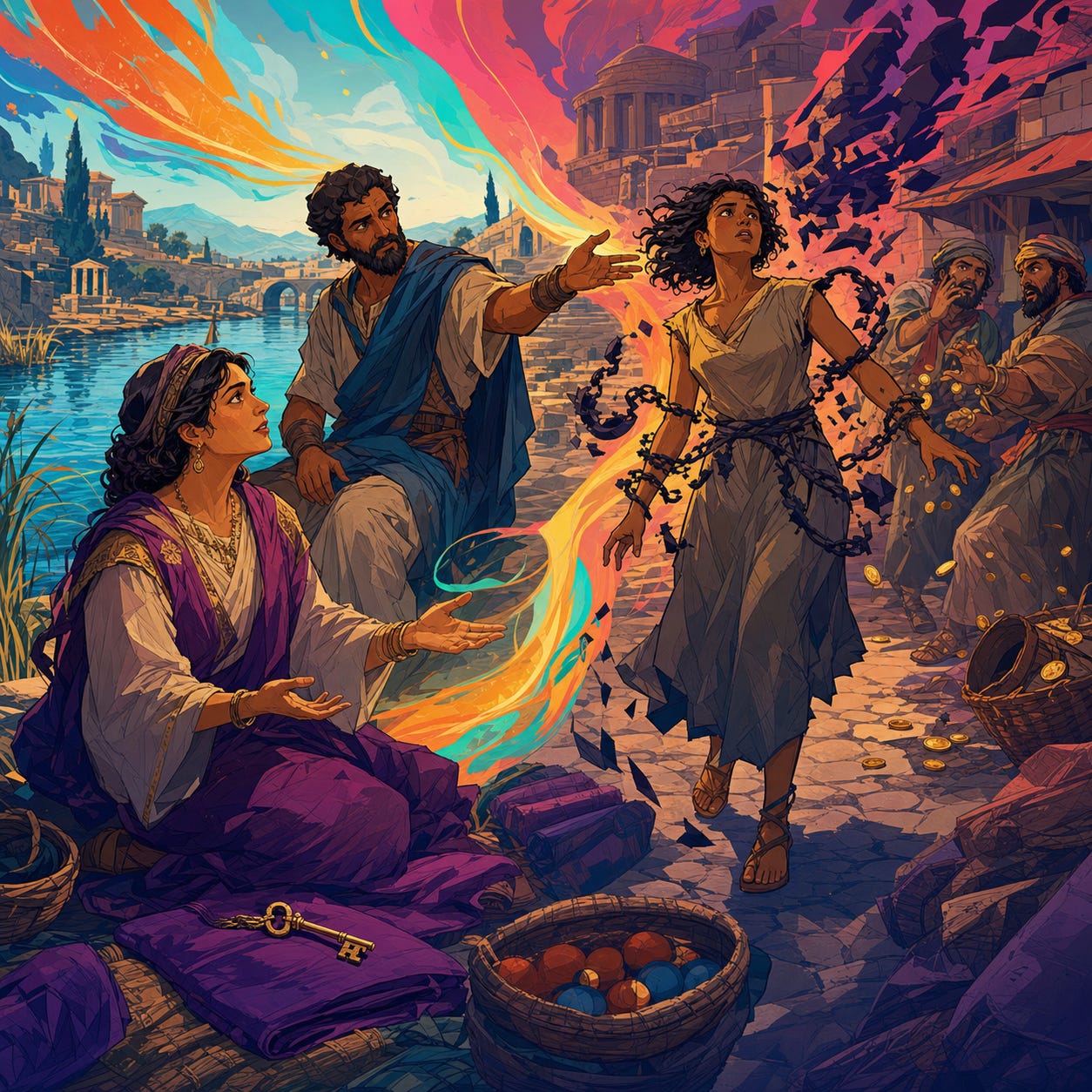
One of them is Lydia, a seller of purple from Thyatira. She worships God. She knows the Scriptures. She is listening. The Lord opens her heart to heed the things spoken by Paul.
Her conversion is quiet. There is no public confrontation, no dramatic deliverance, no political crisis. The word enters prepared soil. Lydia and her household are baptized. She opens her home to the missionaries and constrains them to stay. The Gospel arrives as fulfillment.
Then Luke places another woman in the path of the apostles.
She has no name. She is a slave girl possessed by a spirit of divination. Her masters profit from her fortune-telling. She is bound twice over, spiritually by the demon and economically by the men who own her. She follows Paul and the others, crying out that they are servants of the Most High God who proclaim the way of salvation.
Her words are true. Her spirit is unclean.
Falsehood does not always arrive in false sentences. Truth can be used to gather the wrong crowd, create the wrong atmosphere, and attach the message of Jesus Christ to a spirit of spectacle, confusion, and manipulation.
Paul endures this for many days. Then, greatly annoyed, he turns and commands the spirit in the name of Jesus Christ to come out of her. It leaves that very hour.
The Gospel meets Lydia by opening her heart. The Gospel meets the slave girl by casting out her demon. One receives gentle illumination. The other receives violent liberation. One has wealth, agency, and a household. The other is treated as property and used for profit. One encounters the apostles in peace beside the river. The other encounters them in the noise of the street.
The same Jesus Christ comes to both.
The kingdom does not operate by one human technique. It meets each bondage according to its nature. Where there is ignorance, it teaches. Where there is seeking, it fulfills. Where there is possession, it commands. Where there is exploitation, it disrupts.
The Gospel is peace to those who receive it. It is war against everything that owns them.
The Courtroom is for Money
The slave girl’s deliverance creates an immediate problem.
Her masters see that their hope of profit is gone. They do not rejoice that a tormented girl has been restored. They do not dispute Paul’s theology. They do not investigate whether a spiritual evil has occurred. They have lost revenue. So they seize Paul and Silas and drag them into the marketplace before the authorities.
Their accusation is carefully chosen.
“These men, being Jews, exceedingly trouble our city, and they teach customs which are not lawful for us, being Romans, to receive or observe.”
The charge is political, ethnic, and cultural.
“These outsiders threaten our way of life.”
Darkness rarely confesses its financial motive when righteousness threatens its income. It recruits law, custom, identity, fear, and public order to defend what profit alone cannot justify. Paul has already been accused by Jews of betraying Jewish customs. Now Romans accuse him of teaching customs unlawful for Romans. The Gospel is condemned from opposite sides for opposite reasons.
That is what happens when a man walks a straight path through a crooked world. Those bent in different directions may still unite against him.
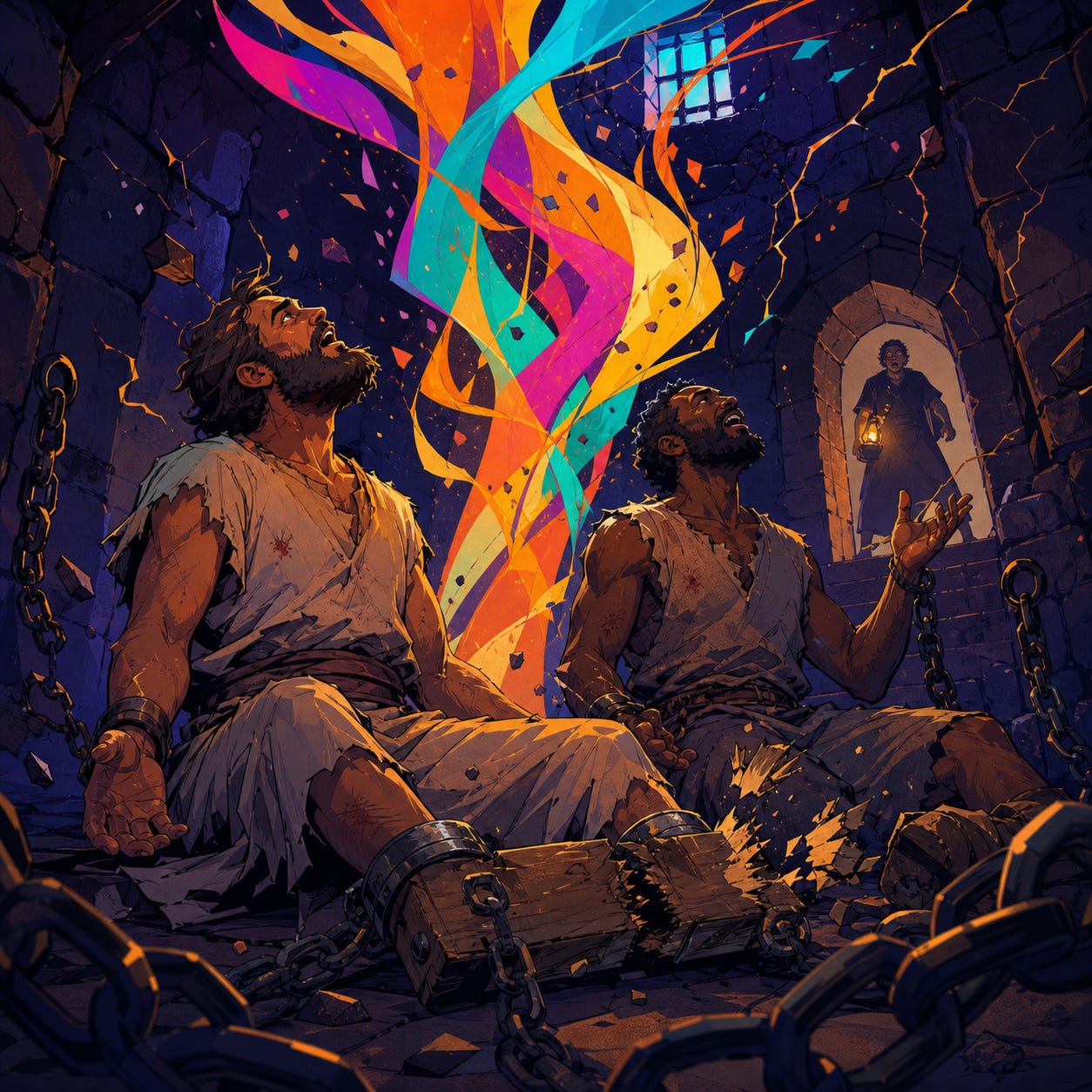
The crowd rises up together. The magistrates tear the clothes from Paul and Silas and command that they be beaten with rods. After laying many stripes upon them, they cast them into prison and command the jailer to keep them securely.
He places them in the inner prison and fastens their feet in the stocks.
The debt is paid.
The Jerusalem Council frees Paul from the yoke of circumcision as a condition of salvation. That freedom does not spare his back from the rod.
The Gospel opens Lydia’s home. That hospitality does not prevent the prison cell.
Paul liberates a slave. The city calls him a criminal.
Christian freedom is not freedom from consequences. It is freedom from the fear of consequences for doing the right thing. To stand upright in a crooked age is to be called proud. But we need not wallow in the muck with those who have no hope.
Acts does not give us one rigid model for every conflict. Acts publishes the Spirit who lifts up our heads to see the Day approaching.
Timothy yields. Paul resists. Lydia receives.
The demon is expelled. Barnabas departs. Silas joins. Doors close. Philippi calls.
Conflict. Sacrifice. Redirection. Deliverance. Persecution.
Paul ends this portion of the story stripped, bleeding, chained, and locked in the deepest cell. By every visible measure, he has been cast down. But he belongs to the Man whom death itself could not contain.
And so there he sits in prison, singing the Psalms.

"Christian freedom is not freedom from consequences. It is freedom from the fear of consequences for doing the right thing."
Amen.
This was a fantastic article about Christian freedom, thank you for that.