“We must through many tribulations enter the kingdom of God.”
It does not flatter. It does not soothe. It does not spare confusion, betrayal, danger, or the long attrition of resistance. It places the Christian life under a hard and necessary light.
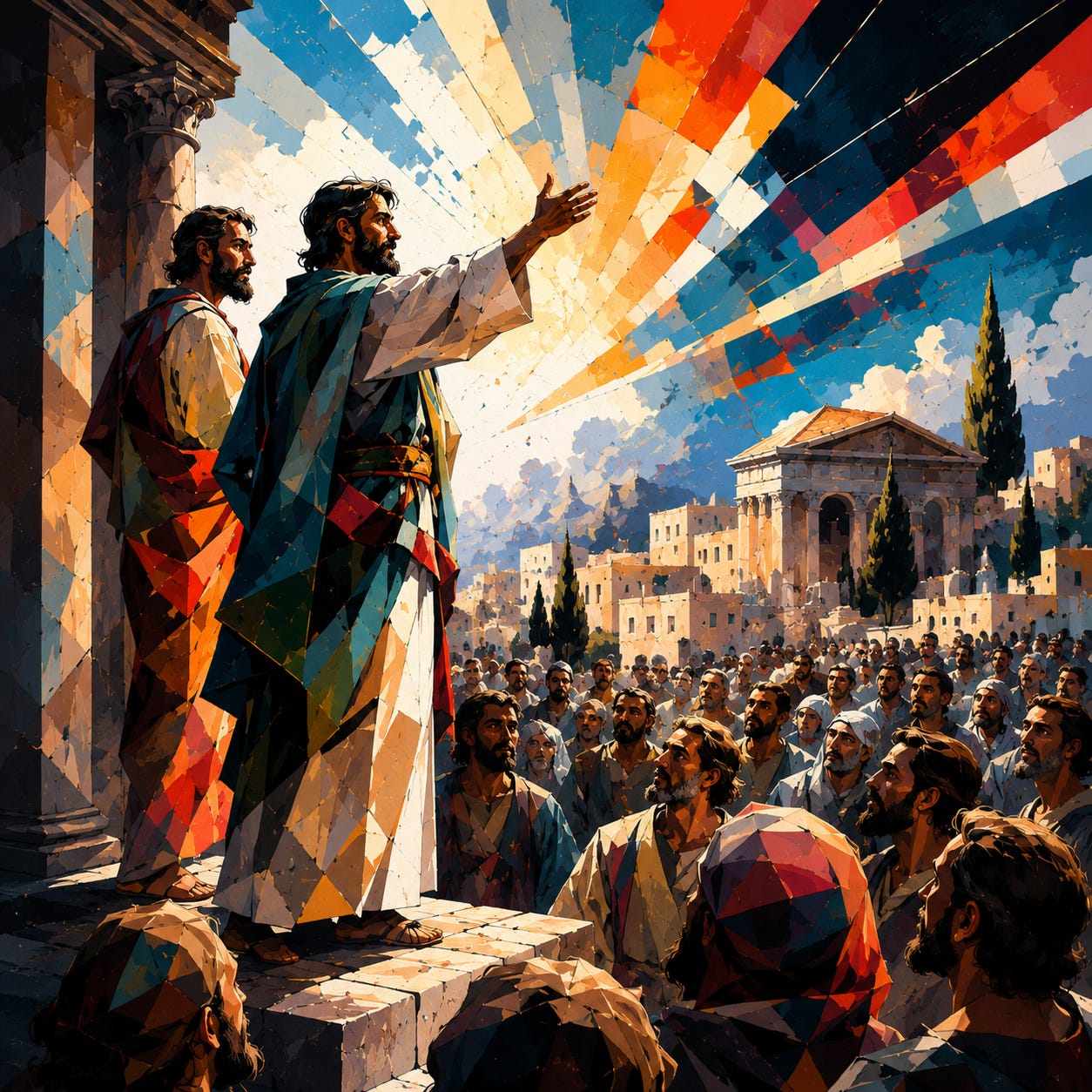
Tribulation is not a malfunction.
It is part of the terrain.
Acts 14: Paul and Barnabas preach. Some believe. Others harden. Minds are poisoned. Cities divide. Violence gathers. They move, return, strengthen, appoint, and continue. The chapter is neither sentimental nor tragic. It is martial. It shows men under orders learning to distinguish between danger, duty, timing, and fear.
Such situational awareness is largely gone from modern life where survival has become a story we tell to frighten naughty children. But between the grocery store and the World Cup, we interpret suffering as proof that something has gone wrong.
But a man who expects comfort at all times will misread the battlefield. It is only when we embrace the nature of our tribulations that we begin to see.
The mission means going through it.
Paul and Barnabas enter Iconium and speak in the synagogue. A great multitude believes, both Jews and Greeks. The Word acts. It divides. It reveals what was already hidden in the hearers. Faith rises in some. Hatred rises in others.
The unbelieving Jews do not merely disagree. They stir up the goy and poison their minds against Christianity. Before stones are raised, words are bent. Before blood is shed, judgment is corrupted. The assault begins in perception.
Paul and Barnabas do not become timid. They speak boldly. A violent attempt forms. Pagans, Jews, and soft elite unite to abuse and stone them.
At last, the apostles flee.
This too is obedience.
Retreat is the first half of the rally. Scripture is serious about war and the facts of the mind. A man under orders does not confuse exposure with faithfulness. He preserves himself when preservation serves the work. He stands when standing serves the work. He leaves when leaving serves the work.
The mission decides.
In Lystra, Paul sees a man crippled from birth. He looks at him intently and perceives that he has faith to be healed.
“Stand upright!”
The man leaps.
The crowd does not understand. Man worships what he fears. Now, Barnabas is Zeus and Paul is Mercury, and the priest of the Sky God is bringing oxen and garlands to offer sacrifice.
Paul and Barnabas tear their clothes.
Their sermon is simple.
“We are of the same nature as you! Turn from useless thoughts to the living God, greater than sky, earth, sea, and all in them. He is not hidden. See the rain, fruitful seasons, food, and gladness?”
Not the law of Moses. Not the throne of David. Creation.
Doesn’t matter. They can scarcely restrain the crowd from sacrificing, except then Jews arrive from Antioch and Iconium and just like that the same fickle crew that worshiped Paul throws rocks at him until (they think) he is dead.
They drag him outside the city and leave him to rot.
Paul rises. The disciples gather around him. He gets up and returns to the city.
What governs you?
Paul and Barnabas eventually return through Lystra, Iconium, and Antioch, strengthening the souls of the disciples. They do not assure the new Christians that the worst is now behind them. They teach them how to interpret what is coming.
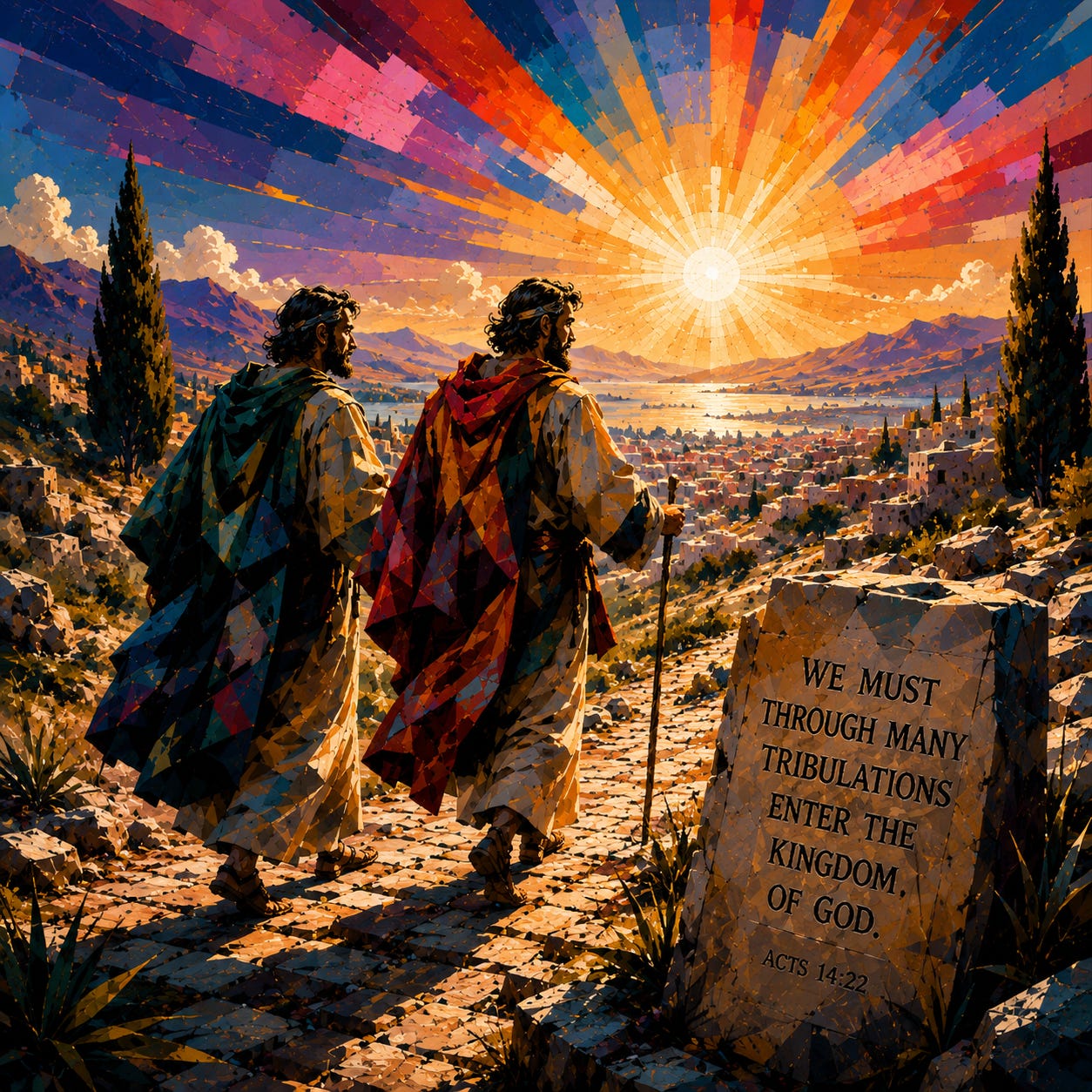
“We must through many tribulations enter the kingdom of God.”
The word “must” matters. Tribulation is not presented as a rare misfortune for unusually unlucky believers. It is the bond of Sonship in the Kingdom.
The world resists the reign of Jesus Christ because the world does not desire the King. His reign does not remove us from the world’s hostility. It exposes us.
The “theology of the cross” is the field in which we live, where the rest of the world treats men like animals, where rebellion descends into appetite, coercion, fear, and force. We are not redeemed to escape such treatment. You are born again so that such treatment does not turn you into the same kind of beast.
When insulted, do you become ruled by it? When threatened, does fear drive you? When praised, do you forget your place? When deprived, do you pout?
When struck, do you forget Who allowed the blow?
The devil is not free. He is not equal to God. He is not an independent darkness running parallel to eternal light. He remains a creature under restraint. He rages, deceives, devours, and accuses, but he does so on a chain.
Evil is never sovereign. Knowing that with the conviction to walk right back into town is how we reign.
Survival
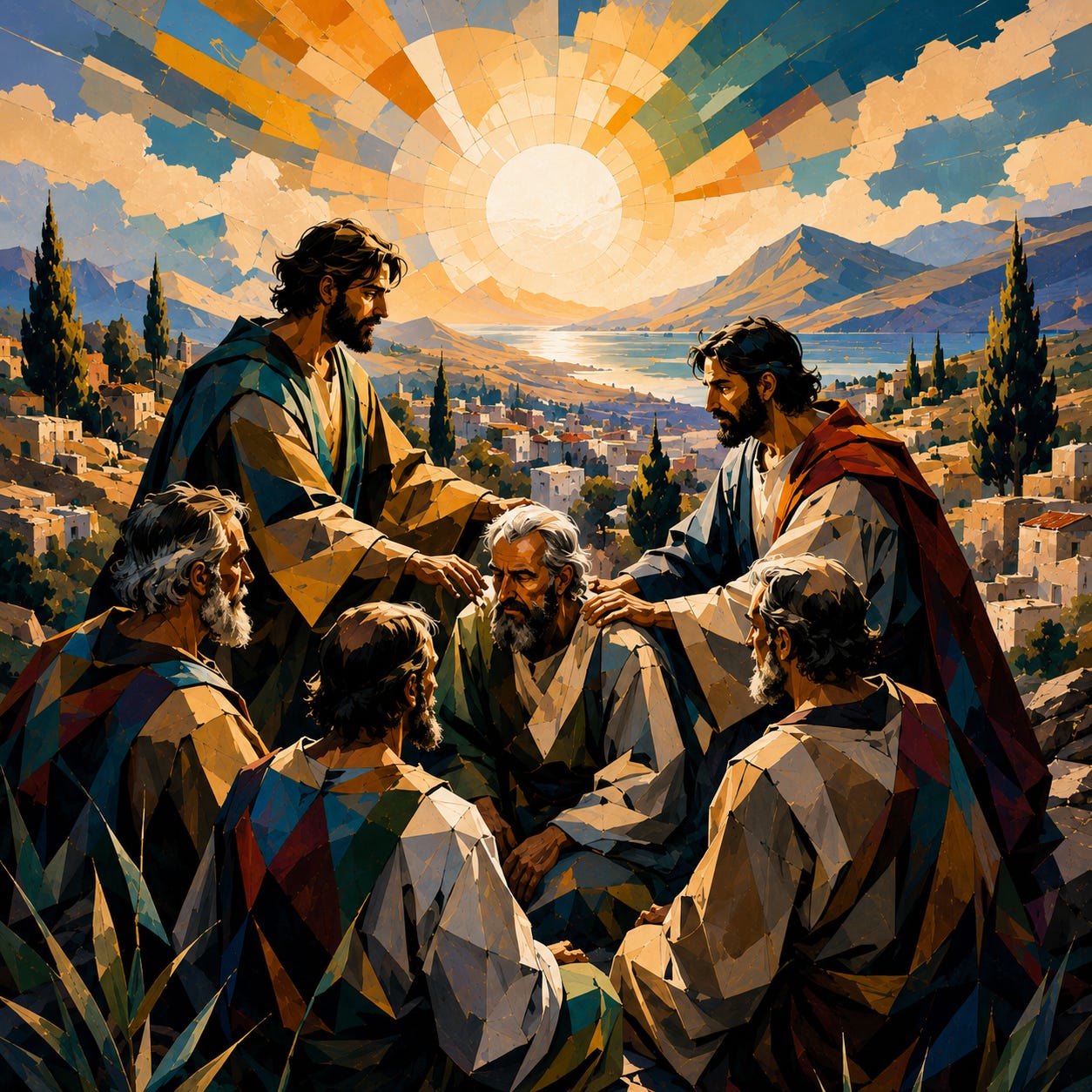
Paul and Barnabas appoint elders in every church. Each township crew requires order, stability, and fatherly oversight.
The Greek word is presbyteros. It means an older man, a man marked by agedness.
Presbyteros adores what we moderns decry: years produce honor as a matter of fact. Age carries gravity. Any man, even a slovenly, foolish one, who has endured, learned, repented, buried, built, lost, remained, and spoken must then possess a certain glory in authority that is simply unavailable to youth.
This authority does not make him a prophet. It makes him older than you. You might be super smart, but you’re still next in line to sit down first.
A civilization that despises age despises memory. A world that despises fathers loves hypocrisy. In place of wisdom, processes degrade. In place of judgment, policy entangles. In place of trust, surveillance shames.
The apostles did not appoint managers.
Masculine Situational Awareness
Masculine situational awareness begins with the refusal to lie.
The first truth not to lie about is your environment.
A man must know where he is. He must know what is happening around him, what is happening within him, who is present, who is absent, what is moving, what is threatened, what matters, and what does not. He must learn to read motive without becoming paranoid, danger without becoming timid, and opportunity without becoming greedy.
This is not suspicion. It is stewardship. To stand upright is to see the horizon. The man bent over his appetites sees only the ground beneath him. The man governed by approval sees only the faces of the crowd. The man ruled by fear sees only the nearest threat. The man ruled by resentment sees only the injury.
The upright man lifts his head. He does not imagine that all things bear equal weight. He sorts. Some things are mission-critical. These must be guarded even at cost. Some things are useful. They assist the mission but are not the mission. Some things are replaceable. Status, possessions, reputation, comfort, and most forms of worldly security belong here.
Some things are burdens. They do not merely fail to help. They hinder movement.
A man who cannot distinguish these categories will sacrifice the essential to preserve the disposable. He will lose the house in order to save the couch.
You need an internal code.
You cannot both conform and be free unless there is more mystery than 2+2. Beliefs supplied by institutions, markets, media, and mythologies that hate the God who made you are built into the vocabulary of our times.
The answer cannot be the private lawlessness that is virulent everywhere. The Christian is not autonomous. This is why vocabulary matters.
Words are not decorations laid over reality. They are tools of perception. A man without stable words cannot hold stable thought. He becomes vulnerable to every redefinition. Evil does not need to defeat him by argument if it can first seize his nouns.
The Root and the Offspring
Taking back the Bible’s Words grants an unchanging vocabulary for a changing world.
A great place to start is near the end of Revelation, where Jesus Christ gives His penultimate self-declaration:
“I am the Root and the Offspring of David, the Bright and Morning Star.”
Jesus is the Root of David. He is the hidden source beneath the kingly line. Before David was, Jesus is. David’s throne, promise, bloodline, victories, songs, sins, and hope all depend upon Him.
Jesus is the Offspring of David. He enters the line He founded. He becomes the Son of the man whose Lord He already is. The source becomes the fruit. The Creator enters the genealogy.
The Greek word rhiza means “the buried living source from which visible life rises.” Genos means kind, race, generation and kin. Jesus is both origin and result, before and after, Lord and Son. He is not merely attached to David’s history. He holds it together.
Even here the title “King” cannot be reduced to a political or theological word. A king is head of a kindred, the chief of his kind, the father of kinship. He stands as the embodied unity of his people.
Jesus Christ is King not because He has seized power over strangers, but because all kinds, tribes, families, and nations have their origin in Him.
The Bright and Morning Star
That is what the King calls Himself.
In all ancient Western lore, the morning star is that specific, brilliant light, visible near dawn, which we now call Venus. “She” appears before sunrise as a herald. Her appearance signals that the dominion of night is ending.
Except when Venus is the Evening Star. That happens too. Not necessarily the first, but surely the brightest star apparent in the night, swift to vanish beneath the horizon, Venus’ orbit takes her in a constant sling shot motion about our sky.
The Greek is here rich.
Aster is a star. The sound has survived across languages and centuries with remarkable stability. It remains in astronomy, asteroid, asterisk, and the old tongues that named the lights above long before modern men covered the night with electric glare.
Lampros means bright, radiant, shining. You know, like a lamp in a dark place.
Proinos means of the morning, belonging to the dawn.
What does this mean?
Jesus is not one more object in a pagan heavens. He is the Lord who made the sky. Isaiah’s use of the term notwithstanding, Jesus in this next to last of the verses in the Bible seizes celestial mythology and judges it to be His own. Every old confusion, every false goddess, every astral story, every attempt to deify the creature is answered by the Creator who says, “I am.”
The stars declare the glory of God. Their courses, signs, seasons, risings, settings, constancies, variations and even the Proto-Indo-European etymology of the word itself bear witness to an order that outlasts all that man can build.
The man who looks up remembers the scale of things.
Situational awareness begins with attention. It learns the room, the road, the neighborhood, the season, the faces, the silences, the wind, the time of day, and the movement of the sky. It does not turn creation into an oracle. It receives creation as witness.
Your crisis is not the whole cosmos. Your enemy is not omnipotent. Your suffering is not eternal. Your debt of death has been paid. The King who names Himself after the morning star also holds you in your courses.
The mind does not become stable by accident. It must be trained. Grabbing sound words is essential. The Sons of Solomon discipline is simple.
One Psalm.
One Proverb.
One portion of the direct words of Jesus Christ.
The Psalms teach the mouth to pray. They give words for terror, rage, praise, betrayal, confession, warfare, mercy, kingship, exile, vindication, and hope. They prevent the suffering man from becoming speechless or feral. When the world treats him like an animal, the Psalms teach him to remain human before God.
The Proverbs train judgment. They teach the difference between wisdom and cleverness, profit and theft, pleasure and adultery, speech and babbling, debt and slavery, discipline and abuse. They expose the mechanisms of the world. Dishonest scales are not merely ancient merchant problems. They are the pattern of all systems that rename theft as fairness.
The words of Jesus Christ give the rules of engagement. Follow Me. Fear not. Watch. Pray. Forgive. Judge rightly. Take up your cross. Let your yes be yes. Seek first the Kingdom. Be faithful unto death.
These words become the whetstone of your heart.
The purpose is not information accumulation. It is the formation of reflex. In crisis, a man does not rise to the level of his aspirations. He falls to the level of his training. Scripture memorized, prayed, and repeated establishes patterns available under pressure. The Word enters like seed. It grows inside the man. It alters what he notices, what he names, what he fears, and what he loves.
Sanctification is not automatic in the mechanical sense. Men resist, evade, excuse, and forget. Yet the Word is living. It does not leave the hearer untouched. Even where faith is weak, the repeated truth of Scripture lays rails for thought. It creates pathways away from folly.
A man needs those rails before the night becomes darker.
The Lamp Before Dawn
Acts 14 gives no promise that the crowd will become reasonable. Revelation 22 gives no suggestion that the night is harmless. Tribulation is real. But the Kingdom is now within you. The apostolic witness, the Word of the Living God, is more durable than optimism.
Resistance is not abandonment. Hatred from others is not divine judgment nor public praise always His favor. Do not hand your conscience to the group. Do not worship danger, comfort, survival, or suffering.
Heed the King’s English. Appoint elders. Comfort brothers. Be mission-critical. Set down your burdens. Buy that field.
Stand, under the God-given sky.