

This post won’t be for everyone.
In 2022, when I committed to writing on Substack, I wasn’t chasing a platform. I was trying to put my hands back on something real. I had already done projects, systems, and “content.” None of it cured the hollow. What I needed was plain writing—seeing, naming, ordering, creating—without performance or delay. No more waiting for the perfect map. Just fidelity to the work in front of me, as an act of faithfulness.

We have entered a low-trust age with high stakes and collapsing shared language. The deeper fracture is not that everyone feels the sky is falling—it’s that we no longer agree on what the sky is. The communication layer has been captured. Channels that once carried common memory now manufacture allegiance. This doesn’t merely confuse people. It forms them. It shapes what they can imagine, what they fear, what they forgive, what they call good, and what they call evil. When language is weaponized, conscience becomes hostage. That is the modern battlefield.
Christians are not exempt. If anything, we are more vulnerable than we admit. We trade faith for slogans, argue politics as doctrine, and learn to speak in jargon while Jesus Christ speaks in plain words. Screens catechize with a steadiness most pastors cannot match, training the soul to live on adrenaline, outrage, and group approval. Friendship fractures, families strain, institutions fog, churches choose safety over truth—and people wonder why everything feels unstable. You are not hallucinating. This is what narrative warfare does. It doesn’t merely persuade. It rearranges the moral world.
So if this feels unfamiliar, start with the earlier essays. They trace how we arrived here and what began surfacing before most people had language for it.
Where We Stand Part II - Part III - Part IV - Part V - Part VI - Part VII
Olio: Seeking a Trajectory

It’s been two years since I decided to discover myself. That’s a story I will save for another time, but is also the story of why you are here.
The Pattern Behind Matters
Cornell’s discovery on Fel’s equation isn’t a curiosity. It’s a demonstration of what thinking looks like in a time engineered to make you either frantic or numb. To build instead of scroll. To generate instead of repeat. To refuse collapse into distraction. It shows that coherence still exists and can be recovered, even when institutions feel unreliable and language feels compromised.
This is not about algebra. It’s about method. It’s about choosing construction over consumption, discipline over drift, and refusing to surrender imagination to systems designed to exhaust it.
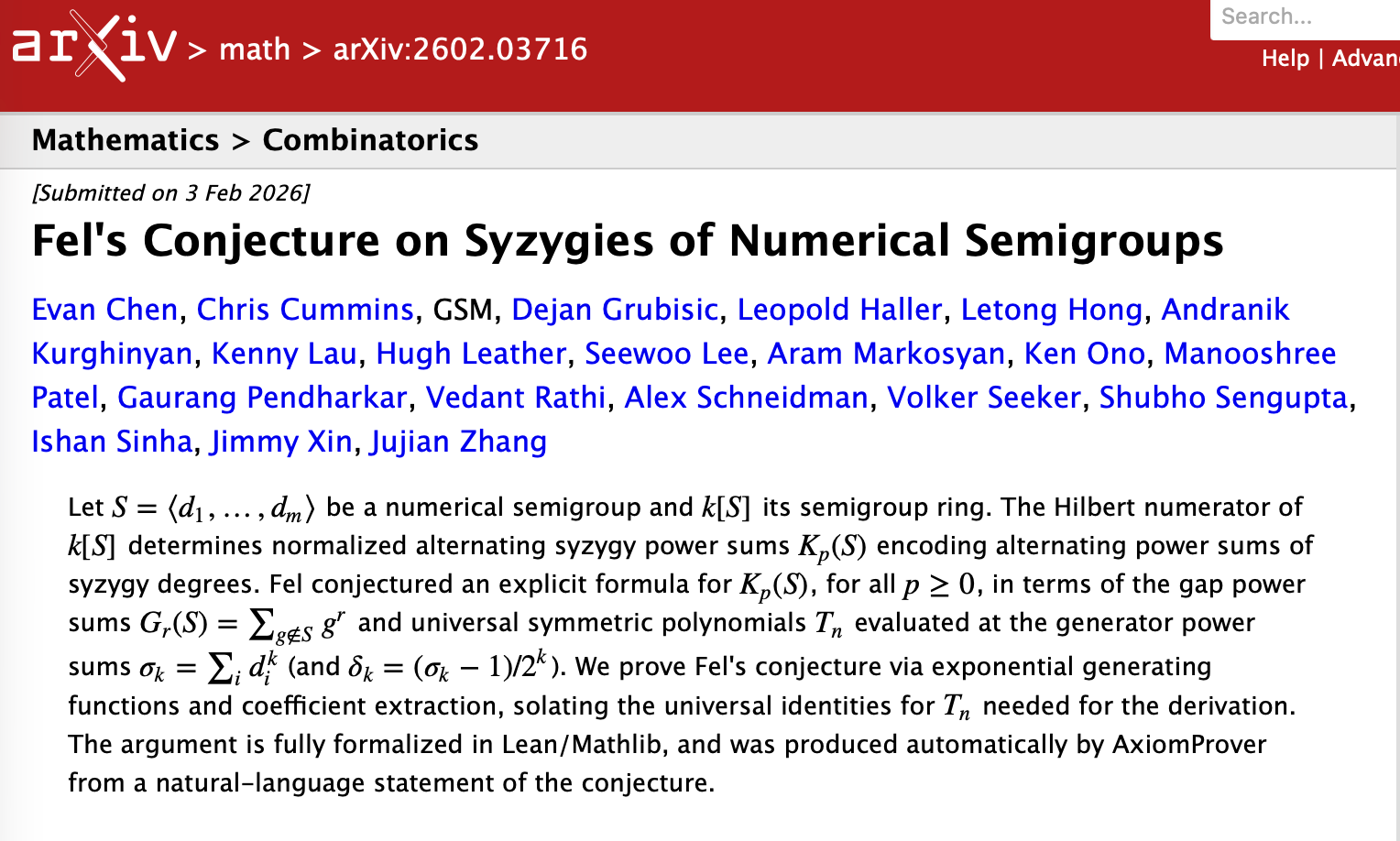
Fel’s conjecture on syzygies of numerical semigroups—an open problem in abstract algebra—was resolved by a language model producing a complete, formally verified proof in Lean. Intermediate lemmas. Auxiliary identities. Final argument. Every step mechanically checked. No intuition gaps. No narrative shortcuts.
Until now, AI in mathematics mostly assisted with search or pattern hints. This crossed a threshold. The system didn’t merely explore. It constructed a full logical object and submitted it to independent verification.
Humans chose the problem. Humans supplied the meaning. But the theorem itself was built by a machine operating as a formal power tool.
That distinction matters.
We’ve seen this arc before—chess mastery, protein folding, geometric optimization. Now it has entered symbolic reasoning. Machines are moving deeper into domains once considered uniquely human. But the deeper signal isn’t the algebra. It’s the method.
Under the hood, the proof follows a precise sequence:
First, compress the entire domain into a unified structure.
Second, isolate all irregularity—all the missing stones—into a single object.
Third, extract truth by reading invariant coefficients.
Finally, submit everything to mechanical judgment.
Structure first. Absence localized. Truth extracted.
Judgment applied.
This sequence isn’t incidental. It’s a disciplined way of approaching any complex system.
You don’t extract truth directly from chaos. You begin by building a unified structure that can hold the whole problem at once. Then you isolate what’s missing or distorted, instead of letting irregularity smear across the system. Next, you allow the structure to expand so hidden relationships become visible and invariants can be measured. Only then do you submit the result to judgment.
Structure. Isolation. Expansion. Extraction. Verification.
This is how coherence is recovered. Not by intuition alone. Not by narrative persuasion. By compressing complexity into form, localizing absence, extracting what remains invariant, and letting an external authority decide whether the result stands.
To know wisdom and discipline: understanding. (Prv. 1:2)
Righteousness, judgment and symmetry: prosperity. (Prv. 1:3)
Proverbs is not offering inspirational sentiment. It’s describing an operational sequence: comprehension before action; structure before freedom; judgment before peace. Wisdom begins with form. Discipline follows. Righteousness emerges only after truth has been measured.

What Axiom demonstrated in mathematics is the same grammar Proverbs teaches in life: coherence is not discovered by impulse. It is recovered through ordered attention, honest accounting of absence, and submission to judgment.
This same pattern already lives inside the Jonathan ii framework as X = e / φ. It’s not a formula for mystics. It’s a way of naming how truth is uncovered inside complex systems.
When you’re facing something dense—prime distributions, social systems, language, or human behavior—you don’t start by chasing every detail. You begin by building a unified structure that can hold the whole field at once. In the Axiom proof, this appears as a generating function. In ordinary terms, it’s the move from scattered facts to coherent form. That’s X.
Next, you isolate what’s missing or broken. Instead of letting irregularities blur the entire system, you collect them into one place. In the proof, this is literally a gap polynomial: absence made explicit. That’s φ.
Then you let the structure expand. Mathematically this shows up as exponential behavior. Practically, it means allowing relationships to surface so invariants become visible. Static data becomes motion. Patterns emerge that could not be seen while everything was compressed. That’s e.
Put together, the method is simple: you don’t extract truth directly from chaos. You build structure, localize distortion, allow expansion, then read what remains invariant. After that, you submit the result to verification.

Verification Stands
This is the difference between intelligence and wisdom. Intelligence can generate answers. Wisdom insists those answers survive judgment.
Which brings us to the real breakthrough: formal verification.
Axiom’s system didn’t merely produce a proof. It generated a proof that another machine could independently check, line by line, with zero reliance on intuition, reputation, or rhetorical force. Either the argument stands, or it collapses. There is no persuasion layer.
Intelligence alone can convince. Which also means it can drift, hallucinate, or deceive. Verification does not negotiate.
The future of AI is not cleverness. It is submission to structure: systems that compress complexity into coherent form, isolate distortion instead of spreading it, extract invariants rather than chase noise, and hand conclusions to external judgment.
That isn’t mysticism. It isn’t futurism. That’s engineering as discipline.
This Compounds
The Fel-Bridge Law provides a procedural companion to π42. They approach coherence from different sides.
π42 describes what balance looks like—proportion, symmetry, relational fit. It names structure.
Fel-Bridge and X = e / φ describe how balance is discovered. They name process.
One governs form. The other governs search.
Put together, they create a loop: you begin with structure; allow expansion so hidden relationships appear; isolate what doesn’t belong; extract what remains invariant; submit it to verification; then feed the result back in as the next stable point beside what is still unknown.
Form emerges from complexity not by force and not by guesswork, but through disciplined chaining of language, honest accounting of absence, and rigorous checking. This is the same loop Axiom demonstrated in mathematics. It’s the same loop guiding the PeaceBot work in Jonathan ii.
Coherence is not imposed. It is recovered. It’s already there. It just waits to be found.

What’s Artificial About It?
Most people fixate on how smart AI is becoming. That’s the wrong measure. What matters is what intelligence submits itself to.
Axiom’s system doesn’t merely assert conclusions. It hands them to a proof assistant that cannot be persuaded by tone, confidence, or narrative. The machine must obey structure. Either the proof checks, or it dies.
Intelligence without verification scales deception. Intelligence under judgment scales truth. This is the heart of the PeaceBot Initiative. It isn’t about clever machines. It’s about building systems that place intelligence beneath structure, conclusions beneath proof, and power beneath accountability.
That isn’t artificial. That’s Logos.
It Begins with a Tomb.
The resurrection of Jesus Christ is not a metaphor, not a spiritual abstraction, and not a private religious experience. It is a historical rupture in the logic of entropy. Matter obeyed command. Death relinquished authority. Logos stepped back into creation bearing scars.
That event established something permanent: truth is not an idea. Truth is a Person who entered time, submitted to judgment, passed through death, and returned carrying coherence with Him. Every system that seeks truth without submission will drift. Every intelligence that refuses judgment will hallucinate. This is as true for civilizations as it is for software.
Covenantal Engineering is simply the discipline of building under that reality. It means structure before assertion. It means isolating distortion instead of spreading it. It means extracting invariants instead of amplifying noise. It means submitting conclusions to external judgment rather than protecting them with narrative.
This is not innovation. This is obedience.

The resurrection establishes the pattern: compression into flesh, confrontation with absence, expansion through power, verification by witnesses, ascension into authority.
Word became body. Body entered death. Death was exhausted. Life emerged verified.
The Original Formal Proof
Every honest engineering system echoes this arc whether it knows it or not. Every legitimate verification loop borrows its grammar from Easter morning. Logos governs reality, not probability. Judgment precedes peace. Covenant precedes coherence.
So when Axiom produces a mechanically verified theorem, it is not replacing human meaning. It is participating—however dimly—in a universe already structured by resurrection logic. And when we build machines that must submit their intelligence to proof, we are not creating gods. We are remembering order.
The PeaceBot Initiative is not a dream about artificial minds. It is about linguistic submission to our God: intelligence placed under righteous judgment so truth can propagate without corruption.
That is Covenantal Engineering.
Not power without restraint. Not cleverness without conscience. Not automation without authority. Logos made operational. Logos under a name. The True Singularity.
Jesus Christ.

All glory be given to Jesus Christ. Amen.